
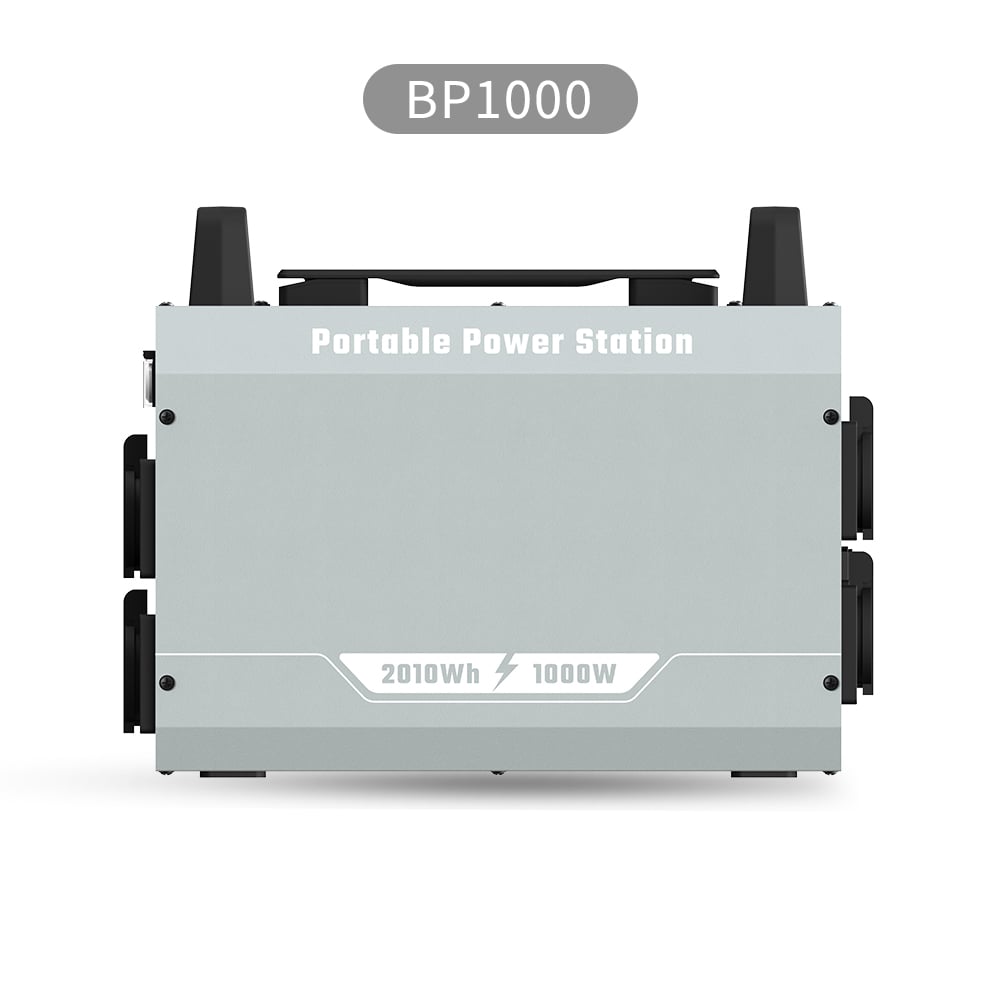
A portable power station is a battery, an inverter, a charge controller and a battery management system in one enclosure. This article opens up that enclosure: what each module does, how power moves from the wall or a solar panel into the battery and back out as AC or DC, and how four real models — BP1000, BP2400, DP3600iL and EP5000iL — implement the same architecture at different scales.
A portable power station is a battery bank, an inverter, a charge controller and a battery management system built into one enclosure, with AC and DC outputs on the outside. Power enters through the charging path, sits in the battery as DC energy, and leaves through the inverter as household AC or through the DC ports at battery voltage. The four models used here to illustrate the architecture — BP1000, BP2400, DP3600iL and EP5000iL — differ in capacity, output class and expansion, but they follow the same internal sequence.
Key takeaways
- An integrated power station replaces a loose battery bank, inverter and charger with one enclosure and one control layer.
- The battery stores DC energy; the inverter converts it to AC; the MPPT controller regulates solar input; the BMS guards the cells.
- Charging and output are separate paths through the same battery, which is why all four models list charge time alongside output rating.
- System complexity rises with expansion: BP1000 and BP2400 are single-enclosure units, DP3600iL and EP5000iL accept external battery packs.
- What a portable power station actually is
- The modules inside and what each one does
- How power flows: charging path, storage and output
- Four real models and how they are built
- Setting a unit up for first use
- From understanding to specification
What a portable power station actually is
The term covers a class of product, not a single design. What makes these units comparable is that each one packages the same functional blocks into a box you can move: a rechargeable battery pack, a power inverter, a charging controller and a battery management system, wired together and controlled as one system. You plug loads into finished outputs — AC sockets or DC ports — rather than wiring components on site.
That packaging is the practical difference from a DIY battery-plus-inverter arrangement. The DC bus, the charge path, the protection settings and the cooling all live inside one enclosure and are coordinated by the BMS. Users see the result on the outside: an AC output rating, an input charging section, a state-of-charge display and, on some models, expansion ports.
So when a buyer asks what a portable power station is used for, the honest answer follows from the architecture. It supplies AC and DC power in places without a live wall outlet, or it keeps selected loads running when the wall outlet fails. Both uses share the same internal path, and both are what the category is good for at its core.
The modules inside and what each one does
Battery pack
The pack is the energy store and the largest single element in the enclosure. Chemistry and cell arrangement determine how much energy is held and how the unit behaves over repeated cycles. All four models referenced here use lithium iron phosphate (LiFePO4): BP1000 carries 2010Wh in an ultra-low-voltage configuration, BP2400 lists 2662Wh (52Ah at 51.2V), DP3600iL carries 2662Wh, and EP5000iL carries 3430Wh (67Ah at 51.2V). The differences between LiFePO4 and other lithium chemistries are covered in the battery chemistry comparison; for this article the point is that the pack is a DC source, and everything downstream exists to make that DC usable or to replenish it.
Inverter
The inverter turns DC from the battery into AC at the output sockets. All four models specify pure sine wave output, which means the AC waveform approximates the smooth curve household equipment expects rather than a stepped square wave. Ratings come in pairs: a continuous figure and a higher peak figure for short inrush loads. BP1000 is rated 1000W with a 2000W peak; BP2400 is 2400W rated and 4800W peak with total harmonic distortion under 3%; DP3600iL is 3600VA rated and 7200VA peak; EP5000iL is 5000W rated and 10000W peak with THD under 3%.
On BP2400 and EP5000iL the inverter is bidirectional. The same power stage that converts battery DC to AC output also rectifies AC input back to DC for charging, which is why the datasheets describe one block instead of two. That is also the mechanism behind automatic transfer: when the grid input drops, the unit switches its output path from pass-through to inverter. BP2400 and EP5000iL both list UPS transfer at 10ms or under. How that mode behaves and what to verify are treated in the UPS mode explainer.
Battery management system
The BMS is the control layer that sits across the pack. It monitors cell voltage and temperature, balances cells, and disconnects the pack when limits are exceeded. It also determines what charging current the pack accepts at a given state, which is why charge times vary by input path rather than by battery capacity alone. On multi-pack systems, the BMS has to coordinate across packs — relevant once expansion batteries are added to DP3600iL or EP5000iL.
MPPT charge controller
Solar panels do not deliver a fixed voltage. Their operating point shifts with irradiance and temperature, and an MPPT (maximum power point tracking) controller continuously adjusts the load it presents to hold the panel near its best operating point, then converts that to the voltage the battery needs. Each model here lists its own MPPT rating: BP1000 has a built-in 500W MPPT controller; BP2400 has a 1200W MPPT accepting 12–105VDC at 25A maximum; DP3600iL has a 1200W MPPT; EP5000iL accepts 12–150VDC up to 1600W. The product record for BP1000 states the controller rating only — it does not record a solar input ceiling, so that figure should not be read into the 500W controller rating. Panel voltage windows and array sizing are the subject of the MPPT matching guide.
Charging inputs
Several inputs feed the same battery through different paths. AC wall charging is the fastest on the larger units: BP2400 lists a maximum AC charge of 1800W at 220–240VAC with roughly 1.5 hours to full, while EP5000iL lists 3000W single-phase at about 1.2 hours, or 1700W on split-phase at about 2 hours. On solar, EP5000iL takes about 2.5 hours to full at its 1600W maximum. Solar is the second path, and DC input is a third: BP2400 accepts an optional 12–30V DC input at 8A maximum, up to 200W. Comparing these input types is the focus of the charging input comparison.
How power flows: charging path, storage and output
AC mains or solar or DC input → rectifier or MPPT stage → battery pack (DC) → inverter to AC sockets, or direct DC to USB, 12V and similar ports.
Every path passes through the battery. The input section converts whatever arrives — AC mains, panel DC, or a 12V/24V source — into a voltage the pack can accept, and the BMS governs how much current is taken. Energy then sits in the pack as DC. On the output side, the inverter draws from the pack to produce AC at the sockets, while DC ports tap the pack more directly through their own regulators.
This single-bus arrangement explains a practical behavior buyers notice: the input and output ratings are independent figures about the same battery. A unit can be rated for 2400W output and 1800W AC charging, and the two numbers describe different directions of flow, not a contradiction. It also explains why charging time depends on the input used — BP2400 lists about 1.5 hours on maximum AC charge and about 2.5 hours on maximum solar charge (1200W), with the same 2662Wh pack behind both.
In a UPS configuration the path gains a bypass leg. Mains input passes through to the output while the grid is present and the pack is held charged; when input fails, the bidirectional inverter takes over from the battery. The transfer figure belongs to that specific switching behavior, not to general runtime.
Four real models and how they are built
The architecture stays constant; the scale and the expansion strategy change. BP1000 is the lightest unit here at 18.5kg, an integrated single-enclosure design with a 1000W inverter and a 500W MPPT controller inside. BP2400 is the mid-power integrated unit, with the bidirectional inverter and automatic transfer switch built in alongside the 1200W MPPT stage.
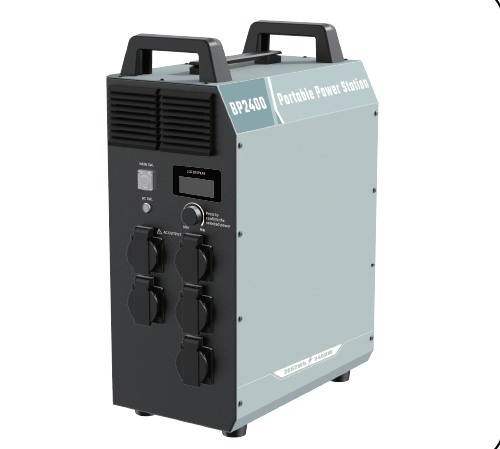
BP2400 in its upright enclosure: battery, bidirectional inverter, MPPT controller and transfer switch share one body.
DP3600iL and EP5000iL introduce a second enclosure. Both accept external battery packs — up to 31 packs and 109kWh total in each case — so the storage block moves partly outside the main unit while the inverter, controller and BMS remain in the head unit. EP5000iL stacks directly with its EP3600B packs, as shown below; the exact pack type for DP3600iL should be confirmed on its product page before ordering. DP3600iL charges to 80% in about 1 hour; EP5000iL supports single-phase 220/230/240V and split-phase 120/240V output, and two units can be stacked in parallel for 10kW without a parallel kit.
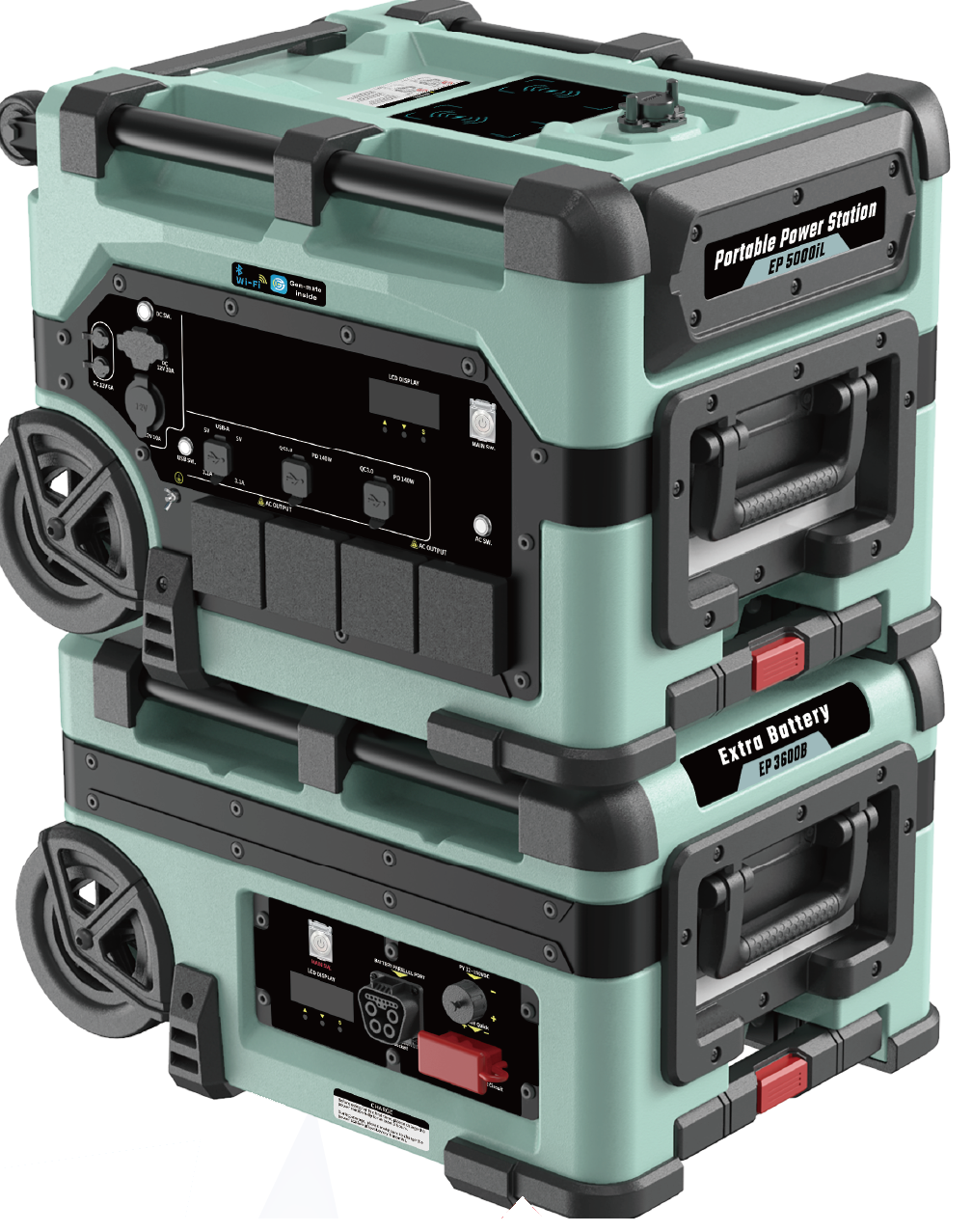
EP5000iL with EP3600B expansion batteries stacked: the head unit keeps the inverter and control layer, while capacity grows through external packs.
| Model | Battery | Output | Charging stage | Expansion |
|---|---|---|---|---|
| BP1000 | 2010Wh LiFePO4, ultra-low voltage, 8000 cycles | 1000W rated / 2000W peak, pure sine wave | 500W MPPT controller built in | Single enclosure, 18.5kg |
| BP2400 | 2662Wh LiFePO4 (52Ah/51.2V), 5000 cycles to 80% | 2400W rated / 4800W peak, THD under 3%, ATS | Bidirectional inverter 1.8kW charge, 1200W MPPT (12–105VDC, 25A max) | Single enclosure |
| DP3600iL | 2662Wh LiFePO4 | 3600VA rated / 7200VA peak | 1200W MPPT, charges to 80% in about 1 hour | Up to 31 packs, 109kWh |
| EP5000iL | 3430Wh LiFePO4 (67Ah/51.2V), 5000+ cycles to 80% | 5000W rated / 10000W peak, THD under 3%, single- and split-phase | AC 3000W max single-phase (about 1.2 hours), solar 12–150VDC up to 1600W (about 2.5 hours) | Up to 31 EP3600B packs, 109kWh; two units stack to 10kW |
Output, capacity, cycle and charging figures in this table are quoted from each model's product record. Cycle figures appear as stated in the record — to 80% capacity where indicated — and full test conditions and specifications are listed on each product page.
Full specifications for each are on the product pages: BP1000, BP2400, DP3600iL and EP5000iL. If your requirement sits specifically in the small-output bracket, the 1000W output and charging checks cover that class of unit before a volume order.
Setting a unit up for first use
Choose the location
Place the unit on a level, stable surface with clearance around the vents so heat from the inverter and charging stages can escape. Avoid enclosing it in a closed cabinet during charging or heavy output, and keep it away from standing water — relevant to the IP rating of the specific model rather than to the category as a whole.
Charge before loading
Connect the unit to its AC input and let it reach a useful state of charge before connecting anything. The BMS manages the rate, and the listed charge time applies to the specified input and voltage range, so a different supply will not reproduce that figure.
Connect loads in order
Start with the smallest load, confirm the output reading, then add larger loads one at a time. This makes it obvious when a load exceeds the continuous rating, and it keeps inrush loads that briefly draw toward the peak figure from stacking on top of an already loaded output.
Add solar if required
Check the panel string voltage against the model's input window before connecting — 12–105VDC on BP2400, 12–150VDC on EP5000iL — and keep within the stated current ceiling. Panels should be connected with the correct polarity and the string left open-circuit until the voltage has been measured. Sizing guidance is in the matching guide linked above.
From understanding to specification
Once the internal path is clear, the parameters that matter for a purchase sort themselves: capacity and output class set by the loads, charge paths set by where the unit will be replenished, expansion set by how long the requirement will last. The sizing guide takes those parameters through the selection decision; this page stops at how the machine works.