A buyer-side comparison of the four charging routes for portable power stations: what each route needs at the site, published fill times for the BP3600 and BP2400, how to calculate the energy cost of a refill, and the temperature and enclosure limits that decide where a unit can realistically be recharged.
The short answer to where a portable power station can be charged is that it depends on what the site can supply. The four charging routes you will specify most often are AC mains, solar through the unit's MPPT controller, vehicle 12V DC, and an EV charging port. Each has a different fill time, a different set of site prerequisites, and a different energy cost profile, and those three differences decide which route belongs in the specification for a given deployment.
What this means for an RFQ
- Fill time is route-specific. Quote it per charging input, not as one headline number.
- AC input at 220-240VAC and at 100-120VAC are separate specifications that produce different fill times on the same unit.
- Solar input needs a voltage window match, not just a panel wattage.
- Vehicle 12V DC is the slowest route and should be treated as an availability option, not a routine refill method.
- Charging temperature is 0 to 45 degrees Celsius on the BP3600 and BP2400, which rules some sites out for recharge even where discharge would be fine.
The Four Input Routes Side by Side
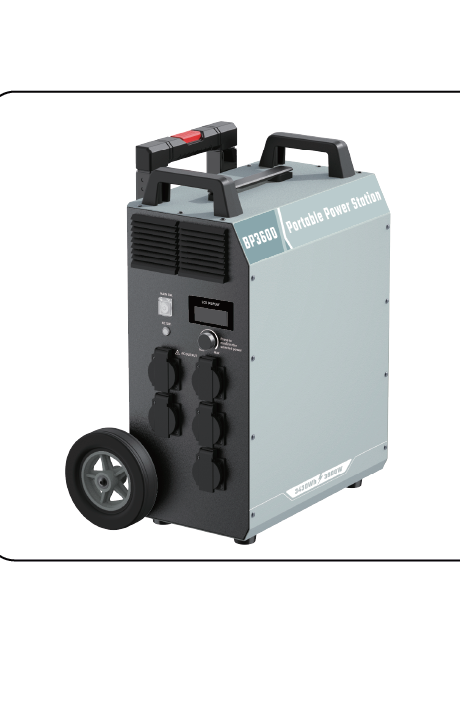
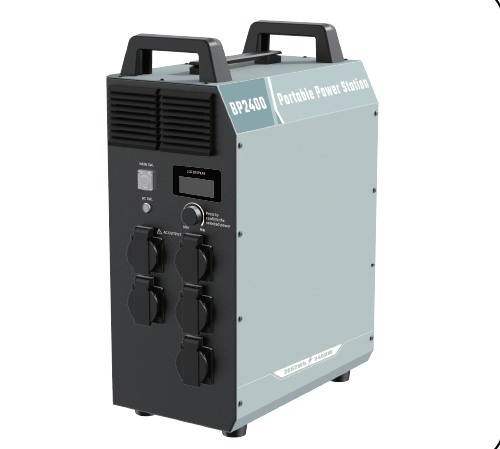
Published figures below are the manufacturer specifications for two models, so a distributor can see how far apart the routes actually are before committing to a site plan. The BP3600 carries a 3430Wh LiFePO4 battery; the BP2400 carries a 2662Wh LiFePO4 battery.
| Input route | Typical site condition | BP3600 published fill time | BP2400 published fill time | What the buyer must confirm |
|---|---|---|---|---|
| AC mains at 220-240VAC | Warehouse, shop, workshop with a standard high-voltage wall circuit | Maximum 3000W input, full charge in 1.2 hours | Maximum 1800W input, full charge in 1.5 hours | Circuit capacity and breaker rating at the charge point, plus available outlet count across the fleet |
| AC mains at 100-120VAC | Lower-voltage mains market, temporary site supply, older building circuits | Maximum 1800W input, full charge in 2 hours | Not stated in the published specification for this voltage band | Which voltage band the target market actually delivers, and whether the quoted fill time was measured in that band |
| Solar through MPPT | Off-grid cabin, remote monitoring post, yard without grid service | 12-150VDC at 25A, maximum 2400W input, full charge in 1.5 hours; built-in 2400W MPPT controller | 12-105VDC at 25A, maximum 1200W input, full charge in 2.5 hours | Array voltage falls inside the MPPT window on the coldest and hottest day of the year, and irradiance at the site in the worst month |
| Vehicle 12V DC | Service van, RV fleet, mobile crew base | 12-30V at 8A, maximum 200W input, full charge in 18 hours | Optional DC charging, 12-30V at 8A, maximum 200W input | Continuous duty rating of the vehicle socket and wiring, and whether the vehicle is running during charge |
| EV charging port | Site already fitted with EV supply equipment | Not a published input figure on these models; compatibility must be confirmed per site | Not a published input figure on these models; compatibility must be confirmed per site | Connector type, signalling behaviour and what the port will actually deliver to a non-vehicle load |
For the EV route, connector and signalling behaviour is the part buyers most often skip, so a separate note is worth reading before a site survey: further reading on EV port compatibility. That article covers the port side; this one covers how the four routes compare by site condition.
Matching the Route to the Site
In practice one route becomes primary, one becomes backup, and each combination carries a limitation that has to be designed around rather than discovered later.
Warehouse or shop with grid power
Primary route is AC mains. On the BP3600 portable power station a 3000W AC input brings the 3430Wh battery to full in 1.2 hours at 220-240VAC, which is fast enough to fit a shift change or an overnight turnaround. Backup is solar or vehicle DC, useful only as a top-up. The limitation is the distribution board: several units charging simultaneously at maximum AC input will load the circuit, so the buyer needs to state how many units sit on one circuit and at what charge rate.
Off-grid cabin or remote site relying on solar
Primary route is solar through the MPPT controller. The BP3600 accepts a 12-150VDC window at 25A with a maximum 2400W input and reaches full charge in 1.5 hours under the stated conditions; the BP2400 smart mobile power station uses a 12-105VDC window at 25A with a maximum 1200W input and reaches full charge in 2.5 hours. The limitation is the array, not the unit: an array sized well below the input ceiling will not reach those fill times. Back up with vehicle DC where a vehicle is present. The buyer must confirm string voltage against the narrower BP2400 window before ordering panels.
Service van or RV fleet using vehicle DC
Primary route becomes AC mains at the depot, with vehicle 12V DC as the working route between depot visits. Both referenced models accept 12-30V at 8A with a maximum 200W input, and the BP3600 published figure for a full charge on this route is 18 hours. That number is the limitation: vehicle DC keeps a unit topped up and covers light daily draw, but it cannot replace a full recharge cycle in a shift. Back up with solar where the vehicle roof allows it. The buyer must confirm that the socket and wiring are rated for continuous draw, not just for a phone charger.
Site that already has EV charging infrastructure
Primary route can be the existing EV supply equipment, with AC mains as backup where a conventional outlet is also present. The DP3600iL portable power station is the model in this group that lists utility, solar, AC generator and wind generator inputs as accepted interfaces; its 1200W built-in MPPT controller covers the solar side, and the platform is stackable, with up to 31 extra batteries for a total of 109kWh. The limitation sits on the EV side: an EV port is built to negotiate with a vehicle, so what it will deliver to a stationary load has to be confirmed for that specific charger rather than assumed from the connector shape.
Charging Time Is a Specification, Not a Claim
The spread between routes is wider than most buyers expect. On the BP3600, the published full-charge time runs from 1.2 hours on 220-240VAC mains, to 1.5 hours on solar at maximum input, to 18 hours on vehicle 12V DC. On the BP2400, 1.5 hours on 220-240VAC mains and 2.5 hours on solar at maximum input. The DP3600iL record states 80 percent charge in one hour.
These are not competing claims about the same thing; they are four different interfaces with four different power ceilings. A single headline figure in a brochure tells the buyer nothing about the route they will actually use on site.
In the RFQ, ask for fill time per route, and state the conditions attached to each: input voltage band, maximum input wattage, solar window voltage and current, and ambient temperature. A supplier who quotes one number without a route is quoting the fastest case, which is usually mains at the higher voltage band. That is the wrong number for an off-grid deployment and for a vehicle-mounted one.
What an Energy Refill Actually Costs
The method is straightforward and does not need a published tariff. Convert the battery capacity to kilowatt-hours, then multiply by the buyer's own local electricity price. The BP3600 at 3430Wh is 3.43 kWh per full recharge. The BP2400 at 2662Wh is 2.662 kWh. A mains refill therefore moves that many kilowatt-hours through the meter, subject to the charging efficiency of the AC path.
Solar charging changes the arithmetic. The energy comes from the array rather than the meter, so the recurring cost is the array and its maintenance, not a per-kilowatt-hour purchase. For a site that already has panels, solar is the cheapest route to operate over time; for a site without panels, the array cost has to be carried by the project before any comparison is meaningful.
A distributor should never publish a single cost figure across markets. Electricity pricing differs by country, by region, by tariff structure and by time of day, and the number that is correct for one buyer is wrong for the next. Publish the method, publish the capacity in kWh, and let each market apply its own rate. Anyone quoting a fixed cost to charge from a search result is working from someone else's tariff.
Temperature and Enclosure Limits Decide Where a Unit Can Be Recharged
The BP3600 and BP2400 both publish a charging temperature range of 0 to 45 degrees Celsius, together with IP53 unit protection and IP66 battery pack protection. Those two facts together decide the recharge location more often than the connector does.
A cold store held below freezing is outside the charging window even though the unit may sit there. The practical answer is to charge elsewhere and move the unit, which means the charging station needs to be somewhere the unit can physically reach, not wherever the socket happens to be. The same applies to an outdoor yard in a market where the ambient temperature drops below the lower limit overnight: an overnight charge cycle planned for that yard will not run as specified.
The IP ratings set the other boundary. IP53 unit protection and IP66 battery pack protection do not make the unit an outdoor permanent installation, and a charging point exposed to driven rain or standing water is a specification question, not an assumption. For each deployment, state the ambient temperature range at the intended charging position and whether that position is sheltered. If it is not, the charging point moves inside and the site plan changes with it.
Site temperature and enclosure conditions also interact with the fill time figures above: a full-charge time quoted at an ambient temperature inside the stated window is the figure to use, and a site outside that window needs a different charging location before the time is meaningful.
FAQ
- Where can the unit be recharged if there is no grid connection?
- Solar through the built-in MPPT controller is the primary option, with vehicle 12V DC as a top-up route. The BP3600 accepts 12-150VDC at 25A up to 2400W; the BP2400 accepts 12-105VDC at 25A up to 1200W. The array voltage has to sit inside that window across the site's temperature range.
- Is a vehicle 12V socket enough for regular use?
- It is enough for top-up and light daily draw. On the BP3600 the published full-charge time on this route is 18 hours at a maximum 200W input, so it is not a substitute for a mains or solar recharge cycle. Confirm the socket and wiring are rated for continuous draw.
- Is solar alone workable?
- It is workable when the installed array can actually deliver the input the unit accepts and the site has usable irradiance in the worst month. The published solar fill times assume the maximum input is available. Size the array against the load profile, not against the unit's ceiling.
- What should be confirmed before quoting?
- The mains voltage band at the site and its circuit capacity, the solar window voltage and array size, the vehicle socket rating, EV port compatibility if that route is proposed, and the ambient temperature at the intended charging position. Quote fill time per route rather than one number.
Next Step for OEM and ODM Projects
DRIVELONG is based in Suzhou, China, with more than 19 years of power generation experience and more than 120 patents, and supplies OEM and ODM energy solutions to buyers in Europe, North America, South America, Australia, Singapore, Russia and the Middle East. The BP3600 and BP2400 publish CE, RoHS and UN 38.3 certification, and all three models referenced here carry a 5-year warranty; the BP3600 and BP2400 also publish a UPS transfer time of 10ms or less. When you send an inquiry, include the site conditions for each charging route you intend to use, the target market and its voltage band, and the required fill time per route. That information is what turns a specification sheet into a quotable configuration. You can review the BP3600 portable power station, the BP2400 smart mobile power station and the DP3600iL portable power station before sending your project brief, so the input requirements and the unit platform can be matched in one round.