LiFePO4 stands for lithium iron phosphate, often shortened to LFP, and it is a member of the lithium-ion family used in portable power stations. This article explains what the abbreviation means and compares chemistry choices on the points a buyer can actually verify on a spec sheet: cycle life class, pack-level safety engineering, weight and energy density trade-offs, and cost per usable cycle.
If you are comparing portable power stations for a retail program, a rental fleet, or a field deployment, the spec sheet will eventually ask you to choose between LiFePO4 and "lithium-ion". The two lines are not opposites. LiFePO4 is one type of lithium-ion battery, and knowing which type you are buying tells you what to verify before you commit to a volume order.
Key takeaways
- LiFePO4 means lithium iron phosphate. It is often shortened to LFP and is a member of the lithium-ion chemistry family.
- "Lithium-ion" on a spec sheet usually refers to other cathode chemistries, so the label alone does not tell you the cycle life class or safety architecture.
- Verify four things: declared cycle life to 80% capacity, pack-level safety engineering, weight and energy density, and cost per usable cycle.
- DRIVELONG LiFePO4 units are declared at 5,000 to 8,000 cycles to 80% capacity, depending on the model.
What does LiFePO4 battery mean?
The abbreviation breaks down into its chemical parts: lithium (Li), iron (Fe), and phosphate (PO4). The cathode of the cell uses lithium iron phosphate rather than the nickel, cobalt, or manganese oxides found in other lithium-ion designs. In datasheets and tender documents you will see it written as LiFePO4, LFP, or sometimes lithium ferro phosphate. All three refer to the same chemistry family.
When a supplier writes only "lithium-ion" or "Li-ion", they are naming the category, not the chemistry. That matters for buyers because cycle life, thermal behavior, and weight differ substantially between lithium-ion sub-types. A spec sheet that gives you the cell chemistry, the declared cycle count, and the test condition (capacity remaining at end of test) is far more useful than one that stops at the category name.
The practical answer to what is LiFePO4 battery mean for a portable power station buyer is this: it is a lithium-ion battery that is normally specified with a long cycle life and a phosphate-based cathode. Whether a particular unit actually delivers that depends on the cell grade, the battery management system, and how the manufacturer declares its cycle life. Those are checkable.
How LiFePO4 compares with other lithium-ion types in portable storage
Portable power stations on the market use several lithium-ion chemistries. LiFePO4 is one; others are commonly described by their cathode composition or simply grouped as "lithium-ion" or "NMC" in marketing material. Rather than rank chemistries in the abstract, the useful approach for a buyer is to compare them on dimensions that appear in documents you can request and review.
| Checkable dimension | What to ask about LiFePO4 | What to ask about other lithium-ion types |
|---|---|---|
| Cycle life class | Declared cycles to 80% capacity, with test conditions | Same declaration; do not accept a category name alone |
| Pack safety engineering | BMS functions, IP rating of the pack, auto-extinguishing device, transport certification | Same list; request the equivalent evidence |
| Weight and energy density | Wh per kg or Wh per unit weight, plus total unit weight | Same figure, measured on the same basis |
| Cost per usable cycle | Unit cost divided by declared usable cycles, with warranty terms | Same calculation using that supplier's declared figures |
The table is a question framework, not a ranking. Figures for other chemistries vary by cell supplier and must come from the supplier you are evaluating.
Cycle life class: the number that decides fleet economics
Cycle life is the dimension where chemistry choice shows up most directly in total cost. For a rental fleet, a backup power program, or a product you will warrant for several years, the declared cycle count to 80% capacity is the number to anchor on. It is also one of the easiest figures to compare, provided every supplier declares it the same way.
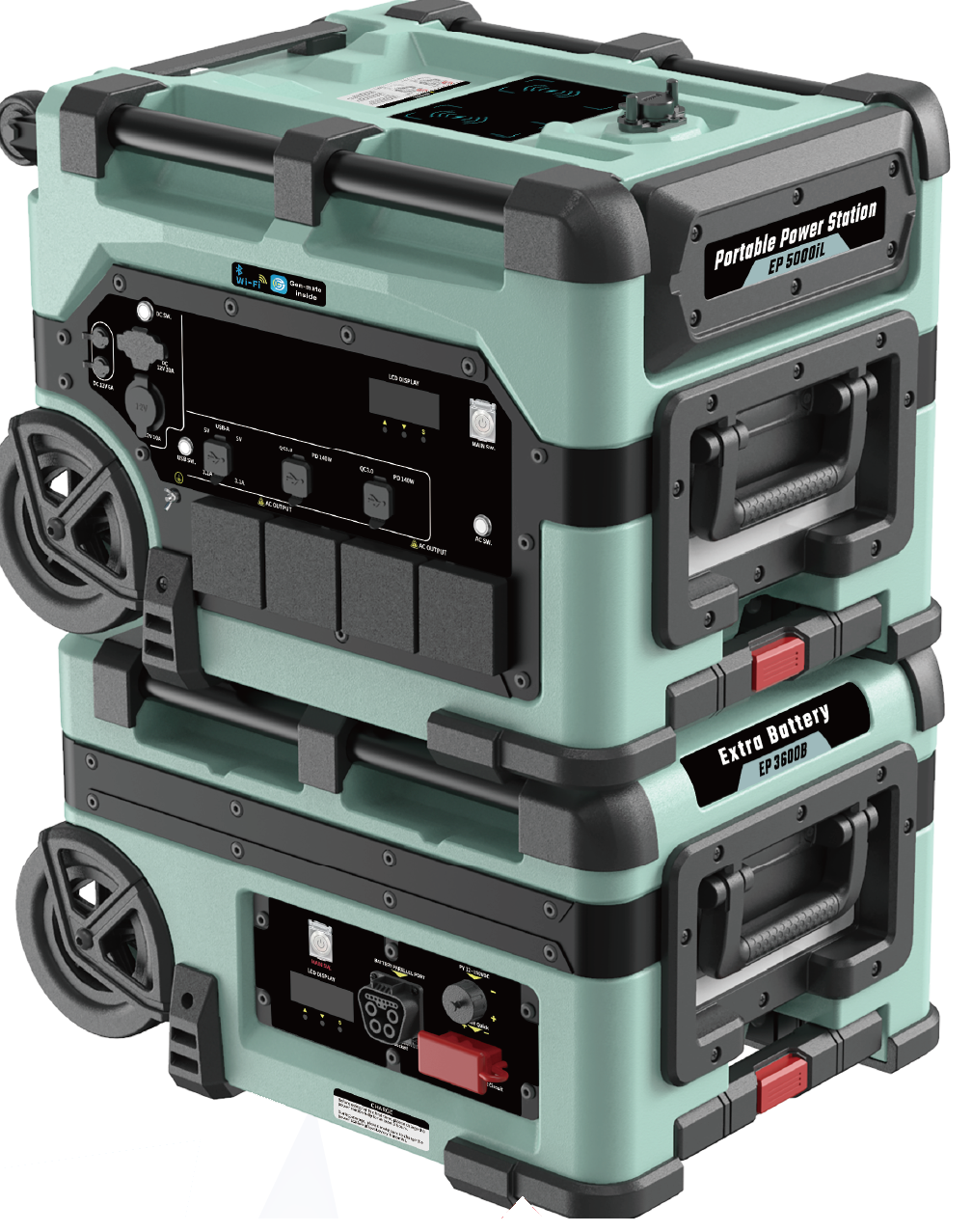
DRIVELONG publishes model-specific cycle life declarations. The EP5000iL is a 3,430Wh LiFePO4 unit rated at 5,000+ cycles to 80% capacity, with a 5,000W rated output and 10,000W peak. The BP1000 is a 2,010Wh ultra-low voltage LiFePO4 unit rated at 8,000 cycles, with a 1,000W rated output. The difference between these two declared figures illustrates why chemistry alone is not enough: both are LiFePO4, but the cycle life class differs by model, so the declaration has to be read per SKU.
When you evaluate other lithium-ion options, ask the supplier to state the cycle count to 80% capacity, the depth of discharge used in the test, the charge and discharge rate, and the temperature. A cycle count without those conditions cannot be compared with a LiFePO4 declaration or with a competing quote.
Safety engineering around the pack, not just the cell
Cell chemistry is one layer of safety. The pack is the other, and for portable equipment the pack is where a buyer can verify the most. The questions below are ones a supplier should be able to answer with documents rather than adjectives.
- Battery management system. Which protections are implemented, and how are over-voltage, over-current, over-temperature, and short circuit handled?
- Pack ingress protection. Is the battery pack rated IP66, and does the rating cover the pack or only the outer enclosure?
- Integrated auto-extinguishing device. Is one fitted, and what triggers it?
- Transport certification. Are listed models covered by UN 38.3 test documentation, which is the baseline for shipping lithium batteries?
These are not abstract concerns. A portable power station moves by road, sea, and air, and it moves repeatedly in rental and field-service use. Pack-level features such as a BMS, an IP66 battery pack, and an integrated auto-extinguishing device belong in the specification you compare, alongside the cell chemistry. Ask for the same evidence set for any other lithium-ion option you are considering, and ask which specific models the documents cover.
A note on documentation. Certification and test reports apply to the models and configurations named in them. When a supplier sends a certificate, check the model list, the issuing body, the version date, and whether any conditions or limitations are printed on the report.
Weight and energy density trade-offs
Portable storage always trades weight against capacity. A larger battery bank gives you more watt-hours but adds kilograms, which affects handling, shipping cost, and whether the unit can be moved by one person. Chemistry influences this trade-off, but so do enclosure design, inverter topology, and thermal management.
For a fair comparison, ask each supplier for the total unit weight and the usable energy in watt-hours, then calculate watt-hours per kilogram on the same basis. Do not compare a bare cell energy density figure against a finished product weight. If a supplier quotes an energy density number for another chemistry, ask whether it is measured at cell, module, or pack level, and at what state of charge and temperature. Those figures should be treated as supplier-declared until you see the underlying test data.
The practical question for most buyers is not which chemistry wins on paper, but whether a given unit's weight is acceptable for the use case. A 2,010Wh unit and a 3,430Wh unit sit in different handling classes regardless of chemistry, so check the weight against how the product will actually be moved.
Cost per usable cycle: the comparison most quotes miss
Unit price alone tells you little about a portable power station that will be cycled daily. The more revealing figure is cost per usable cycle: the purchase price divided by the declared number of cycles to 80% capacity, adjusted for any capacity you cannot use because of depth-of-discharge limits or warranty conditions.
This calculation makes cycle life declarations commercially meaningful. It also exposes quotes that look cheap per unit but carry a short declared cycle life. When you request pricing for other lithium-ion options, ask for the cycle declaration in the same format, and ask what the warranty covers if capacity falls below 80% before the declared count. A supplier who can answer both questions is giving you a comparable number; one who cannot is giving you a price without a cost.
What to put on your supplier checklist
Before any volume order, ask for the following in writing. The list applies whether you are buying LiFePO4 or another lithium-ion type.
- The exact cell chemistry and the model or SKU it applies to.
- Declared cycle life to 80% capacity, with test conditions.
- BMS protection functions and the pack IP rating.
- Whether an integrated auto-extinguishing device is fitted.
- UN 38.3 transport documentation covering the specific models offered.
- Total unit weight and usable energy, so you can calculate energy density yourself.
- Warranty terms tied to the capacity retention figure.
Once those answers are on the table, the chemistry question becomes a commercial one rather than a vocabulary one. LiFePO4 is a lithium-ion chemistry with a strong position in portable storage because it is commonly specified with long cycle life and pack-level safety features. Other lithium-ion types may suit different priorities, and the way to find out is to request the same verifiable figures from every supplier in the comparison.
Frequently asked questions
Is LiFePO4 the same as lithium-ion?
LiFePO4 is a type of lithium-ion battery. Lithium-ion is the broader family; LiFePO4 names a specific cathode chemistry within it. A spec sheet that says only "lithium-ion" is less precise than one that names LiFePO4 or LFP.
What is a good cycle life declaration for a portable power station?
Compare declarations on the same basis: cycles to 80% capacity, with depth of discharge and test conditions stated. DRIVELONG LiFePO4 units are declared at 5,000 to 8,000 cycles to 80% capacity depending on model. Ask other suppliers for their figure in the same format.
Does LiFePO4 chemistry make a power station safe on its own?
No. Safety depends on the pack as well as the cell. Look for the battery management system, the pack IP rating, whether an auto-extinguishing device is integrated, and UN 38.3 transport certification on the models offered.
Why do two LiFePO4 models have different cycle ratings?
Cycle life depends on the cells used, the depth of discharge, the charge and discharge rates, and the thermal design. It is declared per model, which is why you should read the figure for the exact SKU you are buying rather than for the chemistry in general.