A buyer-side verification checklist for shortlisting a 1000W portable power station for resale or projects, covering rated versus peak output, real battery capacity, charging parameters, and the factory questions worth settling before a bulk order is signed.
Bulk Order Verification Guide
Most 1000W portable power stations look similar on a specification sheet. The differences that decide whether a container arrives sellable or becomes a warranty problem sit in three places: how output is rated, what the battery actually delivers, and how the unit charges. This checklist walks a buyer through each of those checks, then lists the questions worth settling with the factory before a bulk order is signed. It is written for importers, distributors, project buyers and private-label brands shortlisting a 1000W-class unit for resale or installation work.
What this checklist covers
- Rated output versus peak output, and why both need verification
- Battery capacity: chemistry, cycle life and usable watt-hours
- Charging parameters: solar input and AC charging
- Factory confirmations before a bulk order
- How to request a quotation and sample evaluation
Key takeaways
- Rated power is the number a buyer resells against; peak power is a short-duration number that protects the inverter during motor startup.
- Battery capacity on a datasheet is nominal. Confirm the nominal configuration and chemistry, not only the headline Wh figure.
- Solar and AC charging inputs determine how the unit behaves in the field, so ask for the input range, not just a wattage figure.
- Unit-to-unit consistency across a batch is a factory question, not a datasheet question.
Rated output versus peak output: two numbers, two jobs
Rated power is the continuous load an inverter is built to carry. Peak power is a higher figure the unit can hold for a short interval, usually enough to start a motor or compressor that draws a surge on startup. A buyer who quotes only one number to their own customers is exposed: quote the rated figure as the working load, and treat peak as a startup allowance with the duration specified by the factory.
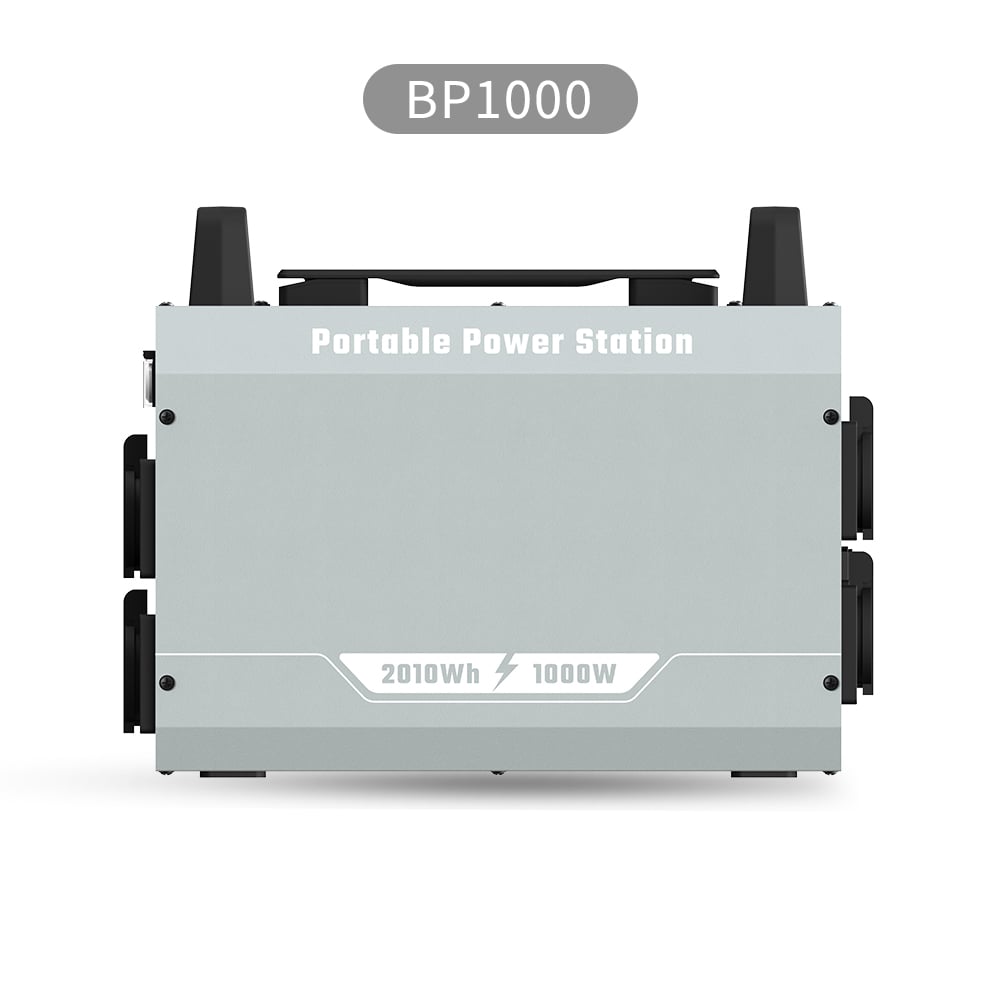
On the BP1000 Portable Power Station, the listed figures are 1000W rated and 2000W peak. The rated figure is what a reseller should publish as continuous output. The peak figure explains why an appliance with a start-up surge can be run on a unit rated below the appliance's nameplate draw, provided the surge is short and within the peak rating. What the peak figure does not do is license a continuous load above 1000W, and part of the verification job is making sure the datasheet, the label on the sample and the marketing copy all describe the same limit.
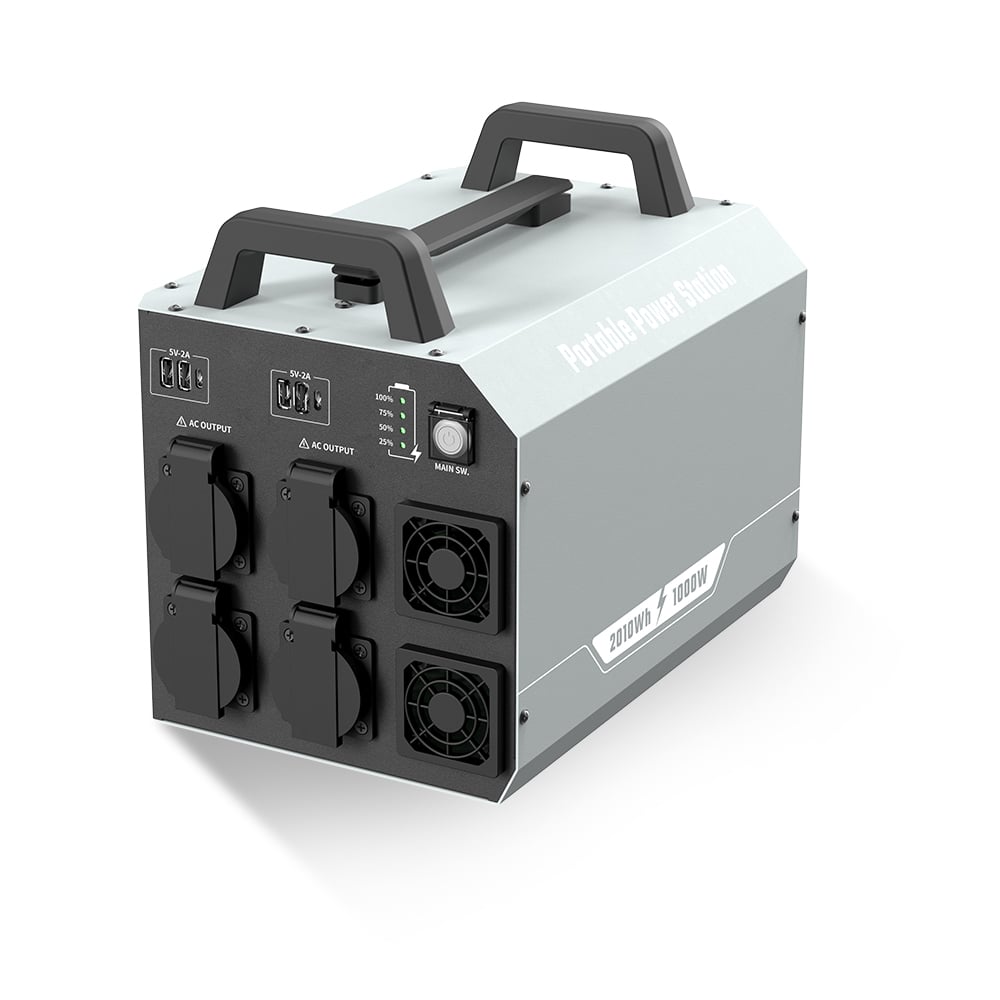
Both numbers need to be checked against the same source. Confirm the rated figure appears on the product label, not only in the brochure. Ask the factory how peak output is measured and for how long it holds, and ask whether the inverter is a pure sine wave unit, since modified sine output can be unsuitable for some appliances with motors or sensitive electronics. The BP1000 is listed with a built-in pure sine wave inverter, and it is rated to power phones, lights, TVs, refrigerators, microwaves and power tools — the range of load types a distributor is likely to be asked about.
Battery capacity: chemistry, cycle life and real usable watt-hours
Capacity is the specification buyers lean on hardest and the one most easily compared wrongly. A headline figure tells you the nominal energy stored. It does not tell you the chemistry, how many cycles the cells are rated for, or how much of that nominal energy the inverter can deliver to a load. Each of those affects what the unit is worth to your customer.
The BP1000 carries a nominal capacity of 2010Wh with a LiFePO4 battery type described as ultra-low voltage, rated for 8000 cycles. LiFePO4 chemistry is worth understanding as a purchasing decision: it is a different cell chemistry from lithium-ion NMC, and the cycle rating on a datasheet is a cell-level durability figure, not a promise about how a finished unit will perform in a particular application. Ask the factory what test conditions the cycle figure refers to.
One point to settle explicitly during the RFQ: catalog copy and specification tables do not always describe the same battery layout. The BP1000 specification table and the unit itself are marked 2010Wh, while descriptive text on some product records refers to a 2×1000Wh configuration. Both descriptions can point to the same class of product, but a bulk buyer needs the nominal capacity configuration confirmed in writing — single-pack versus modular cell layout — because the answer affects labeling, documentation and how you describe the unit in your own market. Add it to the checklist as a written question rather than assuming either figure.
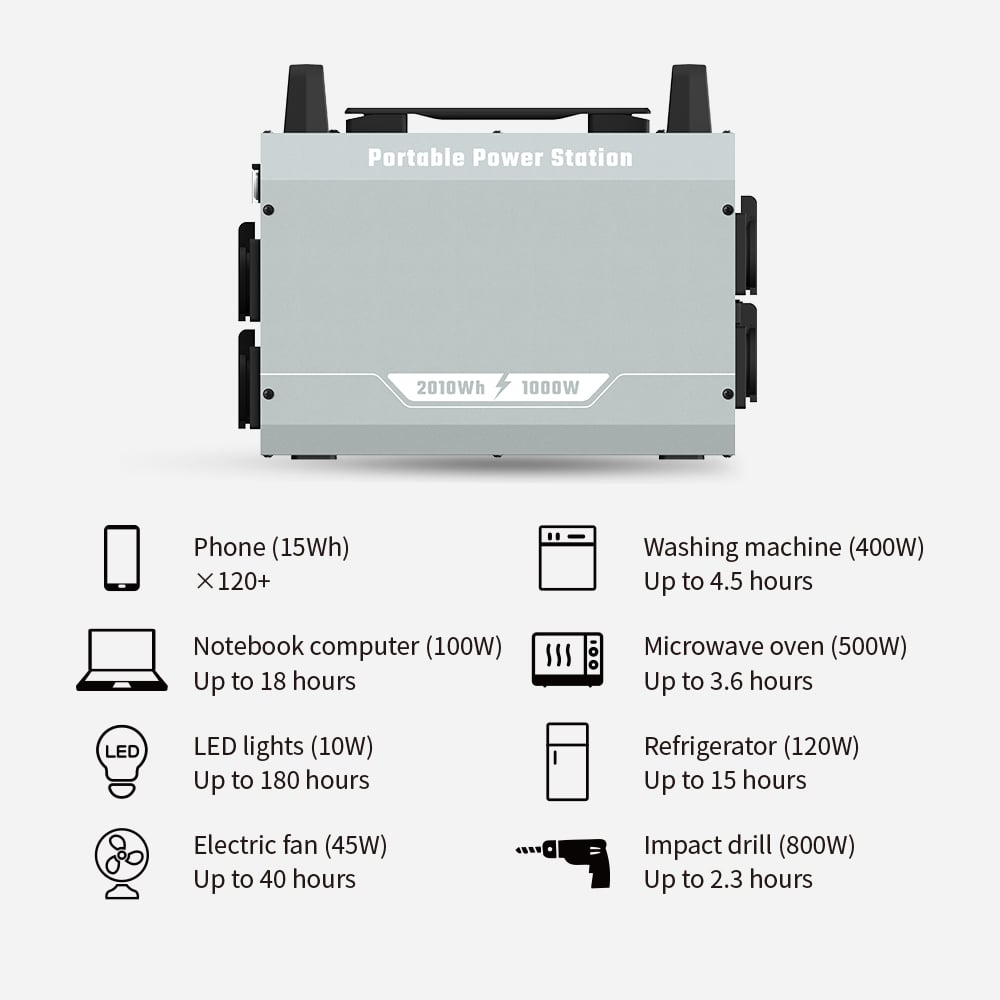
For a sense of what capacity translates into for end users, the manufacturer's runtime infographic gives estimated runtimes for typical loads. These are estimates for representative loads, not guaranteed field results, and actual runtime will shift with load profile, temperature and battery condition.
| Load | Load draw | Estimated runtime |
|---|---|---|
| Phone | 15Wh equivalent | Up to 120 recharges equivalent |
| Notebook | 100W | Up to 18 hours |
| LED lights | 10W | Up to 180 hours |
| Electric fan | 45W | Up to 40 hours |
| Washing machine | 400W | Up to 4.5 hours |
| Microwave oven | 500W | Up to 3.6 hours |
| Refrigerator | 120W | Up to 15 hours |
| Impact drill | 800W | Up to 2.3 hours |
Note that the impact drill and microwave examples sit close to the 1000W rated output. For resale, it helps to pair each runtime figure with the load it belongs to, so your customer can match the unit to their appliance rather than to a headline number.
Charging parameters: solar input and AC charging
Charging is where buyers most often get surprised after the order ships, because the numbers that matter are input ranges and controller type rather than a single wattage claim.
Solar input
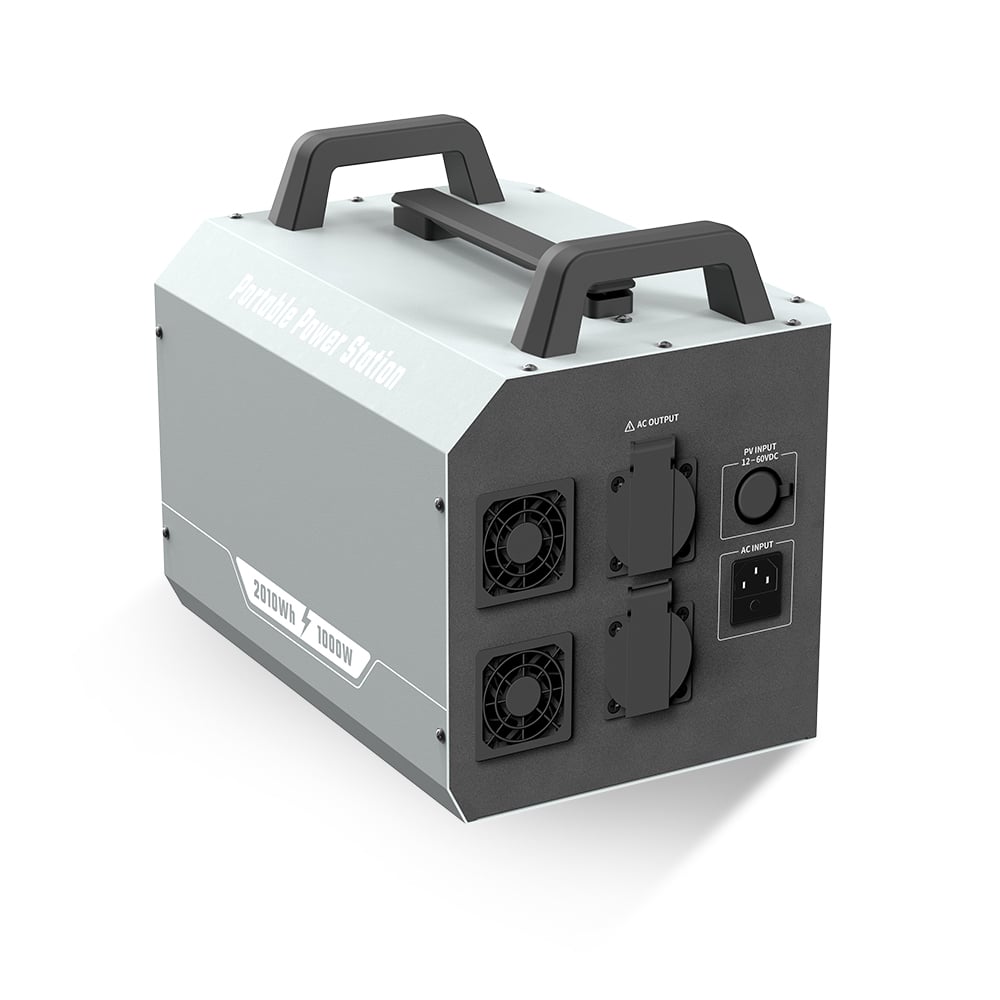
The BP1000 is listed with a built-in 500W MPPT solar controller, and the product photos show a PV input range of 12–160VDC on the charging panel. Both pieces of information matter to a distributor. The MPPT controller type tells your technical customers how the unit tracks a panel's operating point. The input voltage range tells them which panel configurations can connect without an external regulator. Ask the factory for the connector type and the panel wiring guidance so you can answer installation questions accurately.
AC charging
AC charging is the check most often reduced to a single line in a brochure. Before committing, ask the factory for the AC input voltage and frequency range relevant to your destination markets, the AC charging power figure, and whether charging can be limited or scheduled. If your customers will use the unit in different regions, the input range is a compatibility question, not a convenience detail. Where a buyer needs charge time figures, request them from the factory with the test conditions attached rather than relying on a generic claim.
Weight and handling deserve a line here too, because they are part of the charging and logistics story. The BP1000 is listed at 18.5kg net weight, which is relevant both to end-user portability and to carton design and freight planning.
What to confirm with the factory before a bulk order
Datasheet review gets you to a shortlist. The following items are what separate a shortlist from an order you can defend to your own customers.
- Unit-to-unit consistency. Ask how the factory verifies output and capacity across a production batch, and request the inspection criteria used at final test. A single sample tells you what one unit can do; the batch question is what protects your brand.
- Datasheet matching. Confirm that the rated power, peak power, nominal capacity and charging input range on the label, the shipping documents and the marketing copy are identical. Ask specifically about the nominal capacity configuration (single-pack versus modular layout), since naming conventions can differ between descriptive copy and specification sheets.
- Packaging. Request the carton specification, drop-test approach and inner packaging for the unit at its listed net weight, plus whether custom packaging and labeling are available for your brand.
- Certification documentation. Ask which documents the factory can supply for the destination markets you serve, and request copies of the actual documents rather than a summary list. Confirm that the documentation matches the exact model and configuration you are ordering, and that it names the correct manufacturing entity.
- Warranty terms. The BP1000 is listed with a 5-year warranty. Confirm what the warranty covers, how claims are handled for an overseas distributor, which party bears return freight, and what spare parts support is available.
- Commercial terms. Request MOQ, production lead time, payment terms and sample lead time for your specific configuration. These vary by order and should come from the factory in writing, not from a general page.
Sample evaluation and quotation
The practical order of operations is straightforward: define your market requirements, request a sample of the exact configuration you intend to resell, and test it against the checks above before scaling. A sample evaluation should confirm label accuracy against the datasheet, verify rated and peak output behavior with the loads your customers will actually run, measure usable capacity under a defined load, and confirm solar and AC charging inputs work with the accessories you plan to offer.
Drivelong (Suzhou Drivelong Intelligence Technology Co., Ltd.) supplies the BP1000 portable power station as an OEM/ODM product to buyers in Europe, North and South America, Australia, Singapore, Russia and Dubai. If you are shortlisting a 1000 watt portable power station for resale or a project, send your target market, required configuration, branding requirements and volume to the team for a quotation and a sample evaluation plan.
Send your 1000W requirements for a quotation
To move from browsing to a decision, include the following in your enquiry so the reply can be specific:
- Destination market and any documentation you require
- Target configuration and whether your brand will appear on the unit and packaging
- Requested nominal capacity configuration for the battery pack
- Planned accessories, such as solar panels and charging cables
- Estimated order volume and preferred delivery schedule
Start from the BP1000 Portable Power Station product page, or send your requirements directly to the sales team for a quotation and sample arrangement.
Specifications quoted in this article are as listed on the BP1000 product record. Runtime figures are manufacturer estimates for typical loads and are not guaranteed field results. Buyers should confirm final configuration, documentation and commercial terms directly with the supplier before placing a bulk order.