
A plain-language explanation of how UPS mode works in a portable power station, plus a buyer confirmation checklist covering transfer time, waveform quality, rated and peak output, battery chemistry, protection, monitoring, certifications and warranty. Written for overseas B2B buyers, distributors and project buyers evaluating backup power options.
A portable power station with UPS mode is often pitched as a simple replacement for a dedicated uninterruptible power supply. The reality is more specific: the station must pass grid power through to connected equipment and, when mains power fails, hand the load over to its battery within a defined switching time. That switching time, together with waveform quality and protection design, determines whether the station suits a particular load. This article explains how UPS mode works in a portable power station and lists the points a B2B buyer should confirm before specifying one.
Key takeaways
- UPS mode in a power station uses a pass-through path from the grid to the load, plus a bidirectional inverter and an ATS controller that transfer the load to battery power when mains fails.
- Switching time is the first specification to compare against load sensitivity; it is not the only one.
- Output waveform, total harmonic distortion, rated versus peak output, battery chemistry, protection, monitoring, certification and warranty are the remaining checklist items.
- Not every high-capacity power station is positioned as a UPS product; confirm UPS claims model by model.
What UPS mode does in a portable power station
A conventional UPS keeps a battery charged and feeds the load through an inverter stage. A portable power station with UPS mode does something similar, but the station is also a general-purpose energy storage product. In normal operation, grid power passes through the station to the connected equipment while the battery is maintained. When the mains supply drops, a controller switches the load from the grid path to the inverter and battery path.
Two hardware blocks make this possible. The first is a bidirectional inverter, which can convert DC battery energy to AC for the load and also convert AC input to DC for charging. The second is an automatic transfer switch (ATS) controller that detects the loss of mains and commands the transfer. The quality of that transfer is measured by the switching time, usually expressed in milliseconds.
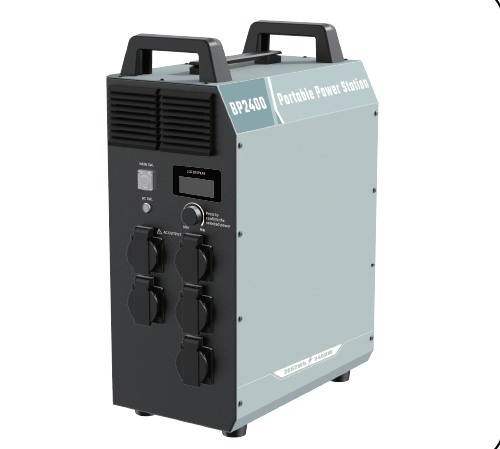
On the DRIVELONG BP2400 Smart Mobile Power Portable Power Station, UPS Function is specified with a switching time of under 10 milliseconds; confirm the test conditions behind this figure with the supplier for your intended load. The same model uses a built-in bidirectional inverter plus ATS controller, and provides a pure sine wave output with THD below 3 percent. Those three facts belong together: transfer time, waveform and distortion define how the station behaves at the moment of a mains failure and while it carries the load.
Where the load actually goes when mains fails
During normal operation the connected equipment is powered from the grid. The battery is held ready. When the grid voltage disappears, the ATS controller opens the grid path and closes the inverter path. The inverter draws from the LiFePO4 battery and produces AC output for the load.
The practical question for a buyer is what the connected equipment does during those milliseconds. Some loads ride through a short interruption without resetting. Others, including certain IT equipment and control systems, treat any interruption as a power loss and reboot or drop a process. The station's switching time is therefore compared against the hold-up time of the load, not against a generic industry figure. A UPS power station sold into a project should have its transfer time documented so the buyer can make that comparison for each load type.
Buyer checklist: what to confirm before specifying a UPS power station
The following checklist is organized around the questions that decide whether a portable power station UPS suits a given installation. Each item should be answered with a documented value, not a general statement.
| Confirmation item | What to ask the supplier | Why it matters |
|---|---|---|
| Transfer or switching time | What is the specified switching time in milliseconds, and under what test conditions was it measured? | The load must tolerate the interruption; sensitive equipment may not. |
| Output waveform and THD | Is the output a pure sine wave, and what is the total harmonic distortion at rated load? | Motors, transformers and some electronics behave differently on distorted waveforms. |
| Rated versus peak output | What is the continuous rated AC output, and what peak output is allowed and for how long? | Starting currents of pumps, compressors and tools can exceed continuous rating. |
| Battery chemistry and cycle life | Which chemistry is used, and what cycle life is specified to what end-of-life capacity? | Determines service life and replacement planning. |
| Protection design | What overcurrent, overvoltage, overtemperature and fire-protection measures are built in? | Affects safety in unattended backup installations. |
| Monitoring options | Are local display, app monitoring or network interfaces available? | Needed for remote sites and for service response. |
| Certifications | Which certifications apply to the exact model and market? | Import and project acceptance depend on market-specific compliance. |
| Warranty and after-sales | What is the warranty term, and what spares and support commitments apply? | Defines the total cost of ownership over the service period. |
Transfer time versus load sensitivity
Start with the load list. If the protected equipment includes devices with short hold-up times, the switching time of the station must be shorter than the time those devices can tolerate. For loads that can tolerate a longer interruption, transfer time is less critical. The BP2400's specified switching time of under 10 milliseconds gives project buyers a concrete figure to compare against each device's documented tolerance.
Output waveform quality and total harmonic distortion
A pure sine wave output with low total harmonic distortion is the baseline for equipment containing motors, transformers or sensitive power supplies. The BP2400 specifies pure sine wave output with THD below 3 percent. Buyers should confirm the distortion figure is stated at rated load, because waveform quality can degrade as the load approaches the inverter limit.
Rated versus peak output
Rated output is the continuous figure the station can deliver. Peak output is the short-term figure available for starting surges. The BP2400 is specified at 2400W rated and 4800W peak AC output. When sizing a station for a pump or compressor, the starting current is the number to compare against peak output, and the running current against rated output.
Battery chemistry and cycle life
LiFePO4 is the common chemistry for stationary backup because of its cycle life and thermal behavior. The BP2400 uses a 2662Wh LiFePO4 battery rated for 5000 cycles to 80 percent capacity. That cycle figure should be read as a specification to 80 percent of original capacity, not as a guarantee of unlimited service.
Protection design
Backup installations often run unattended. Ask what protection is built in at the cell, pack and system level. The BP2400 includes an automatic fire extinguishing device, overall IP53 protection, and an IP66 battery pack. These are model-specific facts; they should not be assumed for other stations in a range.
Monitoring options
Remote monitoring supports service response and helps operators see battery state before an outage. The BP2400 provides Wi-Fi and Bluetooth app monitoring. For project buyers, confirm whether the app or interface supports the languages, accounts and reporting the site needs.
Certifications
Certification must match the exact model and destination market. The BP2400 is listed with CE and RoHS certifications and with UN38.3, the transport test for lithium batteries. Buyers importing into other markets should confirm which additional approvals apply and request the corresponding documents for the specific model.
Warranty and after-sales support
The BP2400 carries a five year warranty. For distributors, warranty terms should be read together with spare-part availability and the response process for replacements. The BP2400's net weight is about 36 to 38 kg, which is relevant to installation handling and to freight planning. As a single note on charging, the BP2400 supports AC recharge up to 1800W in about 1.5 hours, which affects how quickly a site can be returned to a charged standby state after an outage.
An expandable option for larger backup requirements
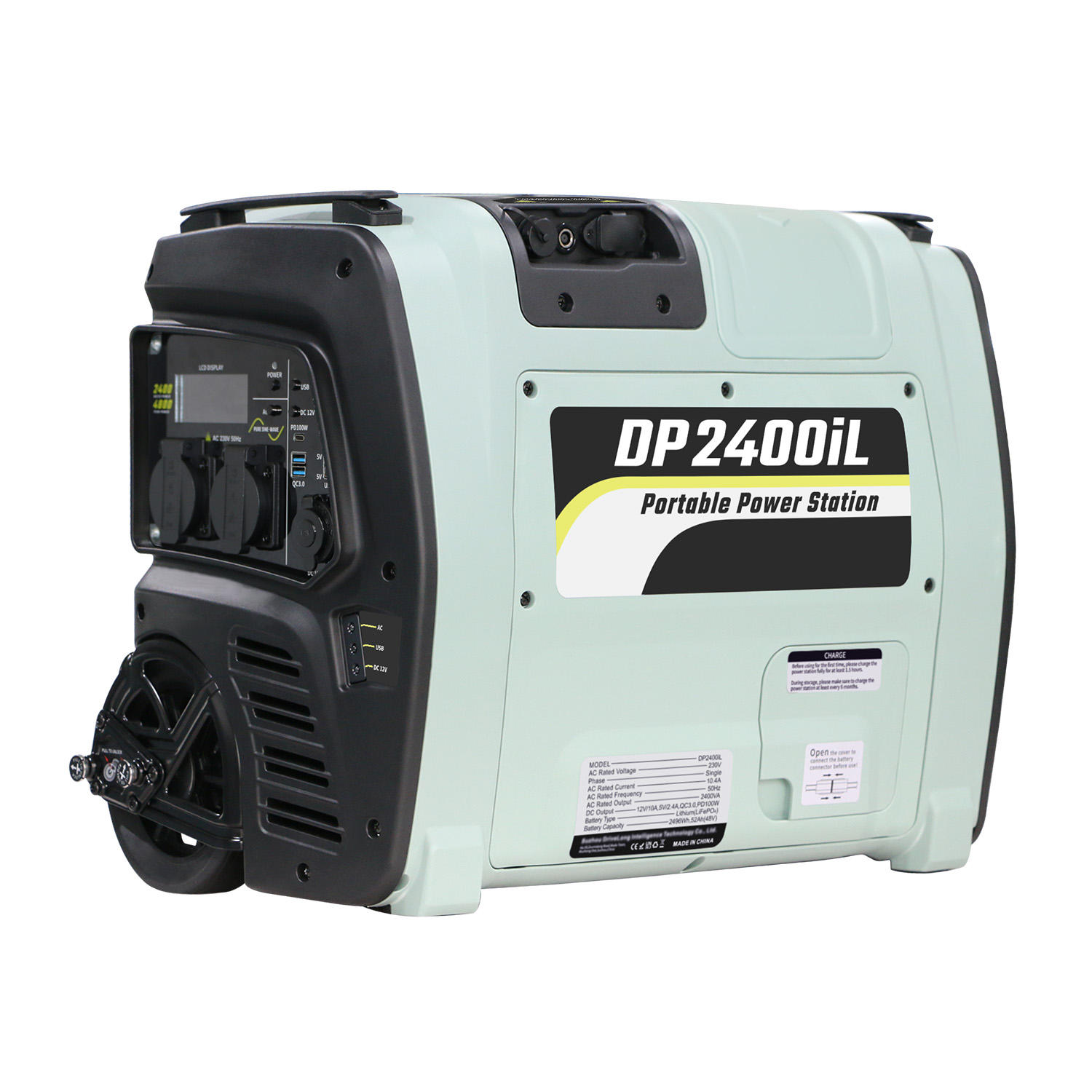
Where the backup requirement is larger than a single station can carry, capacity and output can be scaled with parallel and expansion-capable models. The DRIVELONG DP2400iL Portable Power Station uses a 2496Wh LiFePO4 battery and is rated at 2400VA with a 4800VA peak output. These output figures are expressed in VA rather than W, so when comparing the DP2400iL with watt-rated models such as the BP2400, confirm the power factor conversion with the supplier. Two units can be paralleled to double the output, and the system can be expanded with up to 31 additional battery packs to roughly 109kWh total. It supports fast charging to 80 percent in 1 hour and carries a five year warranty.
The DP2400iL is presented here as an expandable and parallel-capable option. UPS mode, switching time, waveform quality and ingress protection are specified on the BP2400, not on the DP2400iL. Buyers who need UPS behavior should specify the model that carries the UPS specification, and use the DP2400iL where expansion and parallel output are the priority.
Frequently asked questions
Can any portable power station work as a UPS?
No. UPS mode requires a pass-through path, an inverter that can take over the load, and a controller that performs the transfer. A station without those features may still power equipment, but it will not provide the defined switching behavior of a UPS power station.
Is a switching time under 10 milliseconds fast enough?
It depends on the load. Compare the station's specified switching time with the hold-up time of the connected equipment. Equipment that tolerates a short interruption will ride through; equipment with very short hold-up will not, regardless of the station used.
Does UPS mode reduce battery life?
In normal operation the battery is maintained while grid power passes through. The battery is exercised during outages and transfers. Cycle life specifications, such as the 5000 cycles to 80 percent capacity on the BP2400, describe the battery's expected behavior over its service life.
What should a distributor request from the supplier?
Request the model-specific specification sheet showing switching time, waveform and THD, rated and peak output, battery chemistry and cycle life, protection design, monitoring options, certifications and warranty terms. Confirm that each value applies to the exact model being quoted.
OEM/ODM cooperation and RFQ
DRIVELONG is a B2B OEM/ODM manufacturer of portable power stations, inverters and industrial solar panels based in Suzhou, serving Europe, the Americas, Australia and other markets. Distributors and project buyers evaluating a portable power station with UPS for backup power can send an RFQ with the load list, required switching time, output and capacity, destination market and certification needs. The response can be matched to the BP2400 or the DP2400iL, depending on whether UPS behavior or expandable capacity is the priority. Include the target market and expected annual volume so the quotation covers the correct certification and warranty terms.