
A procurement-focused pairing guide for RV dealers, fleet outfitters and distributors: which panel type (fixed, flexible or foldable) fits which RV mounting surface, how wattage steps map to daily loads, and how to read a power station's real MPPT input window before committing to an RFQ.
RV Solar Procurement Guide
Three decisions decide whether an RV solar kit sells well or comes back as a warranty issue: which panel construction suits the mounting surface, what wattage step the coach actually needs, and whether the chosen power station will accept that panel array inside its MPPT input window. This guide walks the whole chain for dealers, fleet outfitters and distributors who are building a repeatable RV solar configuration instead of a one-off.
What this guide covers
- Panel construction: flexible, rigid fixed and foldable
- Wattage steps mapped to RV usage patterns
- Pairing panels to portable power stations by MPPT input window
- Two reference builds: BP2400 and EP5000iL
- RFQ checklist for OEM and distribution buyers
Why panel choice comes before power station choice
Most sourcing conversations about portable solar panels for rv use start with the battery and work backwards. In practice the mounting surface and the roof curve decide the panel format, and the panel format decides the realistic array wattage. Only then does it make sense to talk about which storage unit sits behind it.
A curved fibreglass roof will not take a rigid framed module without standoffs and extra sealing work. A flat-roof utility trailer is the opposite case. A rental fleet that moves units between vehicles needs a panel that travels in a bag, not one that is bonded down. Each of those three situations lands on a different product family, and the array voltage and current that follow from it determine which power station is a valid match.
Panel types: what each one is actually for
Flexible panels for curved roofs
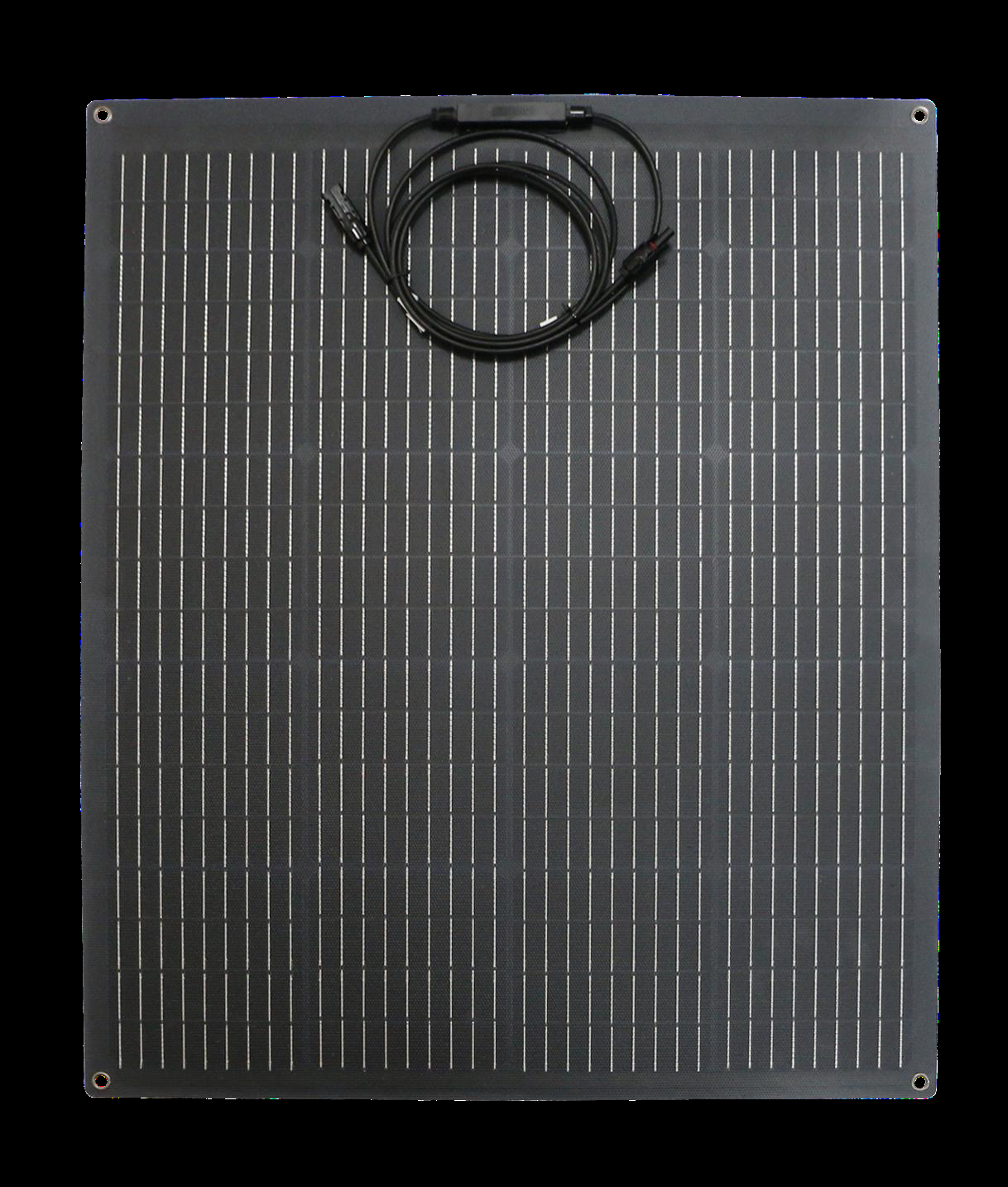
Flexible monocrystalline panels are the default for curved RV and yacht roofs because they bond or hang close to the surface. The DS-series in this range uses A-grade 5 busbar mono cells, and the junction box is fully filled with glue for rain sealing. Eyelets are provided for hanging and installation, so the same panel can be bonded to a roof or suspended from a rail or awning frame.
Three wattages are available in this construction line: the 100W DS100F flexible solar panel, the 170W DS170F flexible solar panel and the 300W DS300F flexible solar panel. For a dealer standardising one roof panel across a model range, the 170W class is usually the volume item; the 300W class suits longer coaches where roof real estate allows a single larger footprint.
Foldable panels for rental and multi-vehicle fleets
Where the panel has to move between vehicles or be stowed when the coach is in storage, a foldable unit makes more sense than a bonded one. The 100W DSF100C foldable solar panel carries USB output, TYPE-C, a DC 5521 18V output and MC4 connectors. That connector set matters for outfitters: MC4 lets the panel feed a power station's solar input, while the DC 5521 and USB ports serve accessory charging without touching the main battery.
Matching panel format to the sales channel
| RV scenario | Panel format | Why |
|---|---|---|
| Curved fibreglass or aluminium coach roof | Flexible (100W / 170W / 300W) | Conforms to the curve; glue-filled junction box for weather sealing; eyelets for mounting |
| Flat utility trailer or toy hauler roof | Rigid fixed module | Flat surface takes framed hardware; confirm frame and mounting spec with the supplier |
| Rental fleet, loan units, demo coaches | Foldable (DSF100C) | Portable between vehicles; MC4 plus DC 5521 and USB outputs |
| Dealer add-on accessory sale | Foldable or 100W flexible | Low-friction attach to an existing power station purchase |
Wattage steps that match RV usage patterns
Buyers often ask for a single “right” wattage. The honest answer is that wattage follows the daily energy budget, and the array voltage follows the panel count. For capacity sizing itself, the method is already set out in how to select the right size portable power station for your needs; this section only covers which panel step corresponds to which RV duty cycle.
- Single 100W flexible or foldable panel. Suits weekend coaches and rental units where solar is a maintenance charger for the house battery and a top-up for phones and small accessories.
- Single 170W flexible panel. The pragmatic middle step for a dealer standard-fit: more headroom than 100W on the same roof area class, without changing the mounting method.
- Single 300W flexible panel or two mid-size panels. Fits full-time and long-stay coaches where the array is expected to carry a meaningful share of daily consumption rather than just maintain the battery.
- Foldable plus fixed combination. Some outfitters ship a bonded roof panel for the base load and a DSF100C as a portable supplement for shaded pitches. The two arrays must be checked together against the power station's input limits.
When the daily load is unknown, do not guess a watt-hour figure into a quotation. Ask the buyer for the appliance list and run time, or write the array step as “confirm with the supplier” until the load schedule arrives.
Pairing panels to power stations by MPPT input window
This is where RV kits fail in the field. A panel array that looks good on a spec sheet can sit outside the station's input window once series voltage is counted at low temperature, or can exceed the current ceiling when panels are paralleled. The voltage-window arithmetic itself is covered in solar panel and MPPT matching for a portable power station and is not repeated here. What follows is the RV-specific pairing logic.
The BP2400 window
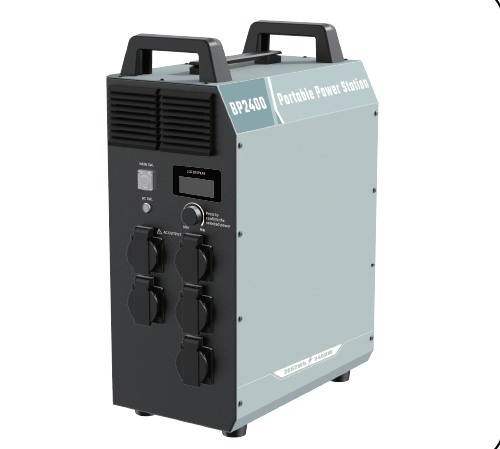
The BP2400 smart mobile power portable power station uses a 2662Wh LiFePO4 pack with 2400W rated and 4800W peak pure sine wave output (THD under 3%). Its built-in 1200W MPPT accepts 12–105VDC at 25A maximum, and solar charging tops out at 1200W with a full charge in 2.5 hours. The unit is rated IP53 with an IP66 battery pack, carries CE, RoHS and UN 38.3 documentation, and has a 5-year warranty. UPS switchover is under 10ms.
For RV work the 105VDC ceiling is the operative number. It supports multi-panel series strings comfortably, but the 25A current limit means parallel strings need checking against panel current, not just total wattage. A configuration worth quoting to dealers: one 300W flexible roof panel as the base array, with a DSF100C available as a portable supplement, provided the combined string is verified against both the voltage ceiling and the current limit.
The EP5000iL window
The EP5000iL smart mobile power station carries a 3430Wh LiFePO4 pack with 5000W rated and 10000W peak output. Its solar MPPT input accepts 12–150VDC at a maximum of 1600W, with about 2.5 hours to full on solar. It shares the under-10ms UPS switchover, IP53 unit and IP66 battery pack ratings, and the 5-year warranty.
The 150VDC ceiling and 1600W solar ceiling open up larger roof arrays. This is the unit for coach builders fitting two or three flexible panels in series, or for fleet outfitters whose vehicles carry high continuous loads. The wider voltage headroom also makes it more forgiving of cold-morning open-circuit voltage rise than a lower-ceiling unit, though the exact cold-condition voltage must still be confirmed against the panel datasheet.
Pairing summary for RFQ discussions
BP2400: 12–105VDC, 25A max, 1200W solar ceiling. Suits mid-size RV arrays and single-panel-plus-portable layouts.
EP5000iL: 12–150VDC, 1600W max solar. Suits multi-panel roof arrays and high-draw fleet vehicles.
| Power station | Battery | Output rating | MPPT solar input | Best-fit RV array |
|---|---|---|---|---|
| BP2400 | 2662Wh LiFePO4 | 2400W rated / 4800W peak | 12–105VDC, 25A max, 1200W ceiling | Single 300W roof panel, or 170W roof panel plus DSF100C supplement |
| EP5000iL | 3430Wh LiFePO4 | 5000W rated / 10000W peak | 12–150VDC, 1600W max | Two to three flexible roof panels in series; fleet vehicles with high continuous loads |
Where expansion changes the pairing
Dealers who expect the customer to add storage later should plan the array around the expanded system, not the initial one. Capacity expansion behaviour and what the buyer must confirm are covered in extra battery pack expansion for portable power stations. The RV-specific consequence is simple: if a coach is likely to grow from a BP2400 to a larger bank, the roof panel array should already sit inside the wider input window rather than being sized tightly to the first unit.
RFQ checklist for dealers, outfitters and distributors
These are the items that, when missing from an enquiry, delay quotation or produce a kit that has to be re-specified.
- Roof construction and curvature for each coach model in the range; this decides flexible versus rigid panel format.
- Whether panels are bonded, hung from eyelets, or carried loose; the DS-series eyelets support hanging and installation, but the mounting method should be stated in the RFQ.
- Panel wattage step per model and the number of panels per roof.
- Intended power station model, and whether the array will be series or parallel.
- Connector specification: MC4 is standard on the DSF100C; state the required connector on flexible panel orders and confirm with the supplier.
- Documentation package required per market, including CE, RoHS and UN 38.3 for the power station side.
- Whether private label, packaging or connector customisation is required, and at what order volume; OEM and ODM terms should be confirmed with the supplier per project.
- Warranty expectations: power stations in this range carry a 5-year warranty; panel warranty terms should be requested explicitly.
Putting the chain together
A workable RV solar programme reads in one direction: mounting surface sets panel construction, duty cycle sets wattage step, wattage and panel count set array voltage and current, and the power station's MPPT window either accepts that array or does not. The BP2400 covers mid-size single-panel and panel-plus-portable layouts within 12–105VDC; the EP5000iL covers larger series roof arrays within 12–150VDC and 1600W. Where a specification, certificate or customisation requirement is not answered above, state it in the enquiry rather than assuming it, and the supplier can confirm it against the exact model and market.
Send your coach model list, roof type, panel wattage step and intended power station to the supplier's sales team, and ask for a configuration sheet with connector, documentation and OEM terms itemised per SKU.