
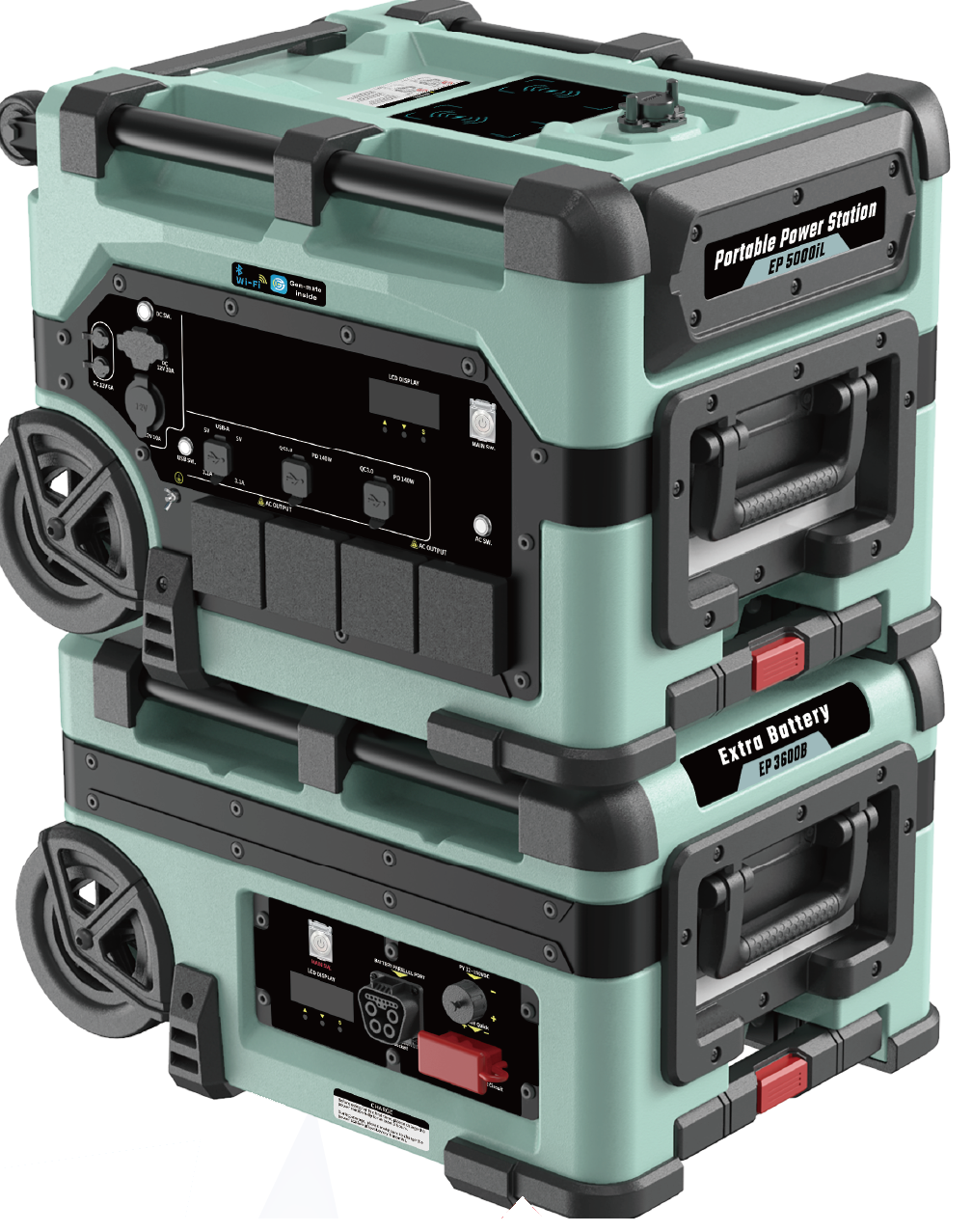
A capacity-step planning method for extra battery pack expansion on portable power stations. It shows how each step up in storage changes the order, when moving up a step beats adding another pack, and the confirmation checklist buyers work through before a supplier can quote.
Capacity planning guide
Most buyers start a portable power station project with one capacity figure in mind, then discover that extra battery pack expansion is not a single purchase but a sequence of capacity steps. Each step changes how many packs you need, how the host station is configured, and what the supplier has to confirm before a quotation can be issued. This guide sets out that sequence and the questions that decide each step.
Key takeaways
- Extra battery pack expansion is planned in steps: base host station, first battery packs, next step up, top of the ladder.
- The jump from one step to the next is decided by output requirements and headroom, not by pack count alone.
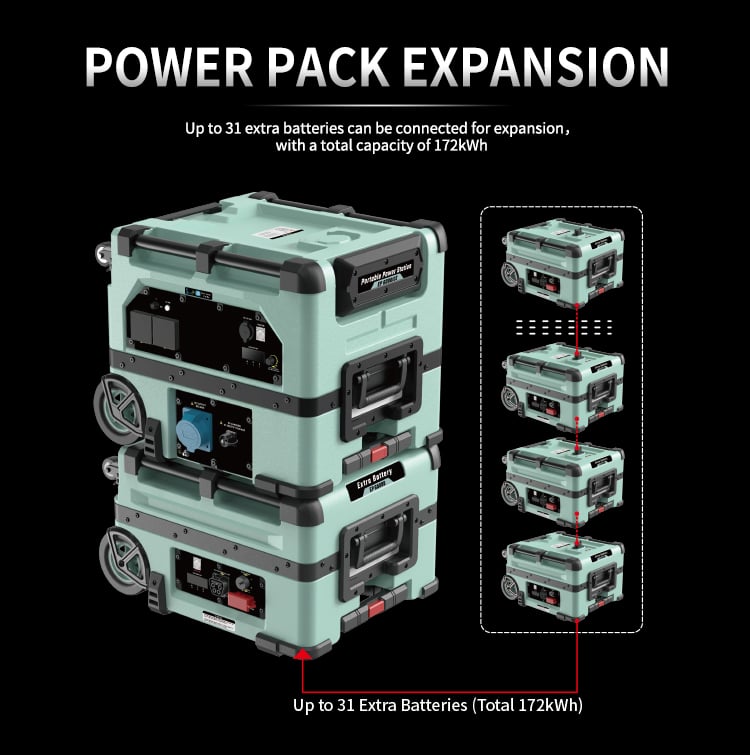
- Supported expansion reaches up to 31 extra battery packs, with system totals of 109kWh, 172kWh or 372kWh depending on the host model.
- Several order details depend on answers only the supplier can give, so the confirmation checklist should be completed before you ask for a quotation.
What this article covers
What the capacity steps actually are
An external battery pack in a power station system is an extra battery pack that connects to the station host to add storage. It is not a phone power bank and it is not a standalone product with its own inverter; it extends the capacity of the host it is matched to. Buyers who search what is external battery pack usually want that distinction first, because the answer determines everything downstream: which host model can accept the pack, how many packs the host supports, and what the combined system total becomes.
A portable battery pack, in the same context, is the same class of add-on storage sold as a repeatable unit. That repeatability is the whole point. Instead of buying one very large station, a buyer can start with a host and a small number of packs, then repeat the pack purchase as load grows. So when buyers ask what is a portable battery pack in a power station context, the practical answer is that it is a unit of expansion rather than a separate power source.
That is why extra battery pack expansion is best read as a ladder of capacity steps. The steps below come from currently documented configurations and represent the real levels the ordering conversation moves through.
| Step | Scale of expansion | Total system capacity | What changes in the order |
|---|---|---|---|
| Step 0: base host | No extra battery packs | Host capacity only, for example 2496Wh, 2662Wh, 3430Wh, 5376Wh or 7680Wh | Single unit, no pack compatibility to confirm |
| Step 1: first battery packs | A small number of packs on one host | Host capacity plus pack capacity | Pack model, cable set and connection order must be confirmed |
| Step 2: next step up | More packs on the same host, approaching a documented ceiling | Up to 109kWh total on the models with that ceiling | Whether the host, not the pack count, now becomes the limit |
| Step 3: top of the ladder | Full documented expansion on the largest host | 172kWh or 372kWh total depending on host model | A different host model is now part of the order, not more packs |
The number of packs supported is documented as up to 31 extra battery packs across the expanded models. The total system capacity differs because the host platform differs, which is the first signal that this is a step decision and not a spare-parts decision.
How to size capacity in four steps
Capacity-step planning starts from the load side. Work through the four steps in order, and stop at the first step that already satisfies the requirement with some headroom. The purpose of the method is to avoid ordering packs you will not use and to avoid ordering a host that cannot reach the required total.
Step one: fix the base host
The host sets the output ceiling and the expansion ceiling. In the DP2400iL portable power station, the base is 2400VA rated and 4800VA peak with 2496Wh of LiFePO4 storage, and two units can be connected in parallel to double output. That makes it a sensible first step where the load is moderate and the plan is to expand storage rather than output.
Step two: add the first battery packs
Once the host is fixed, the first packs set the shape of the order: the pack model, the quantity, and how the packs connect. Expansion is repeatable, so most buyers begin with a small count and treat the first packs as the minimum viable expansion. For a mid-size base, the DP3600iL portable power station gives 3600VA rated and 7200VA peak on 2662Wh, with a built-in 1200W MPPT controller and the same up-to-31-pack expansion path.
Step three: scale the pack count toward the documented ceiling
This is where buyers need to watch two limits at once. The first is the host ceiling: whether the host can still be the anchor at the total you want. The second is where the system total stops matching the host family. Models documented at up to 109kWh total and models documented at 172kWh or 372kWh total are not interchangeable in a single order, even though the pack count figure of up to 31 appears in each case.
For mobile requirements, the EP3600iL high-power mobile power station carries 3600VA rated and 7200VA peak on 3430Wh with a four-wheel chassis and large-diameter rollers, and it follows the up-to-31-pack path to a 109kWh documented total. The EP5000iL smart mobile power station also sits on 3430Wh, with 5000W continuous and 10000W peak, expansion listed as up to 31 EP3600B extra batteries for 109kWh total, and UPS transfer time of 10ms or less. If the site needs uninterrupted transfer, that transfer figure belongs in the step-three decision, because it constrains the host choice rather than the pack count.
Step four: decide whether the top of the ladder is required
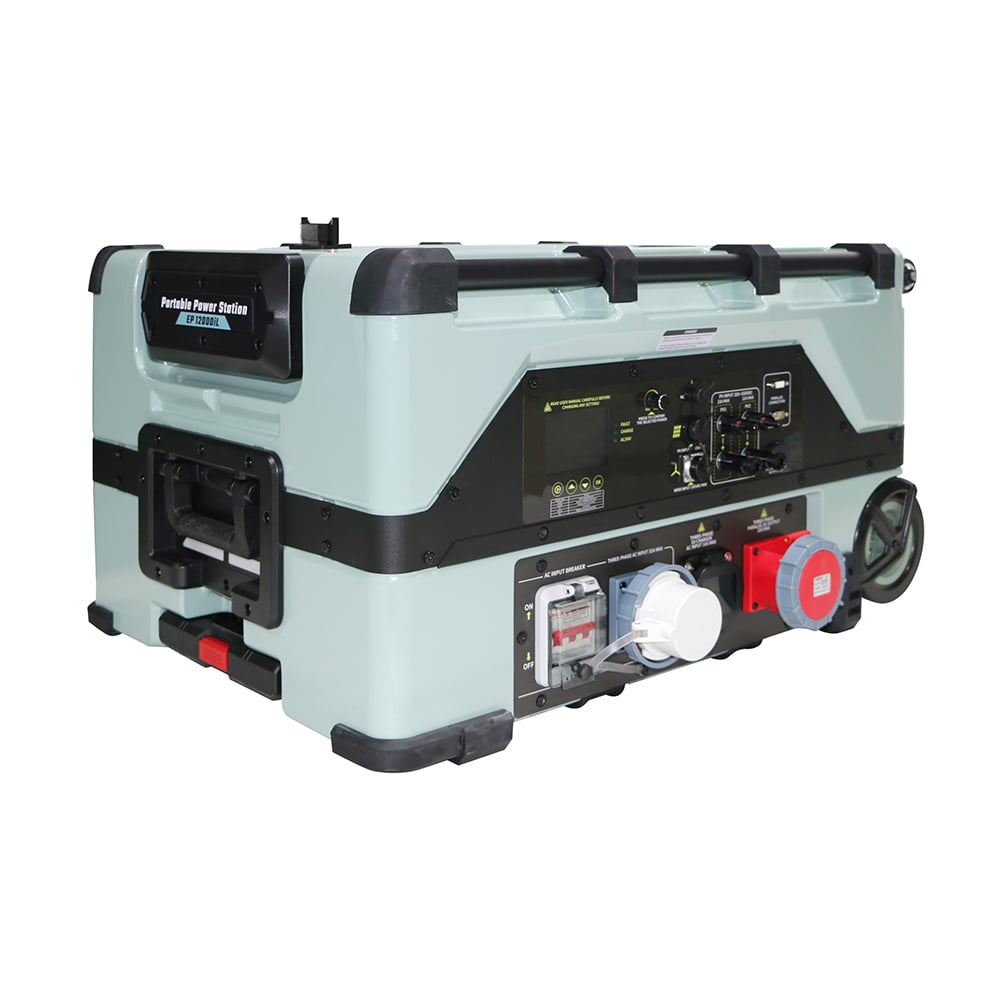
At the top, the host changes. The EP12000iL flagship high-power mobile power station is rated 12000VA with 24000VA peak on 7680Wh, supports stacking and parallel continuous output of 24kW, and reaches a documented 372kWh total across up to 31 extra battery packs. The EP6000iLS high-power mobile power station covers the middle of the top end at 6000VA rated and 12000VA peak on 5376Wh with a 172kWh documented total, and the DP6000iL portable power station offers 6000VA rated and 12000VA peak on 5376Wh toward the same 172kWh total. If your calculated requirement already fits a lower step, the top of the ladder is not the automatic choice.
When moving up a step beats adding one more pack
Adding one more pack is the cheaper-looking move, but it is only correct while the host is still the right anchor. Use these tests in order.
- Output test. If the required continuous output is already at or near the host rating, another pack adds storage but not output. At that point the step change is a host change. The EP5000iL illustrates the pattern: two units in patented parallel stacking give 10kW continuous output with no extra parallel kit, which is a different order shape from stacking packs on one host.
- Total-capacity test. Compare the requirement against the documented system total for the host family. If the required total sits closer to 172kWh or 372kWh than to 109kWh, the lower step cannot be fixed with more packs.
- Continuity test. Where the load cannot tolerate a transfer gap, the 10ms or less UPS transfer figure on the EP5000iL is a host-level property. No additional pack changes it.
- Charge-window test. Where the duty cycle is defined by how quickly the system returns to full, the host is the deciding component. The EP6000iLS is documented at 90% charge in one hour.
- Environment test. Where the site imposes enclosure requirements, the host and pack ratings are fixed per product, not improved by count. The EP5000iL is documented at IP53 for the unit and IP66 for the battery pack, with RoHS, CE and UN 38.3 certification.
- Order-complexity test. Every pack added above the documented ceiling forces a host change anyway. Moving up a step before that point keeps the order in one configuration instead of two.
Where a test falls between two documented values, write the requirement as a range and confirm the exact figure with the supplier. Do not close the gap with an assumed number.
The buyer confirmation checklist before quoting
The capacity steps tell you what to aim for. The checklist tells you whether the supplier can actually quote that configuration. Each item below states what to ask, which answer changes the decision, and what it changes in the order.
| Confirmation item | What to ask | The answer that matters | What it changes in the order |
|---|---|---|---|
| Host and pack pairing | Which extra battery pack model matches the host I selected? | The named pack model for that host, such as EP3600B for the EP5000iL | Whether the pack line is valid at all |
| Documented expansion ceiling | How many extra battery packs does this host support, and what total does that give? | Up to 31 packs, with the total stated for that host family | Which capacity step the order belongs to |
| Output requirement | Does the required continuous output sit inside the host rating? | A rating above the requirement, or a plan to parallel two units | Host step, and whether parallel connection is part of the order |
| Connection and cable set | What connection hardware and cable set ships with the packs? | The exact supplied items for that configuration | Whether a separate connection item must be added |
| Parallel behavior | Is parallel connection supported on this host, and does it need extra hardware? | Whether configuration alone enables it | Whether the order needs a second host or an additional kit |
| Transfer and protection | What transfer time and enclosure ratings apply to the host and the pack? | Stated figures per product, for example 10ms or less and IP53 or IP66 | Host step where continuity or environment is the deciding factor |
| Certification documents | Which certification documents accompany this configuration? | The certification list applicable to the named models | Whether the configuration can clear your own import requirement |
| Warranty terms | What warranty term applies to host and packs? | The stated term for the models in the quotation | Comparison of steps on equal terms |
| Rest of the requirement | What else must be fixed before a firm quotation? | Whatever the supplier still lists as open | Whether the quotation can be issued now or later |
Two product-level points are worth confirming with the supplier rather than assuming. The EP5000iL is documented at UPS transfer time of 10ms or less and at IP53 for the unit and IP66 for the battery pack, with RoHS, CE and UN 38.3 certification. On the flagship EP12000iL a built-in 22kW EV charger is part of the unit, which changes the electrical layout of the order rather than the pack count. Where any figure affects your acceptance criteria, confirm the exact figure with the supplier.
DRIVELONG is a Suzhou, China based manufacturer of portable power stations and solar products supplying OEM and ODM to buyers in Europe, North America, South America, Australia, Singapore, Russia and the Middle East, with 19+ years of power generation experience, and states EU and US certification. Host and pack models in this range carry a 5-year warranty. Buyers working from an existing specification often need one extra step: send the load requirement and the target step, and ask for the configuration to be confirmed against it.
FAQ
What is an external battery pack in a power station system?
It is an extra battery pack that connects to the station host to add storage; it does not replace the host. On the models documented here, the host accepts up to 31 extra battery packs, and the available system total depends on the host family rather than the pack alone, with documented totals of 109kWh, 172kWh and 372kWh.
What is a portable battery pack in the same context?
It is the repeatable add-on storage unit for the host, sold in quantities rather than as a one-off accessory. The pack model must match the host, for example the EP3600B pack for the EP5000iL host. Both host and pack are documented product items, and pairing is confirmed model by model.
How far can capacity be expanded?
Expansion is documented as up to 31 extra battery packs, which reaches a 109kWh total on the models with that ceiling and 172kWh or 372kWh on the larger host families. The deciding factor is the host model, not the number of packs alone, so the required total should be matched to a host family before the pack count is fixed.
Do I need a product-selection framework before requesting a quote?
No. The practical order of work is to fix the capacity step, then complete the confirmation checklist. Once the host model, the required pack count and the answers on connection, parallel behavior, transfer, protection and certification are settled, the supplier has what it needs to confirm the configuration.
Start from the step your requirement actually reaches, then request the configuration and quotation for that step. Include the host model you have in mind, the required pack count, the continuous output the site needs, and any site condition such as enclosure or transfer continuity, so the configuration can be checked against documented limits before the quotation is prepared.