
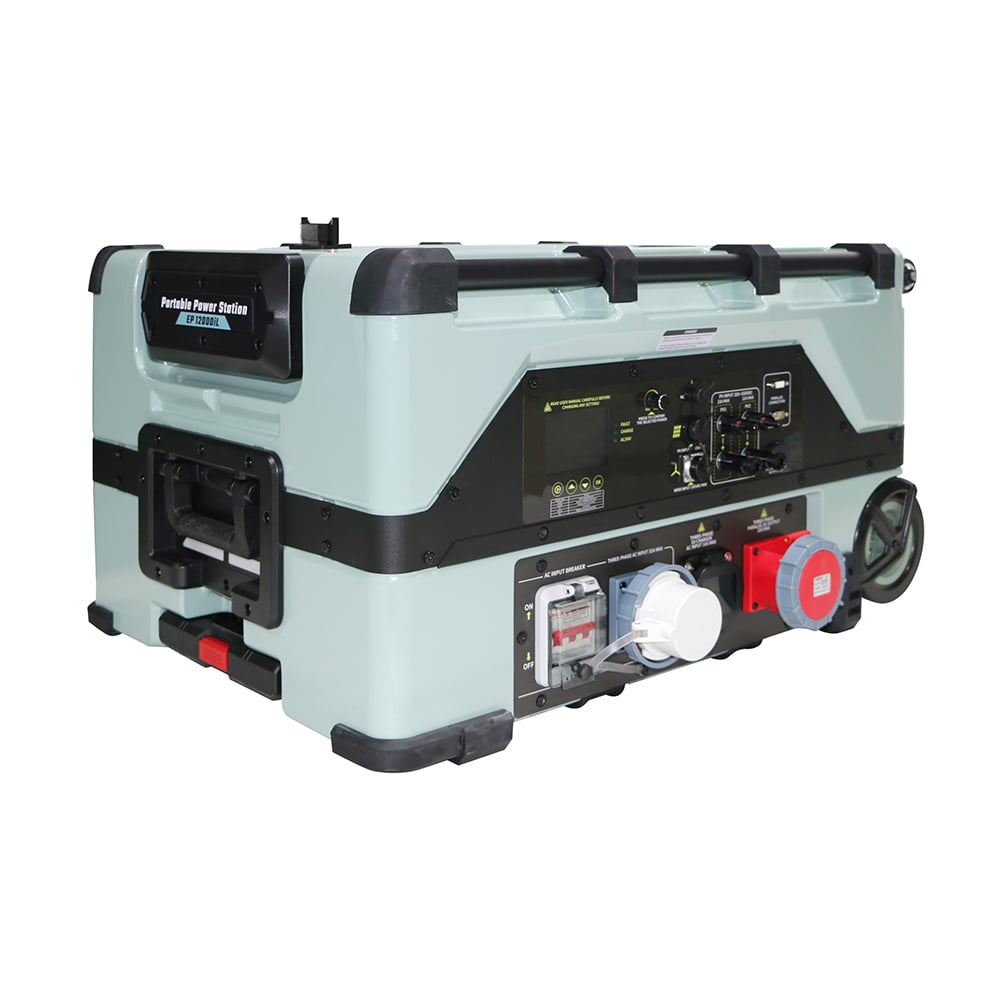
A 50 amp RV outlet is a 120/240V split-phase service, not a larger 120V socket. This article sets out the three hardware conditions a portable solar power station must meet — split-phase output, continuous capacity against the roughly 12 kVA a 50A service can deliver, and surge headroom for motor loads — then maps two DRIVELONG platforms against them and closes with the questions to put in an RFQ.
A 50 amp rv outlet does not work like the 30 amp connection most portable power buyers already understand. A North American 50A RV pedestal is a 120/240V split-phase service: two 120V legs, a shared neutral and a ground. The two legs add up to roughly 12 kVA at 50A × 240V, and each leg can carry about 6 kW on its own. A solar power station that only produces a single 120V output cannot feed that connection, however large its battery is.
So the question a distributor, OEM buyer or rental operator should be asking is not "how many watts does it have" but "does it deliver split-phase 240V at a continuous rating I can match to the coach's load list, with enough surge headroom for the compressor starts." This article sets out the three hardware conditions that answer it, then compares two DRIVELONG platforms against them. Load-budget arithmetic for the single-phase case is covered in the 30A load-budget companion piece; this article stays on the 50A hardware question.
Key takeaways
- A 50A RV outlet is split-phase 120/240V, carrying up to about 12 kVA in total and about 6 kW per 120V leg.
- A solar generator for 50 amp RV service must output 240V split-phase, not a single 120V leg.
- Continuous rating is the real constraint: the EP12000iL delivers 10kW split-phase continuous, below full pedestal loading, so the load list must be matched and confirmed.
- Surge capacity for motor starts is a separate specification from continuous wattage and should be confirmed as a duration, not just a headline peak.
Why the 50A outlet changes the requirement
A 30A RV connection in North America is typically a single 120V feed. One live conductor and a neutral, roughly 3.6 kVA at 30A × 120V. A portable station with a 120V outlet can, in principle, be wired to that. The 50A connection is a different animal. The pedestal presents two hot legs that are 180 degrees out of phase, and the appliances inside the coach are split across them. A 240V air conditioner or dryer sees the full 240V between the legs, while the 120V branch circuits see one leg each.
Feed that connection with a single 120V source and most of the coach stays dark. That is the practical reason the 50A case is a hardware question first and a capacity question second. Buyers who compare solar generators on total watt-hours alone will shortlist units that cannot physically connect to the pedestal they are meant to replace.
Condition one: split-phase 240V output
The station must present a split-phase output: 120/240V with both legs available simultaneously and a neutral that returns the imbalance. Output topology, not battery size, is the gate. A unit that lists 240V output as a marketing line without confirming the split-phase arrangement (two legs plus neutral) should be treated as unconfirmed until the supplier states the rated voltages and the neutral arrangement.
One point that matters at full load is leg balance. A split-phase source has to hold both 120V legs within tolerance while the coach draws unevenly across them — which is normal, since branch circuits are rarely symmetric. Whether both legs stay balanced at full rated split-phase load is a question for the supplier, not an assumption to carry into a quotation.
Condition two: continuous wattage against the service
The service arithmetic is straightforward: 50A × 240V gives about 12 kVA of total available capacity, and 50A × 120V gives about 6 kW on either single leg. A solar generator does not have to match 12 kVA to be useful, but the buyer needs to know where the unit sits relative to that ceiling, because it determines which loads can run together.
Here the honest position matters. The EP12000iL is listed at a 12000VA rating, and the continuous figure that governs a 50A comparison is its 10kW split-phase output — below full-pedestal loading. Its single-phase continuous figure is 11kW and its three-phase figure is 12kW, so the split-phase configuration is the lowest of the three and the one that governs RV service. That is not a defect; it is the figure a buyer must plan against. If a coach's simultaneous load list exceeds 10kW, the station will not carry it at once, and the load list has to be managed or the requirement reconsidered.
| Condition | What the buyer needs to establish | Why it decides the purchase |
|---|---|---|
| Split-phase output | 120/240V with two legs and a neutral, both legs live at once | A single 120V output cannot feed a 50A pedestal connection |
| Continuous capacity | Rated continuous split-phase kW versus the ~12 kVA service and the coach's simultaneous load list | Determines which appliances can run together and for how long |
| Surge headroom | Peak rating plus the sustained overload duration in seconds or minutes | Motor starts (compressors, pumps) draw far above running current |
Condition three: surge headroom and overload duration
Air conditioner compressors and pumps pull a starting current several times their running current for a short period. A peak wattage figure tells the buyer the ceiling of that capability; it does not tell them how long the unit will hold it. The duration of the surge or sustained overload — expressed in seconds or minutes — is what determines whether a compressor start trips the unit or rides through.
This is a specification to request explicitly. Two units can list the same peak figure and behave very differently across a 240V compressor start. For fleet and rental operators, it also sets the operating procedure handed to the end user: which appliances start first, and what sequence avoids stacking two motor starts on the same leg.
Mapping two DRIVELONG platforms to the three conditions
The two models below sit at different points on the capacity ladder and are best read as two different answers to the 50A question rather than as a good/bad pair.
EP12000iL — high-capacity split-phase platform
The EP12000iL carries a 7680Wh LiFePO4 battery, a 12000VA rating and a 24000VA peak. Its continuous output is 12kW three-phase, 11kW single-phase and 10kW split-phase. Parallel output reaches up to 24kW, and the battery is expandable with up to 31 extra packs to 372kWh in total. It includes a built-in 22kW EV charger, charges fully in about 70 minutes, and carries a 5-year warranty.
Against the three conditions: split-phase output is confirmed in the continuous ratings; the 10kW split-phase continuous figure sits below the roughly 12 kVA a full 50A service can carry, so a coach with a heavy simultaneous load list needs its loads matched rather than assumed; and the 24000VA peak provides surge headroom whose duration should be confirmed in the RFQ. The 12000VA rating and the per-configuration continuous figures appear as separate entries in the product record; this article plans against the split-phase continuous value.
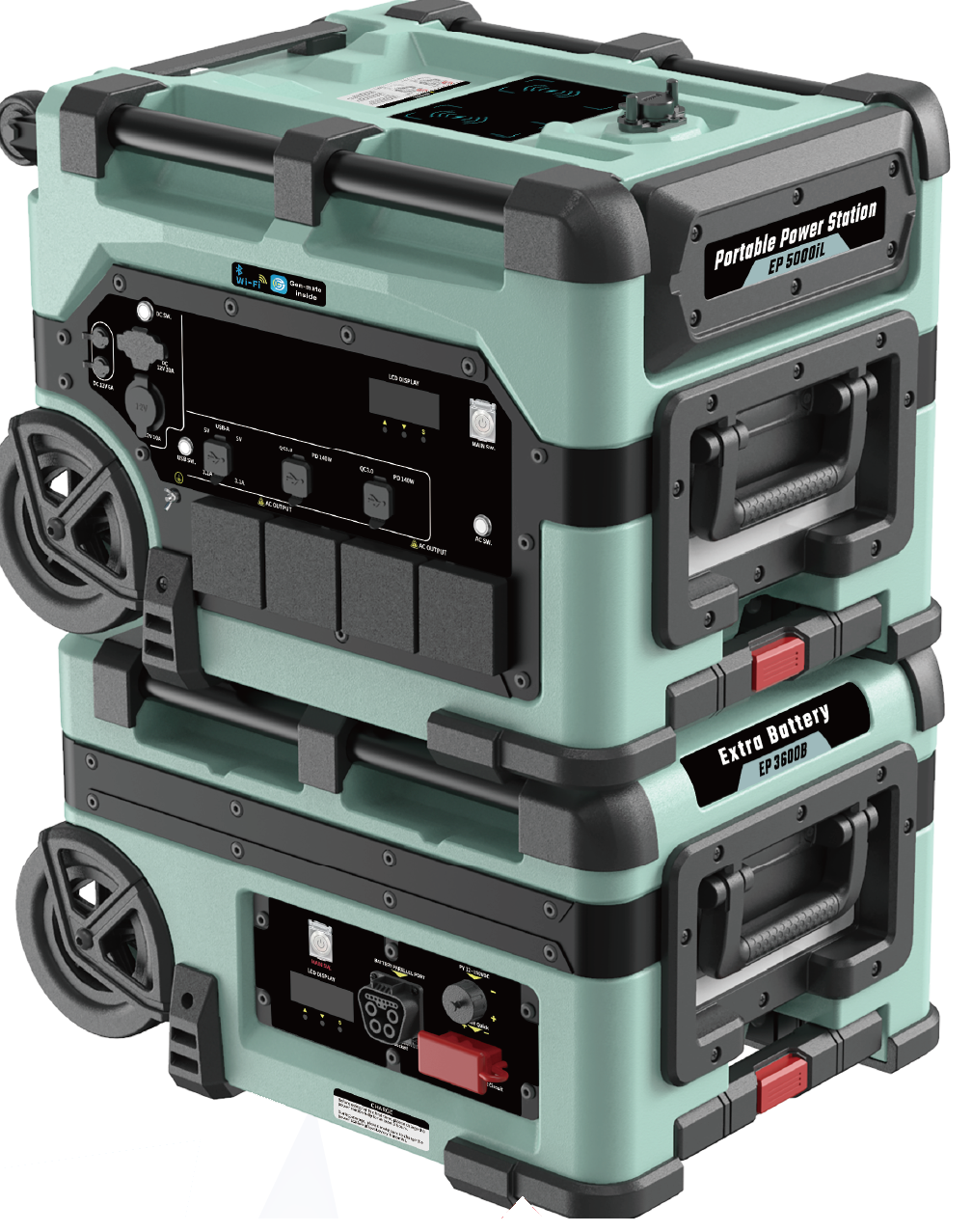
EP5000iL — modular, stackable platform
The EP5000iL is the smaller unit: a 3430Wh LiFePO4 battery (51.2V 67Ah, 5000+ cycles to 80% capacity), 5000W continuous and 10000W peak, pure sine wave with THD under 3 percent. Its split-phase rated voltages are listed as 100/200V, 110/220V and 120/240V. Two units can be stacked in a patented parallel arrangement for 10kW continuous without an extra parallel kit, and the battery can be expanded with up to 31 EP3600B extra packs to 109kWh. AC charging is 3000W single-phase in about 1.2 hours or 1700W split-phase in about 2 hours; solar MPPT input accepts 12–150VDC up to 1600W, full in about 2.5 hours. UPS transfer time is 10ms or less; the unit is IP53 and the battery pack IP66; discharge range is −20 to 60 °C and charging range 0 to 45 °C. Dimensions are 555 × 430 × 420mm at 49kg, with RoHS, CE and UN 38.3 certification and a 5-year warranty. The built-in EV charger can replace a 7kW charging pile when two units are stacked.
Against the conditions: a single unit's 120/240V split-phase rating is listed, but a single unit's continuous capacity is far below the 50A service ceiling; stacked in pairs it reaches 10kW continuous, which is the configuration relevant to a 50A workload. Peak is 10000W per unit, and again the sustained overload duration is an RFQ item. One gap to flag: the product record lists the split-phase rated voltages but does not state a single-unit continuous output at 120/240V, so whether one unit alone can carry part of a 50A service, and at what continuous rating, is an additional item for the RFQ. For fleet buyers the stacking architecture is the practical advantage — inventory can be sized in modules and paired at the point of use, with the 109kWh battery ceiling supporting longer off-grid duty.
| Specification | EP12000iL | EP5000iL |
|---|---|---|
| Battery | 7680Wh LiFePO4 | 3430Wh LiFePO4 (51.2V 67Ah, 5000+ cycles to 80%) |
| Rated power | 12000VA | 5000W continuous |
| Peak power | 24000VA | 10000W |
| Continuous output | 12kW three-phase / 11kW single-phase / 10kW split-phase | 5000W single unit; 10kW continuous with two units stacked in parallel |
| Split-phase voltages | Split-phase output confirmed in continuous ratings | 100/200V, 110/220V, 120/240V |
| Capacity expansion | Up to 31 extra battery packs, 372kWh total | Up to 31 EP3600B packs, 109kWh total |
| Parallel output | Up to 24kW | Two units, 10kW continuous, no extra parallel kit |
| Charging | Full charge in about 70 minutes | AC 3000W single-phase ~1.2 h or 1700W split-phase ~2 h; solar MPPT 12–150VDC up to 1600W, full in ~2.5 h |
| Other features | Built-in 22kW EV charger | UPS transfer ≤10ms; built-in EV charger can replace a 7kW charging pile when stacked; IP53 unit / IP66 battery; −20 to 60 °C discharge, 0 to 45 °C charging; 555 × 430 × 420mm, 49kg |
| Certification | Not stated in the product record; confirm scope with the supplier | RoHS, CE, UN 38.3 |
| Warranty | 5 years | 5 years |
Capacity expansion and what it buys the buyer
Both platforms scale the battery rather than the power stage: the EP12000iL to 372kWh across up to 31 extra packs, the EP5000iL to 109kWh across up to 31 EP3600B packs. For a rental fleet this changes inventory logic. Runtime can be extended per deployment by adding packs rather than by buying another power station, while the number of inverters in the field stays tied to the number of simultaneous jobs.
The distinction to keep clear is between energy and power. Extra battery packs extend how long a given load runs; they do not raise the continuous kW ceiling. A coach whose load list exceeds the split-phase continuous rating will not be fixed by a larger battery bank, only by load management or a parallel configuration.
What to put in the RFQ
Four items close the gap between a catalog listing and a specification a buyer can quote against. Each is a question to the supplier; the answers belong in the quotation, not in an assumption.
- Receptacle and wiring configuration. Does the unit offer a NEMA 14-50 style outlet or a specific wiring configuration for the target market, and what exactly is supplied? This is market-dependent and should be stated per destination.
- Surge and sustained overload duration. How many seconds or minutes will the unit hold its peak or an overload condition before protection engages? This is the figure that predicts motor-start behavior.
- Leg balance at full split-phase load. Do both 120V legs stay within tolerance when the split-phase output is loaded to its continuous rating with an uneven draw across the legs?
- Certification scope. What certification status applies beyond what each model record already lists — for which model, which market and which certificate scope?
Note that this article does not state that either unit ships with a NEMA 14-50 outlet; that is precisely the first confirmation item. Nor should the continuous split-phase figure be read as full-pedestal replacement capacity. The EP12000iL's 10kW split-phase continuous rating is below the roughly 12 kVA a 50A service can carry, and buyers should match their real load list to that figure and confirm the match with the supplier before committing to a program.
Choosing between the two
Where a coach's simultaneous load list fits inside 10kW split-phase, the EP12000iL answers the 50A question in a single enclosure, with parallel output to 24kW available if a fleet later needs more. Where loads are smaller or deployments are dispersed, the EP5000iL offers module-level inventory: single units for lighter duty, paired stacking for 10kW continuous, and battery expansion to 109kWh for long off-grid stretches. The 50 amp rv outlet requirement is met in both cases only once the supplier confirms the four RFQ items above.
Send your 50A load list for a specification match
Share the coach or fleet load list, the target market and the receptacle convention you need, and we will confirm which configuration fits — including the surge duration, leg balance and certification scope answers for the models you are evaluating.