
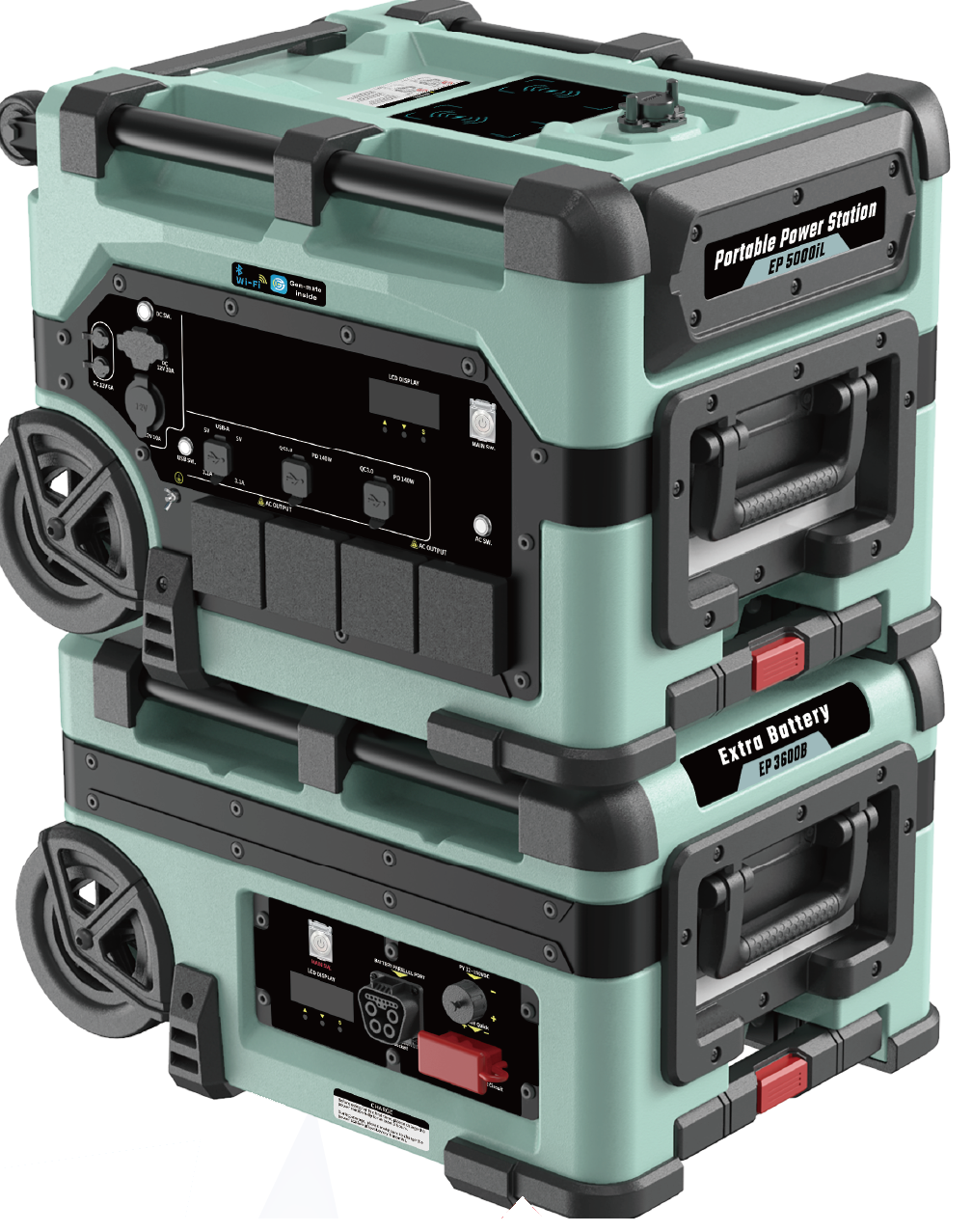
What is the best external battery pack for a portable power station? The answer depends on whether you are short on stored energy (kWh) or short on output (kW). This article compares stacking extra battery packs against paralleling two units across the EP5000iL, DP2400iL and EP12000iL, and explains where to source matched expansion packs for commercial and OEM/ODM projects.
Portable power station capacity
A distributor or integrator scaling a portable power station usually starts by asking what the best external battery pack is. The more useful starting point is whether the installation is running out of energy (kWh) or running out of power (kW), because those two limits are solved by two different changes.
In this article
Stacking extra battery packs raises stored energy in kWh; it does not raise the kW ceiling of the inverter. Paralleling two units raises the kW ceiling. On the DRIVELONG platform, EP5000iL and DP2400iL each expand with up to 31 extra batteries to 109kWh total, and EP12000iL stacks up to 31 extra batteries to 372kWh total. Two EP5000iL units in AC parallel give 10kW max with no parallel kit needed.
Stacking and Paralleling Are Two Different Changes
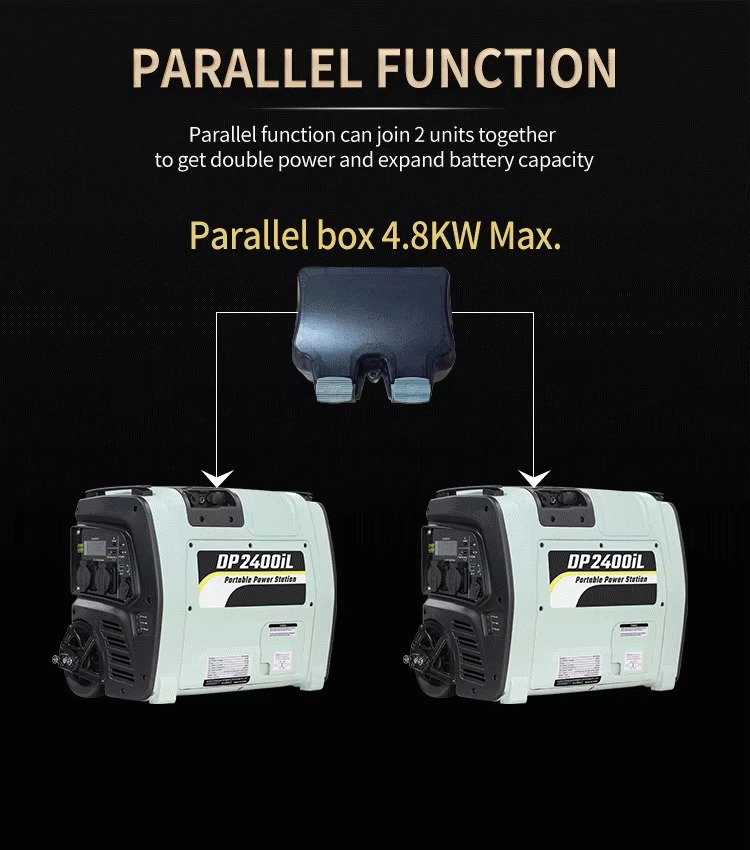
An extra battery pack connects to the station's expansion port and joins the same inverter. A second station connected in parallel brings its own inverter and its own battery into the same output stage. One adds a reservoir, the other adds a pump. That is the whole structural difference, and it decides which figure moves.
| Change | What it increases | What stays the same | Model that supports it |
|---|---|---|---|
| Stacking extra battery packs | Stored energy in kWh | Rated output of the main unit in this mode | EP5000iL, DP2400iL, EP12000iL |
| Paralleling two units | Available output in kW (VA on DP2400iL) | Stored energy of each unit unless packs are added | EP5000iL, DP2400iL, EP12000iL |
Both changes can be combined. A site can stack packs for runtime and parallel a second unit for headroom, which is why the two routes are compared rather than treated as substitutes.
What Extra Battery Pack Expansion Adds: Energy
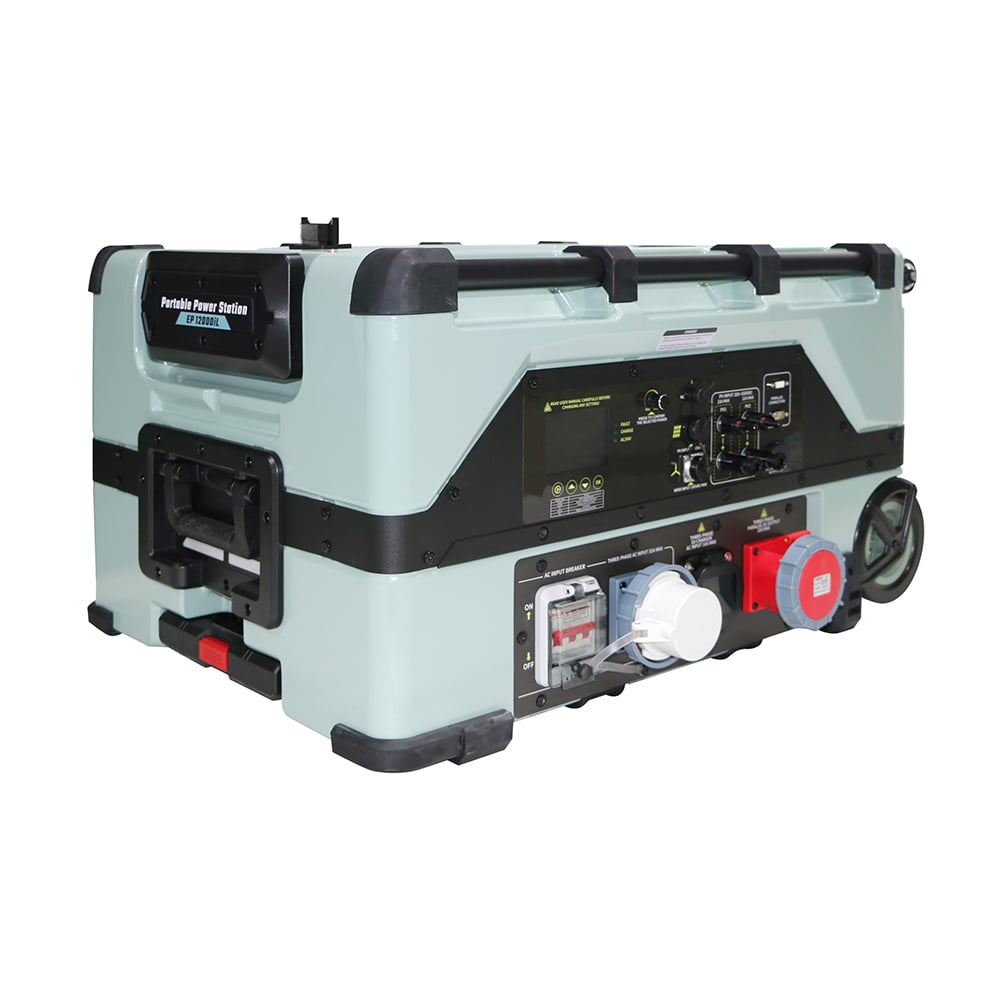
Stacking extra packs into a station raises the total stored kWh. The inverter still has the same kW rating in this mode, and the main unit's rated output is unchanged, so the gain shows up as runtime under the existing load rather than as new headroom.
The expansion figures across the platform are as follows:
- EP5000iL: 3430Wh LiFePO4 base, expanding with up to 31 x EP3600B extra batteries to 109kWh total.
- DP2400iL: 2496Wh LiFePO4 base, taking up to 31 extra batteries for 109kWh total.
- EP12000iL: 7680Wh LiFePO4 base, stacking up to 31 extra batteries for 372kWh total.
The pack that anchors the EP5000iL expansion path is the EP3600B. For a distributor planning a rack or cabinet layout, the count matters as much as the total: 31 packs is a defined physical quantity to plan around, not an open-ended figure.
Energy stacking is the right lever when the load is already within the station's rating and the problem is duration. The EP5000iL Smart Mobile Power Station pairs a 5000W rated, 10000W peak inverter with a 3430Wh LiFePO4 battery and 5000+ cycles to 80% capacity, with UPS transfer of 10ms or less. Unit IP53 and battery pack IP66, RoHS, CE and UN 38.3 certified, 5-year warranty. Those figures describe the base unit; the kWh total comes from the pack count.
What Paralleling Two Units Adds: Output
Paralleling addresses the other constraint. When a load exceeds what one inverter can supply, a second unit raises the ceiling rather than the runtime.
- EP5000iL: two units in AC parallel give 10kW max, with two units stacked and no parallel kit needed.
- DP2400iL: the parallel function doubles output when two units are connected, on a base of 2400VA rated and 4800VA peak.
- EP12000iL: the main unit supports stacking and parallel continuous output of 24kW, on a base of 12000VA rated and 24000VA peak.
On the EP5000iL the absence of a parallel kit is a bill-of-materials point rather than a marketing one: the installer does not carry a separate kit line, and the two-unit configuration is defined by the units themselves. The same logic applies one tier up, where the EP12000iL Flagship High-Power Mobile Power Station is rated 12kW three-phase, 11kW single-phase and 10kW split-phase, and reaches 24kW continuous when stacking and parallel output are used together.
The output path is also the one that changes the site's electrical design, not just its runtime budget. Bringing a second unit into parallel means planning the connection and the load distribution across two inverters, which is a different drawing from adding a pack to an existing port.
Running Out of Energy or Running Out of Watts: What Each Change Fixes
More packs extend how long the same load runs. If a station is carrying a fixed load and simply stops too early, adding kWh to that station moves the stop time later. The inverter rating does not change, so the largest single load the station can accept stays where it was.
A second paralleled unit raises the watt ceiling for bigger loads. If the station shuts down because the load exceeds its rating rather than because the battery is empty, extra packs will not clear that fault. The second unit will, because the available output is what rises.
The diagnostic is the failure itself. A station that carries the load comfortably and then runs out of time needs stored energy. A station that cannot carry the load at all needs output. Getting this wrong is expensive in both directions: over-stacking packs adds cost and footprint without lifting the ceiling, and paralleling a second unit on a load that was always within rating adds output the site never used.
Where both limits apply, the platform allows both moves on the same installation. The DP2400iL Portable Power Station is a clear example of the two levers sitting side by side: parallel function doubles output when two units are connected, and the same model takes up to 31 extra batteries for 109kWh total, on a 2496Wh LiFePO4 base, with a 5-year warranty.
Where to Buy Extra Battery Packs for a Power Station
The sourcing question behind "where can I buy a battery pack" has one practical rule for this category: match the pack to the platform by ordering the pack model the station was designed for. EP3600B is the expansion battery pack for the EP5000iL. It is ordered as that model, through the original system manufacturer, because pack voltage and battery management must match the unit.
A generic consumer battery pack from a general retailer is not an expansion battery for a power station. It may carry the same nominal capacity on the label and still be the wrong part, because the expansion port expects a pack whose voltage and management electronics were designed for that station. The station's own rated performance is defined against its matched pack.
For distributors, solar and RV integrators, backup-power integrators and OEM/ODM buyers in Europe, North America, South America, Australia, Singapore, Russia and the Middle East, DRIVELONG in Suzhou, China manufactures the stations and the expansion batteries as one system. Commercial and OEM/ODM requirements are handled through the DRIVELONG RFQ channel, where the pack model, the station model and the required configuration are specified together.
FAQ
How many extra battery packs can a power station stack?
On the DRIVELONG platform, EP5000iL and DP2400iL each take up to 31 extra batteries for 109kWh total, and EP12000iL stacks up to 31 extra batteries for 372kWh total.
Does paralleling two units need a parallel kit?
For EP5000iL, two units in AC parallel give 10kW max with two units stacked and no parallel kit needed. DP2400iL doubles output through its parallel function when two units are connected, and EP12000iL supports stacking and parallel continuous output of 24kW.
Is an extra battery pack the same as buying a second power station?
No. An extra battery pack adds stored kWh to the station it is matched to, and the main unit's rated output is unchanged in that mode. A second station adds output through paralleling, and on EP12000iL the two can be combined for 24kW continuous output.
Next step
Energy expansion and output expansion sit on the same platform: EP5000iL with EP3600B packs, DP2400iL with its parallel function and 109kWh expansion, and EP12000iL at 372kWh stacking with 24kW continuous output. Send your target kWh, target kW and configuration to the DRIVELONG RFQ channel and the matching station and pack models can be specified in one quotation.