
This article compares two configurations for an RV solar panel kit with battery and inverter: a separated component build (Route A) and an integrated power station plus external panels (Route B). It then provides a concrete RFQ parameter checklist for OEM/ODM buyers and distributors.
Two Ways to Build an RV Solar Panel Kit with Battery and Inverter
RV dealers, kit assemblers and B2B distributors face a common decision when specifying a solar kit: do you source the panels, charge controller, battery and inverter as separate components, or do you start from an integrated power station that already contains the battery, bidirectional inverter and MPPT controller, then add external panels? Both routes can deliver the same core function, but they differ in assembly complexity, field service and RFQ parameters. This article compares them under identical conditions and then gives a parameter checklist you can paste into a purchase inquiry.
- Route A (separated components) offers flexibility but requires more integration work and multiple supplier qualifications.
- Route B (integrated power station plus external panels) simplifies assembly and service, and can still be expanded with extra battery packs.
- Your RFQ must specify panel wattage and connectors, MPPT voltage window and max input, battery chemistry and capacity, inverter rated and peak output, UPS transfer time, protection ratings, certifications and warranty.
Route A: Separated Panels, Controller, Battery and Inverter
In this configuration, the buyer sources four functional blocks independently: solar panels, a charge controller (usually MPPT), a battery bank and a pure sine wave inverter. The panels can be rigid or flexible, roof-mounted or portable. The controller must match the panel array voltage and current. The battery chemistry and capacity are chosen for the desired runtime, and the inverter is sized for the AC loads.
This route suits assemblers who want to mix brands or optimize each block for a specific vehicle layout. It also allows the battery bank to be sized independently of the inverter. The trade-offs are more wiring, more mounting hardware and more supplier relationships to manage. Field service is also more complex because each component has its own warranty and failure mode.
When specifying Route A, the RFQ should clearly state the panel array voltage and current, the battery chemistry, and the inverter continuous and peak ratings. The charge controller must be selected to match the array. For guidance on matching panel voltage to an MPPT window, see our article on solar panel and MPPT matching.
Route B: Integrated Power Station Plus External Panels
Route B starts with an integrated power station that already contains the battery, a bidirectional inverter and an MPPT solar controller. The buyer then adds external solar panels. This approach reduces the number of separate components and can simplify installation and after-sales support.
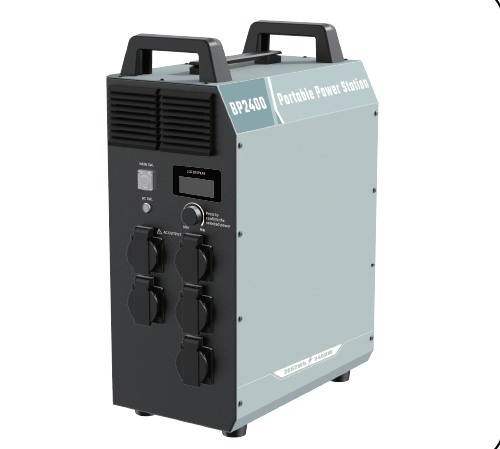
For example, the BP2400 Smart Mobile Power Portable Power Station combines a 2662Wh LiFePO4 battery with a 2400W rated / 4800W peak pure sine wave inverter (THD<3%) and a built-in 1200W MPPT controller (12–105VDC, 25A max). It can accept up to 1200W of solar input and reach full charge in 2.5 hours under standard test conditions. The unit has a UPS transfer time under 10ms, an IP53 unit rating and an IP66 battery pack rating, and carries CE, RoHS and UN 38.3 certifications with a 5-year warranty.
For larger requirements, the EP3600iL High Power Mobile Power Station offers 3600VA rated / 7200VA peak output and a 3430Wh LiFePO4 battery. It supports expansion with up to 31 extra batteries for a total of 109kWh and includes a four-wheel chassis for mobility. It also supports EV emergency charging.
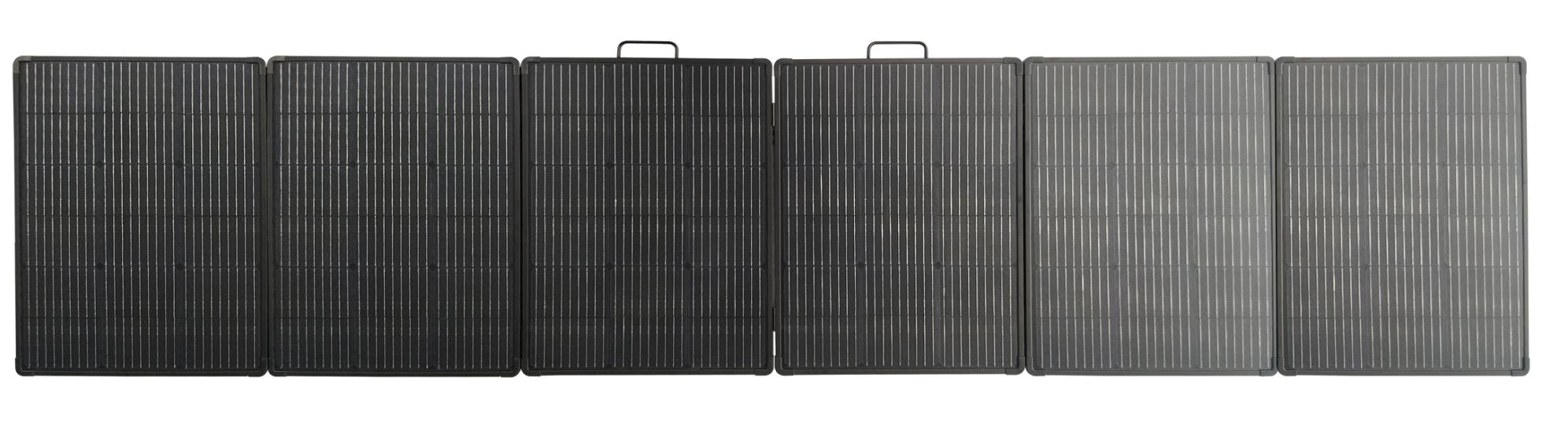
External panels for Route B can be selected from foldable or flexible options. The DSF100C 100W Foldable Solar Panel includes USB, TYPE-C, DC 5521 18V and MC4 connectors. The DSF600A/DSF600 600W Foldable Solar Panel is a higher-wattage foldable option. The DS100F 100W Flexible Solar Panel suits curved or irregular mounting surfaces.
If the application requires more runtime than the integrated battery provides, additional battery packs can be added. See our guide on extra battery pack expansion for portable power stations for the steps and what buyers should confirm.
Comparing the Two Routes Under Identical Conditions
Assume a requirement for a 1200W solar array, a 2400W continuous AC load and a battery capacity of at least 2.5kWh. Under Route A, the buyer would source 1200W of panels, an MPPT controller rated for the array, a 2.5kWh+ battery bank and a 2400W inverter. Under Route B, the buyer could use one BP2400 unit (2662Wh, 2400W rated) and 1200W of external panels.
| Parameter | Route A: Separated Components | Route B: Integrated Power Station + Panels |
|---|---|---|
| Panel selection | Flexible; any panel wattage and connector type | Must match the power station’s MPPT input window and connector type |
| Charge controller | Separate MPPT unit; must be sized to array | Built-in MPPT (e.g., 1200W, 12–105VDC, 25A max on BP2400) |
| Battery | Separate battery bank; chemistry and capacity chosen independently | Integrated LiFePO4 (e.g., 2662Wh on BP2400; 3430Wh on EP3600iL) |
| Inverter | Separate pure sine wave inverter; rated and peak output specified | Integrated bidirectional inverter (e.g., 2400W rated / 4800W peak on BP2400) |
| UPS transfer time | Depends on inverter model | Under 10ms on BP2400 |
| Assembly and wiring | More components and connections | Fewer components; external panels connect directly |
| Field service | Multiple warranties and failure points | Single warranty on the power station; panels separate |
| Expansion | Add batteries or panels as needed | Add battery packs (e.g., EP3600iL supports up to 31 extra batteries) |
Route A is preferable when the vehicle layout demands unusual panel shapes or when the buyer wants to standardize on a particular battery chemistry. Route B reduces integration effort and can simplify after-sales support, but the panel array must be compatible with the power station’s MPPT input.
RFQ Parameter Checklist for RV Solar Panel Kits
Use the following checklist when preparing a purchase inquiry. Replace any value you do not have with “confirm in the RFQ”.
| Parameter | What to specify | Example or note |
|---|---|---|
| Panel wattage and connector types | Total array wattage; connector type (MC4, DC 5521, USB, TYPE-C, etc.) | DSF100C includes USB, TYPE-C, DC 5521 18V and MC4 |
| MPPT voltage window and max input | Operating voltage range (VDC); maximum solar input wattage and current | BP2400: 12–105VDC, 1200W max, 25A max |
| Battery chemistry and capacity | LiFePO4 or other; capacity in Wh | BP2400: 2662Wh LiFePO4; EP3600iL: 3430Wh LiFePO4 |
| Inverter rated and peak output | Continuous wattage; peak wattage; waveform | BP2400: 2400W rated / 4800W peak, pure sine wave, THD<3% |
| UPS transfer time | Transfer time in milliseconds | BP2400: under 10ms |
| Protection ratings | IP rating for unit and battery pack | BP2400: IP53 unit, IP66 battery pack |
| Certifications | CE, RoHS, UN 38.3, etc. | BP2400: CE, RoHS, UN 38.3 |
| Warranty | Warranty period and coverage | BP2400: 5-year warranty |
| Expansion capability | Maximum number of additional batteries | EP3600iL: up to 31 extra batteries (109kWh total) |
For any parameter not listed above, state “confirm in the RFQ” rather than assuming a value. This keeps the inquiry precise and avoids later mismatches.
Next Steps for Dealers and Distributors
Choose Route A if you need maximum flexibility in panel selection or battery chemistry. Choose Route B if you want to reduce assembly steps and offer a single-warranty power solution. In either case, the RFQ checklist above gives your supplier the specific parameters needed for an accurate quotation. For OEM/ODM projects, include your target panel wattage, battery capacity, inverter rating and any certification requirements in the first inquiry.
All specifications in this article are based on published product data. Confirm final parameters and terms with your supplier before ordering.