
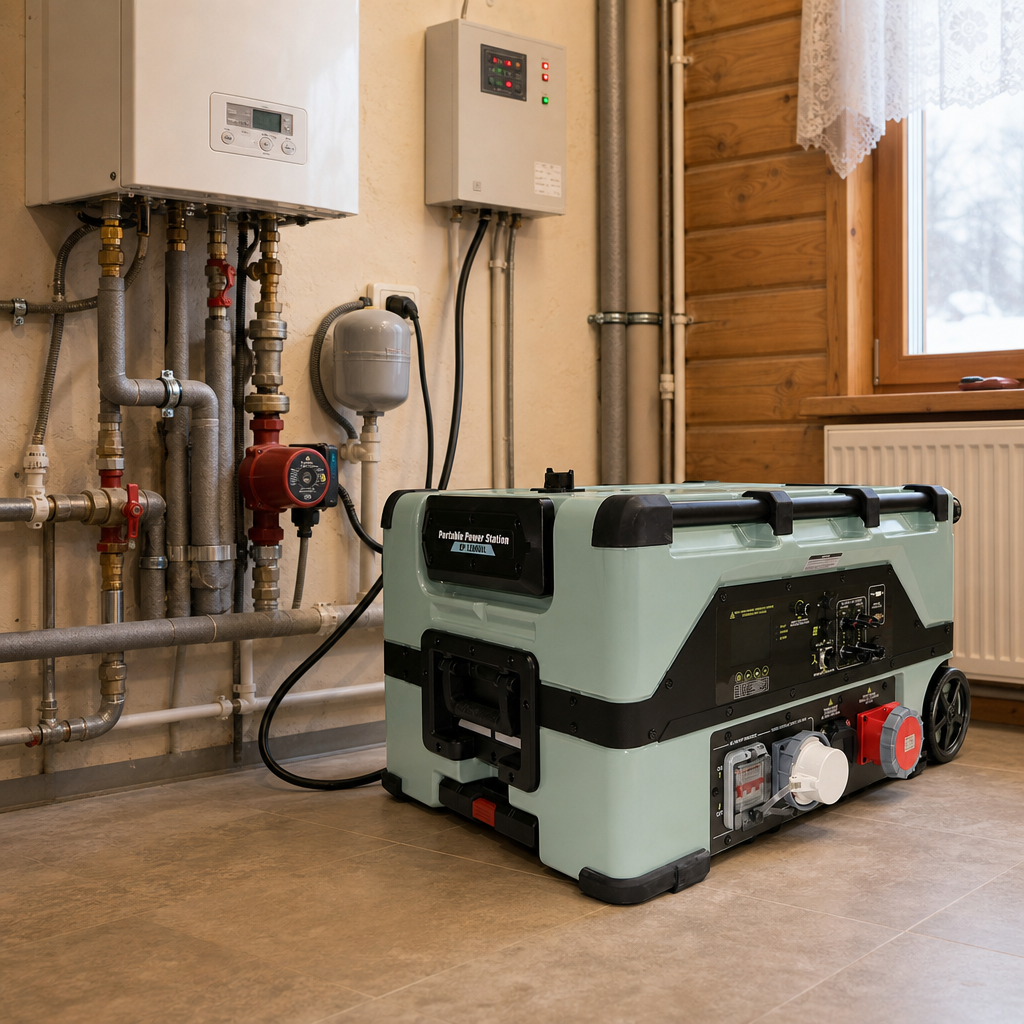
A complete backup power plan for a rural Russian home: load estimates and DRIVELONG EP/DP power station picks for 24h+ winter outage coverage.
Basis of this plan: appliance power figures are typical household estimates; all product parameters are taken from the current project's real, in-stock product records (EP/DP series power stations and DS/DSF series solar panels). This solution uses only the lithium battery storage + solar charging route and contains no fuel-powered generator throughout.
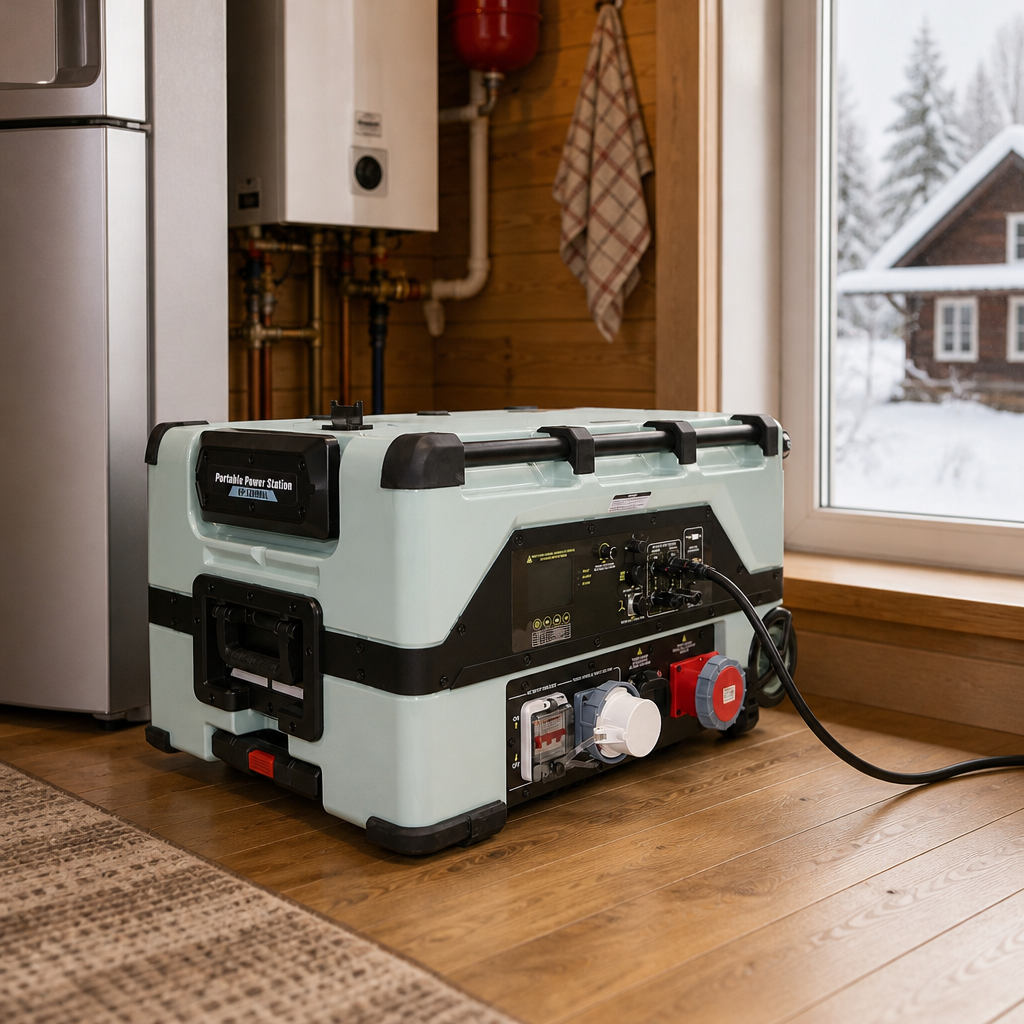
Key takeaways
Winter emergency backup for critical loads (boiler pumps, boiler control, refrigerator, lighting) needs roughly 830W simultaneous and 15–18kWh of usable capacity for 24 hours.
A single 2–3kWh portable unit covers only about 3 hours at 830W — expansion batteries are required for winter.
Whole-home backup includes washing machine, dishwasher, cooktop and kettle: plan for a 6kW-class inverter + 5kWh+ built-in battery + expandability to 20kWh+.
Load staggering decides whether the whole solution works: never run all three short-duration high-power appliances at once.
I. Appliance Power and Consumption Estimates
Appliance | Typical Power | Typical Usage Duration | Estimated Daily Consumption | Load Type |
|---|---|---|---|---|
Gas boiler circulation pumps ×6 | Approx. 60–100W each, 360–600W total | 24h continuous all heating season | Approx. 9–14kWh (winter) | ★ Critical load: must stay powered in winter |
Gas boiler electronic control unit | Approx. 20–50W | 24h continuous | Approx. 0.5–1.2kWh | ★ Critical load: boiler shuts down on power loss |
Refrigerator | 100–200W running (compressor cycling) | 24h | Approx. 1.0–1.8kWh | ★ Critical load |
Light bulbs ×20 (LED 8–10W each) | 160–200W total | Approx. 6h on winter nights | Approx. 1.0–1.2kWh | Critical / semi-critical |
Washing machine | 300–800W running, 2000–2400W peak with heated wash | 1.5–2h per cycle, 3–4 cycles/week | Approx. 0.8–1.5kWh/day average | Schedulable |
Dishwasher | 1800–2400W (consumption concentrated in water heating) | 1–1.5h per cycle, once daily | Approx. 1.2–1.8kWh | Schedulable |
Electric cooktop | 1500–2000W per burner, 3–4kW with two burners | 1–2h/day | Approx. 3–5kWh | Schedulable (high power) |
Electric kettle | 2000–2200W | 3–5 min per use, 5–8 uses/day | Approx. 0.5–0.8kWh | Schedulable (short-duration high power) |
Note: The cooktop, kettle, and dishwasher are all "short-duration, high-power" appliances. Not running all three simultaneously is the precondition for the whole solution to work (load-staggering strategy in Section IV).
II. Capacity and Power Requirements for the Two Supply Scenarios
Scenario A: Winter heating-season emergency backup (critical loads only during outages)
Simultaneous load: boiler pumps ~500W + boiler control ~30W + refrigerator ~150W + lighting ~150W ≈ 830W
Allowing for motor start-up surge of pumps and refrigerator compressor (about 2× rated), reserve peak ≥2kW; recommend inverter power ≥3.6kW, preferably ≥5kW
Capacity: 830W × 24h ≈ 20kWh; adjusted for actual duty cycle and discharge margin, roughly 15–18kWh → recommend ≥20kWh usable capacity to cover 24+ hours
Conclusion: winter emergency backup cannot rely on a single 2–3kWh portable unit; expansion batteries are required
Scenario B: Daily / whole-home backup (including washing machine, dishwasher, cooktop, kettle)
Peak power: approx. 4.5–6kW running simultaneously after load staggering (e.g., two cooktop burners + dishwasher) → inverter power ≥6kW
Daily consumption: approx. 14–18kWh in winter (including 9–14kWh for boiler pumps), approx. 8–10kWh in summer
Capacity strategy: the built-in battery of a single unit covers nights / short outages; fast AC charging or solar top-up during the day; stacked expansion batteries for extended outages
Conclusion: whole-home backup requires a 6kW-class inverter + 5kWh+ built-in battery + expandability to 20kWh+
III. Product Recommendations (all are real, in-stock models from the product library)
★ Recommended Plan A: EP6000iLS High-Power Portable Power Station (one unit covers Scenarios A + B)
Rated 6000VA / peak 12000VA, up to 6kW continuous output — covers whole-home peak loads with staggering
5376Wh LiFePO4 battery; stacks up to 31 expansion batteries for a total capacity of 172kWh (4 packs ≈ +21.6kWh, ~27kWh total, independently supports 24h+ of winter emergency backup)
Built-in patented 16A/32A dual input, charges to 90% in 1 hour; supports AC, solar, and ATS charging; supports EV emergency charging
Patented four-wheel chassis with large rollers — pushable even when fully loaded; 5-year warranty
Recommended winter configuration: 1 main unit + 4–6 expansion batteries
★ Recommended Plan B: EP5000iL Smart Portable Power Station (most complete specs, best winter adaptability)
Rated 5000W / peak 10000W, 3430Wh LiFePO4 (51.2V 67Ah, 5000+ cycles to 80% capacity)
Single-phase rated voltage 220/230/240V, 50/60Hz — fully matches the Russian/European 230V grid standard; pure sine wave output (THD <3%)
UPS switchover ≤10ms: the boiler control unit and pumps are essentially unaffected by grid blips and will not restart or shut down
Solar MPPT 12–150VDC up to 1600W, full charge in ~2.5h; AC charging up to 3000W, full charge in ~1.2h; optional vehicle and wind inputs also supported
Two units in parallel deliver 10kW continuous output (no parallel kit required); supports up to 31 EP3600B expansion batteries for 109kWh total (5–6 packs ≈ +17–20kWh)
Unit IP53 / battery pack IP66 protection; discharge temperature -20°C~60°C; CE/RoHS/UN38.3 certified; 5-year warranty; 49kg with four wheels for mobility
Recommended winter configuration: 1 main unit + 5–6 EP3600B expansion batteries (approx. 20–24kWh total, covering 24h of critical loads)
If loads grow in the future: add a second EP5000iL in parallel for 10kW output
★ Budget Compact Plan C: DP3600iL / DP2400iL (suitable for summer backup + short outages; winter requires expansion)
DP3600iL: 3600VA rated / 7200VA peak, 2662Wh, built-in 1200W MPPT solar controller, up to 31 expansion batteries for 109kWh, charges to 80% in 1 hour
DP2400iL: 2400VA rated / 4800VA peak, 2496Wh, two units in parallel for double output, expandable to 109kWh
Note: a single 2.5kWh unit supports winter critical loads for only about 3 hours (830W × 3h); for winter use, expansion batteries or two units in parallel are essential
★ High-Spec Whole-Home Plan D: EP12000iL Flagship (headroom for large loads / EV)
Rated 12000VA / peak 24000VA, 7680Wh; three-phase 12kW, single-phase 11kW continuous output
Up to 31 expansion batteries for 372kWh; two units in parallel for 24kW; built-in 22kW EV on-board charging module; full charge in 70 minutes; supports high/low-voltage solar, AC, vehicle, wind and other inputs
Suited to future scenarios such as running the full cooktop or adding EV charging — a one-time, future-proof configuration for a rural home
IV. Usage Schedule Recommendations (Load-Staggering Strategy)
Power-supply priority during outages: ① boiler pumps + boiler control (keep heating on, prevent freezing) → ② refrigerator → ③ lighting → ④ router / phone / communications → ⑤ everything else
Scheduling of high-power appliances: stagger the cooktop, kettle, and dishwasher; run only 1–2 high-power appliances at any moment to keep peaks within 6kW; for the washing machine, choose cold-water wash or defer it until grid power is restored
When grid power is available: keep the power station fully charged on standby (EP6000iLS charges to 90% in 1 hour, EP5000iL fully charges in 1.2 hours) and use it as "UPS + backup power"
On sunny days: prioritize solar top-up to reduce grid dependence; carry only critical loads at night
UPS mode (EP5000iL): connect the boiler control unit to the UPS outlet; grid blips switch over in ≤10ms so the boiler does not restart
V. Expansion Options (Parallel Operation / Capacity Expansion / Solar Top-Up)
Capacity expansion: EP6000iLS supports up to +31 expansion batteries for 172kWh; EP5000iL supports up to +31 EP3600B batteries for 109kWh; all models support adding batteries later — start small and buy more based on actual winter outage durations
Parallel power: EP5000iL ×2 → 10kW (no parallel kit needed); EP12000iL ×2 → 24kW; DP2400iL ×2 → double output
Solar top-up (real, in-stock models):
Folding panels (deployed temporarily during outages): DSF600A/DSF600 (600W) ×2 + DSF100C (100W) ×1 ≈ 1300W, close to the EP5000iL's 1600W MPPT limit; roughly 3–5kWh of top-up per sunny day
Flexible panels (permanently mounted on roof/sunroom): DS300F (300W) / DS170F (170W) / DS100F (100W), bendable to conform to roof surfaces with fully potting-sealed, rainproof junction boxes
EP12000iL supports both high- and low-voltage solar input, allowing rooftop module expansion later
Voltage compatibility: EP5000iL explicitly supports single-phase 220/230/240V, 50/60Hz with pure sine wave output, directly powering motor-driven appliances such as washing machines and dishwashers; the other EP/DP series are designed for European market output standards — confirm exact outlet configuration with us before ordering
VI. Winter Operation Notes
Charging temperature 0–45°C, discharge -20–60°C (EP5000iL): during an outage in extreme cold, keep the unit indoors or in an insulated spot and bring it back to room temperature before charging
Prefer models with UPS switchover (≤10ms) for the boiler control unit to avoid frequent restarts
LiFePO4 5000+ cycle life — at dozens of outages per year, the system lasts over ten years; 5-year warranty
Configuration guidance: with ample budget, go straight for "EP6000iLS main unit + 4–6 expansion batteries"; for winter reliability details (UPS, -20°C discharge, 1600W solar), choose "EP5000iL + 5–6 EP3600B"; on a tight budget, start with the DP3600iL and add batteries to upgrade later