
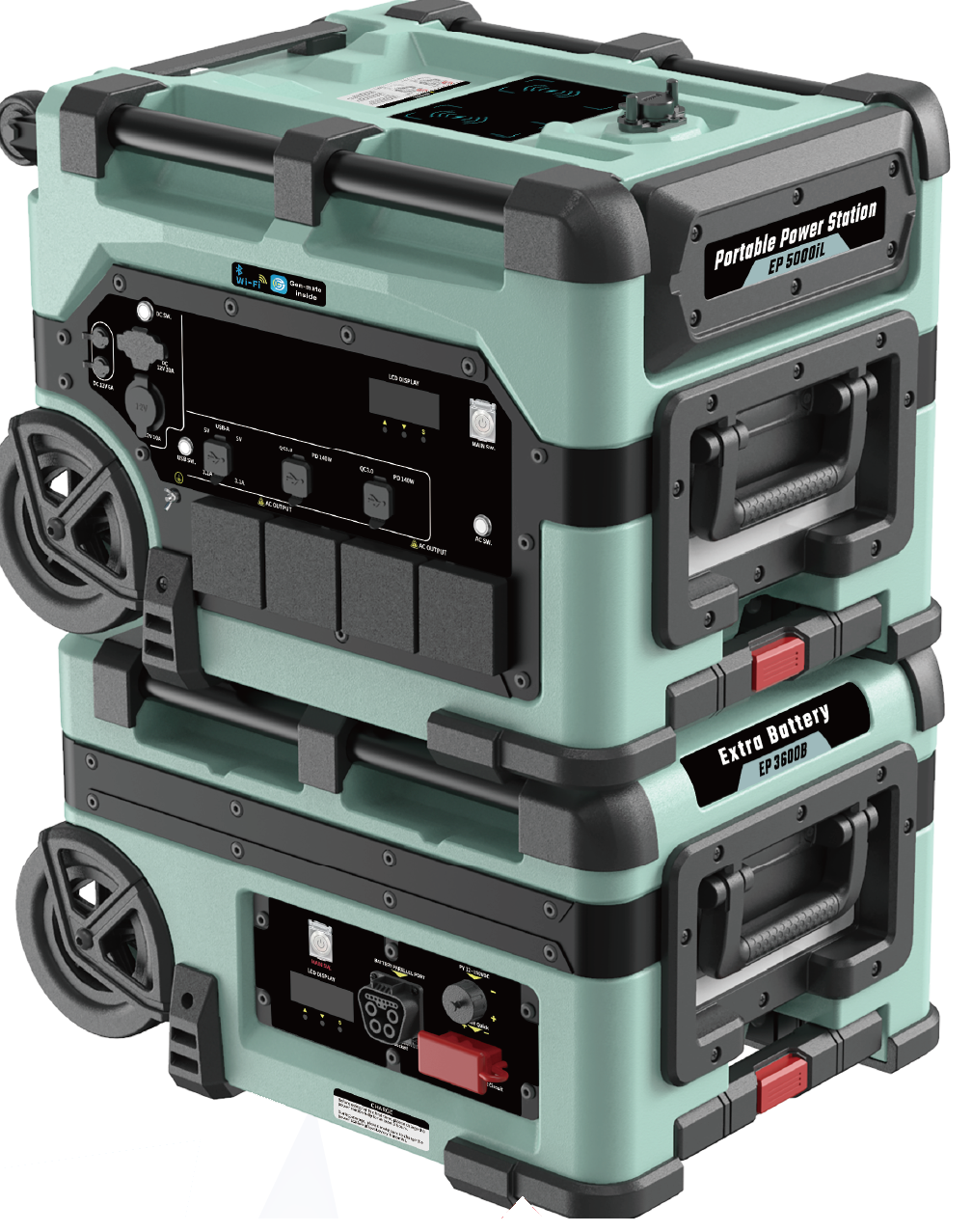
A portable battery pack in an energy-storage context is a rechargeable LiFePO4 battery assembly. It appears in three roles: the built-in pack inside a portable power station, a detachable extra pack that expands capacity, and the portable unit itself as a product category. This explainer covers why LiFePO4 is used, what a cycle rating to 80% capacity means across models, what must match when adding an extra battery, and the charging window and storage habits that protect cycle life.
What a Portable Battery Pack Is in an Energy-Storage Context
A portable battery pack is a rechargeable battery assembly that supplies DC power to a device or system. In the energy-storage field, the term covers three distinct roles, and buyers evaluating a power station need to tell them apart:
- Built-in pack. The internal LiFePO4 pack inside a portable power station. It is not user-removable in most designs and defines the unit's base capacity.
- Detachable extra or external pack. A separate battery that connects to the main unit to increase total stored energy. This is the expansion role — an external battery pack for capacity growth, not a consumer accessory.
- The whole portable unit as a category. In marketing and distribution, "portable battery pack" or "battery power pack" often refers to the entire power station product itself.
This article stays at the energy-storage level. It does not cover phone power banks, jump starters or USB battery packs, which serve different duty cycles and have no role in a power station system.
Key Takeaways
- A portable battery pack plays one of three roles: built-in pack, detachable expansion pack, or the whole portable unit as a category.
- Every DRIVELONG power station and battery pack referenced here uses LiFePO4 chemistry.
- Cycle life is rated to 80% capacity — BP series cells are rated 8,000 cycles; EP5000iL is rated 5,000+ cycles to 80%. It is a comparison spec, not a guarantee of failure-free operation.
- Adding an extra battery pack requires matching brand/model battery family, connector and communication protocol, voltage platform, and protection rating.
- Charging 0–45°C, discharging down to -20°C, and recharging stored units at least every 6 months protect cycle life.
Chemistry: Why LiFePO4 for Frequent-Charge Storage Duty
Lead-acid and some lithium-ion chemistries degrade quickly under repeated partial charging — the typical duty cycle of a solar or backup power station. LiFePO4 (lithium iron phosphate) is chosen for this work for three properties:
- Thermal stability. The phosphate cathode is more resistant to thermal runaway than cobalt-based cathodes, which matters when a pack sits in a vehicle, a shed or a rack.
- Long cycle life. LiFePO4 tolerates thousands of charge-discharge cycles before capacity falls to 80% of original, far more than typical lead-acid.
- No cobalt. The cathode contains no cobalt, which simplifies sourcing and compliance documentation for distributors.
Every DRIVELONG power station and battery pack referenced here uses LiFePO4. The BP500 (500W, 1004.8Wh) and BP1000 (1000W, 2010Wh) use ultra-low-voltage LiFePO4 single-cell systems. The EP5000iL (5000W, 3430Wh) and its expansion pack, the EP3600B, are also LiFePO4. For a distributor, the chemistry is the first filter: if a power station uses a different lithium chemistry, its cycle rating and thermal profile will not match the LiFePO4 numbers quoted across this product line.
Cycle Life: What "Cycles to 80% Capacity" Means
A cycle rating counts full charge-discharge cycles until usable capacity falls to 80% of the original rated value. It is measured under defined test conditions, not under every real-world load and temperature profile. The rating is a comparison spec — it tells a buyer which pack is expected to last longer under similar use, not a promise that the pack will never fail.
Ratings differ by model because cell design, voltage platform and intended duty differ:
| Model | Cycle Rating | Chemistry | Notes |
|---|---|---|---|
| BP500 | 8,000 cycles | Ultra-low-voltage LiFePO4 single-cell | 500W, 1004.8Wh, 350W MPPT, 5-year warranty |
| BP1000 | 8,000 cycles | Ultra-low-voltage LiFePO4 | 1000W, 2010Wh, 500W MPPT, 5-year warranty |
| BP2400 | 5,000 cycles to 80% | LiFePO4 | 2400W rated / 4800W peak, 1200W MPPT, IP53 unit / IP66 battery pack |
| EP5000iL | 5,000+ cycles to 80% | LiFePO4 | 5000W, 3430Wh, expands to 31 × EP3600B = 109kWh |
The BP series ultra-low-voltage cells are rated 8,000 cycles; the EP5000iL is rated 5,000+ cycles to 80%. When two systems offer similar capacity, the cycle rating becomes a primary comparison point for how long the pack keeps delivering useful capacity in service. It does not replace checking the charging window, depth of discharge and operating temperature against the intended deployment.
Compatibility: What Must Match When Adding an Extra Battery Pack
An expansion pack is not a universal add-on. Adding one to a system requires matching five things:
- Same brand and model battery family. The expansion pack must be specified for the base unit. The EP5000iL's named expansion battery is the EP3600B; other packs are not interchangeable.
- Connector and communication protocol. The physical connector and the data link between pack and inverter must be compatible so the system can read state of charge and manage charge current correctly.
- Voltage platform. The expansion pack must operate on the same voltage platform as the base unit. Mixing platforms risks incorrect charge control and unsafe conditions.
- Protection rating. The pack's IP rating must suit the installation environment. The BP2400, for example, carries IP53 for the unit and IP66 for the battery pack.
- Charging inputs. The system's charging paths must support the expanded bank. The EP5000iL accepts charging via AC utility, solar, driving, AC generator and wind turbine through bidirectional inverters, and reaches 80% charge in 1 hour. The EP3600iL (3600VA, 3430Wh) uses the same charging methods — utility, solar, driving car, AC generator and wind turbine — and also charges to 80% in 1 hour.
The expansion ceiling matters for system design. The EP5000iL expands to 31 × EP3600B packs, or 109kWh total. The EP12000iL (7680Wh) expands to 31 extra batteries, or 372kWh total, and fully charges in 70 minutes. The DP2400iL (2496Wh) expands to 31 extra batteries for 109kWh total. A buyer planning a rack or cabinet installation should confirm the target model's maximum pack count and total energy before specifying the electrical room or enclosure.
Compliance context for the EP5000iL: RoHS, CE and UN 38.3. It carries a 5-year warranty. Confirm certification scope for the exact model and destination market with the supplier.
Care and Storage: Habits That Protect Cycle Life
Cycle life is rated under controlled conditions. Real-world charging temperature and storage practice shift the result. Two specifications define the operating window for these systems:
- Charging: 0°C to 45°C. Charging a lithium pack below freezing can cause plating and permanent capacity loss. The EP5000iL lists a charging range of 0°C to 45°C; the BP2400 lists 0°C to 45°C as well.
- Discharging: down to -20°C. The EP5000iL discharges from -20°C to 60°C, so cold-weather output is possible even when charging is not.
For storage, the DP2400iL carries a factory CHARGE label instructing users to recharge the unit at least every 6 months during storage. This is a maintenance habit worth keeping on a schedule: a pack left at low state of charge for long periods can lose capacity permanently. Distributors holding stock or resellers storing units for seasonal deployment should plan a recharge cycle every six months and keep packs within the charging temperature window when doing so.
When to Move from "What Is It" to "How Big and Which Model"
Once the three roles, the LiFePO4 chemistry, the cycle rating and the compatibility checklist are clear, the next decisions are capacity-expansion and model selection. That means comparing base capacity against the load profile and backup duration the end user needs, checking the maximum expansion count and total energy for the target model, and confirming that the charging inputs available on site match what the system accepts.
For a first system, the BP500 portable power station (500W, 1004.8Wh, 8,000 cycles) and the BP1000 portable power station (1000W, 2010Wh, 8,000 cycles) cover smaller backup and off-grid loads. For larger installations, the EP5000iL smart mobile power station (5000W, 3430Wh, expandable to 109kWh) is the base unit for systems that may grow over time. Confirm the battery family, connector protocol, voltage platform and protection rating for any expansion pack before ordering.