
A pairing framework for wholesale buyers, importers and OEM brands: choose foldable versus flexible panels by application, verify the MPPT input window and solar wattage ceiling against the model datasheet, and lock the full set through an RFQ checklist before quoting.
Pair the station and the panel before you quote, not after. A power station with solar panel is ordered as one bundle, and the pairing fixes the landed cost, the export classification and what your customer receives in one box. This article gives importers, distributors and OEM brands a three-part framework: selecting foldable or flexible panels by application, checking the MPPT input window and wattage ceiling against the model datasheet, and locking the full set through a private-label RFQ checklist.
Why pairing decisions belong in the quotation
Buyers of a portable power station with solar panel usually decide two things at the same time: which station class fits the market, and which panel format the end user will actually deploy. Those choices interact. A panel that exceeds the station's solar wattage ceiling is wasted capacity in some cases and unprotected surplus in others. A panel that cannot reach the station's MPPT voltage window may not charge at all under the conditions the buyer expects.
Fixing the pairing before the quote keeps the bill of materials honest. The alternative is a quotation for a station, a follow-up for panels, a second freight estimate, and a customer who discovers the mismatch after delivery. The framework below is built to be applied in this order: application, then electrical fit, then commercial specification.
Choosing foldable or flexible panels by application
The first decision is mechanical, not electrical. Where does the panel live during use?
Panels that travel with the user
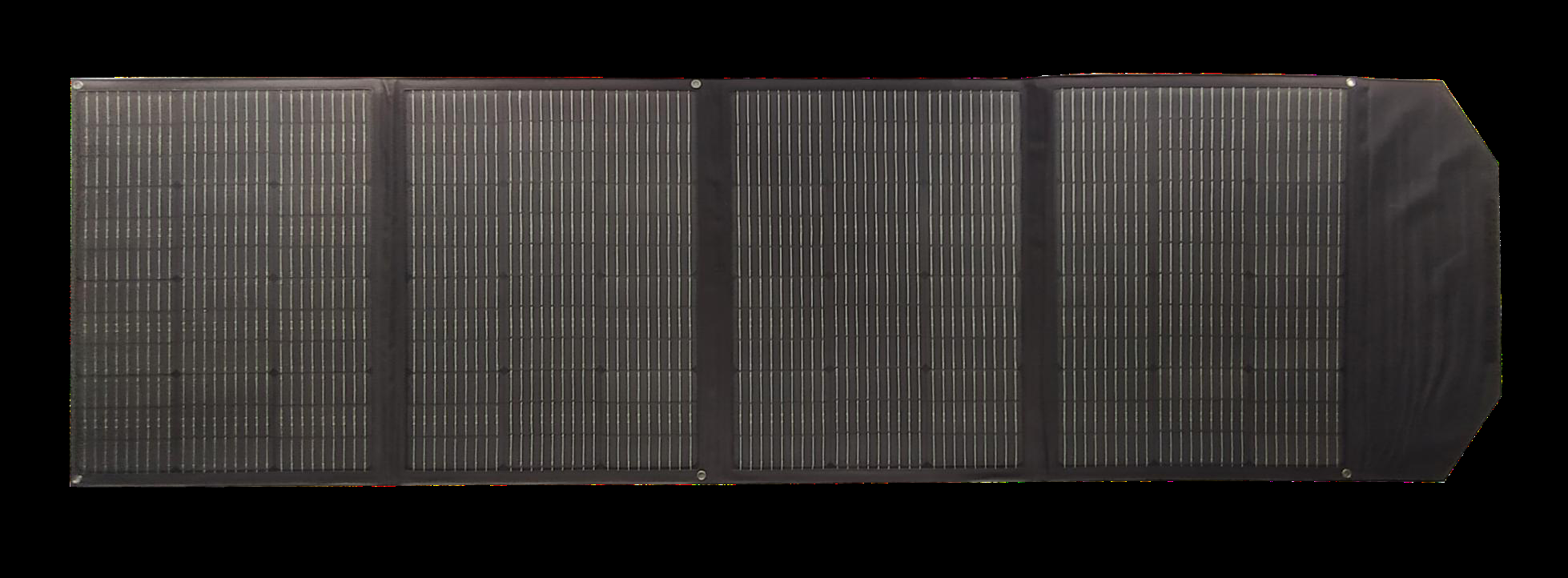
Camping, emergency response, trade-show kits and mobile service calls need a panel that folds, packs and redeploys without a permanent mounting surface. Foldable monocrystalline panels fit that use pattern. The DSF200C/DSF300C Foldable Solar Panel covers 200W and 300W formats, and the DSF600A/DSF600 Foldable Solar Panel covers the 600W formats. Both include USB, Type-C, DC5521 18V and MC4 connectors, which matters because one connector set can serve small devices and the station input without an adapter bundle in every carton.
Panels mounted on curved surfaces
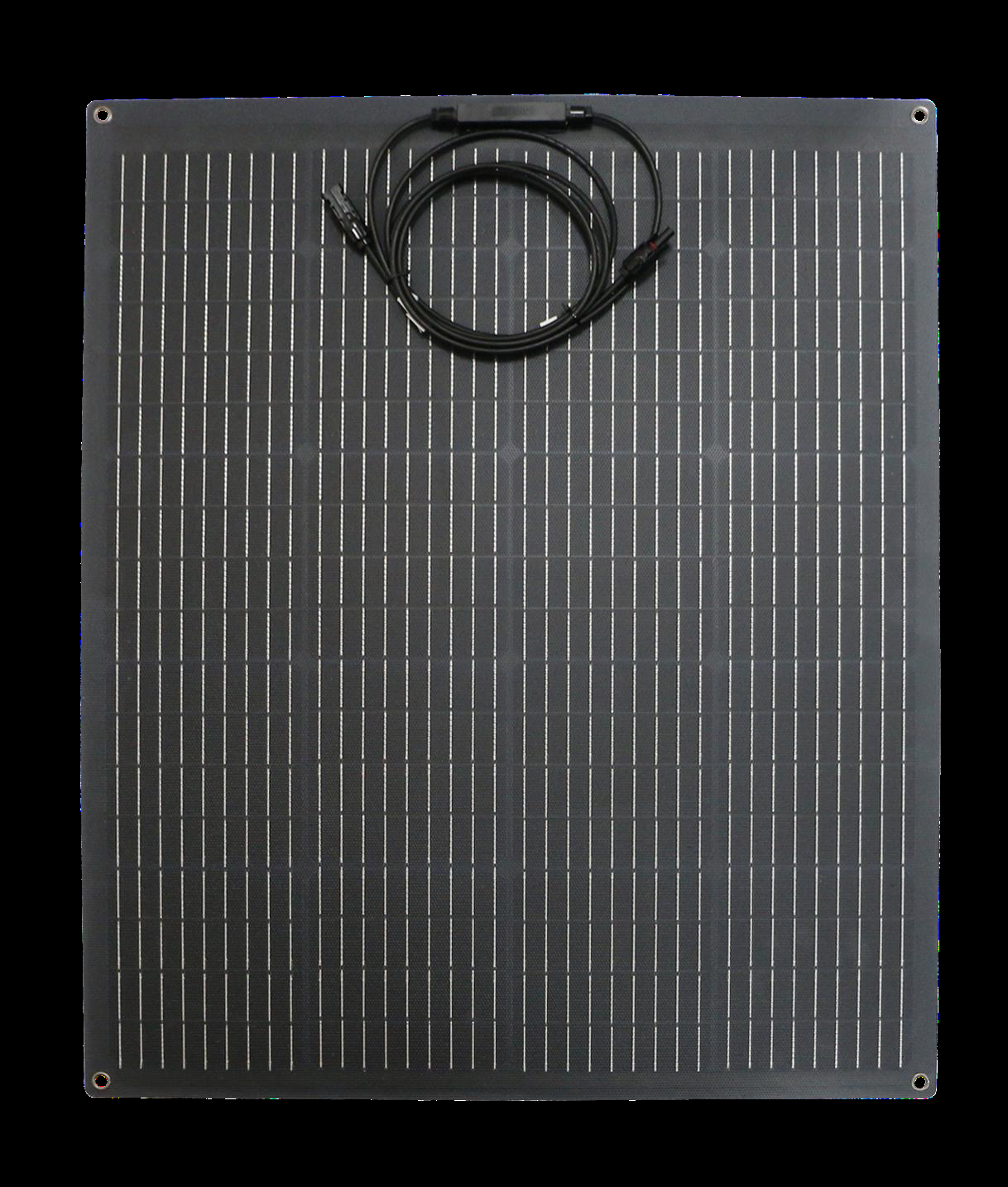
RVs, boats and vehicle roofs have a curved surface and a fixed installation point. A rigid foldable panel needs a frame and a mounting strategy; a flexible panel can be bonded or hung. The DS100F Flexible Solar Panel is a 100W flexible monocrystalline panel for curved RV and yacht roofs, with a rain-sealed glue-filled junction box and eyelets for hanging. Those two details point to the installation decisions a buyer must communicate: bonded to the roof, or hung and removed.
Fixed charging points on job sites
A job-site charging station sits in one place but needs to be repositioned as the workflow moves. Here the panel is semi-stationary and the station rolls. That combination points toward larger foldable panels plus a station with a wheeled chassis, rather than a flexible panel, because the mount is temporary rather than bonded. Whichever format wins the mount decision, the electrical fit is not waived: the MPPT window, input amperage and wattage ceiling checks in the next section still apply before the bundle is quoted.
Verifying the MPPT window and the wattage ceiling
Once the panel format is fixed, check two electrical limits against the model datasheet: the MPPT input voltage window and the maximum solar input wattage. Only this comparison says whether a particular panel array will charge a particular station usefully.
Worked example one: BP2400 with a 600W foldable array
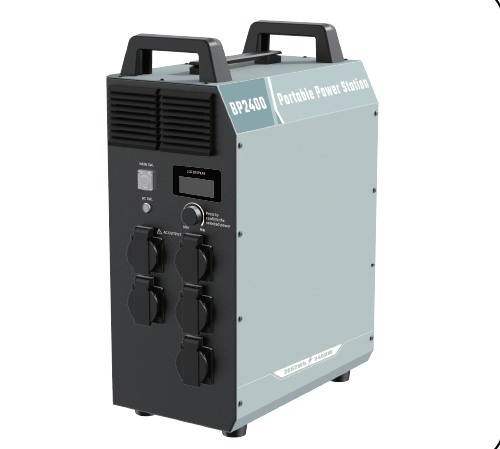
The BP2400 Smart Mobile Power Portable Power Station is listed with a built-in 1200W MPPT, a 12–105VDC input window, 25A maximum input, and solar input up to 1200W. A DSF600A/DSF600 array at 600W sits inside the wattage ceiling with room for a second panel before the 1200W limit is reached. The operating voltage of the panel under load must fall inside 12–105VDC, and the array current must stay within 25A. The station's full solar charge is listed at about 2.5 hours, which is the figure buyers should quote for the charging claim, not a faster number derived from panel nameplate wattage alone.
Worked example two: EP5000iL with a 600W foldable array
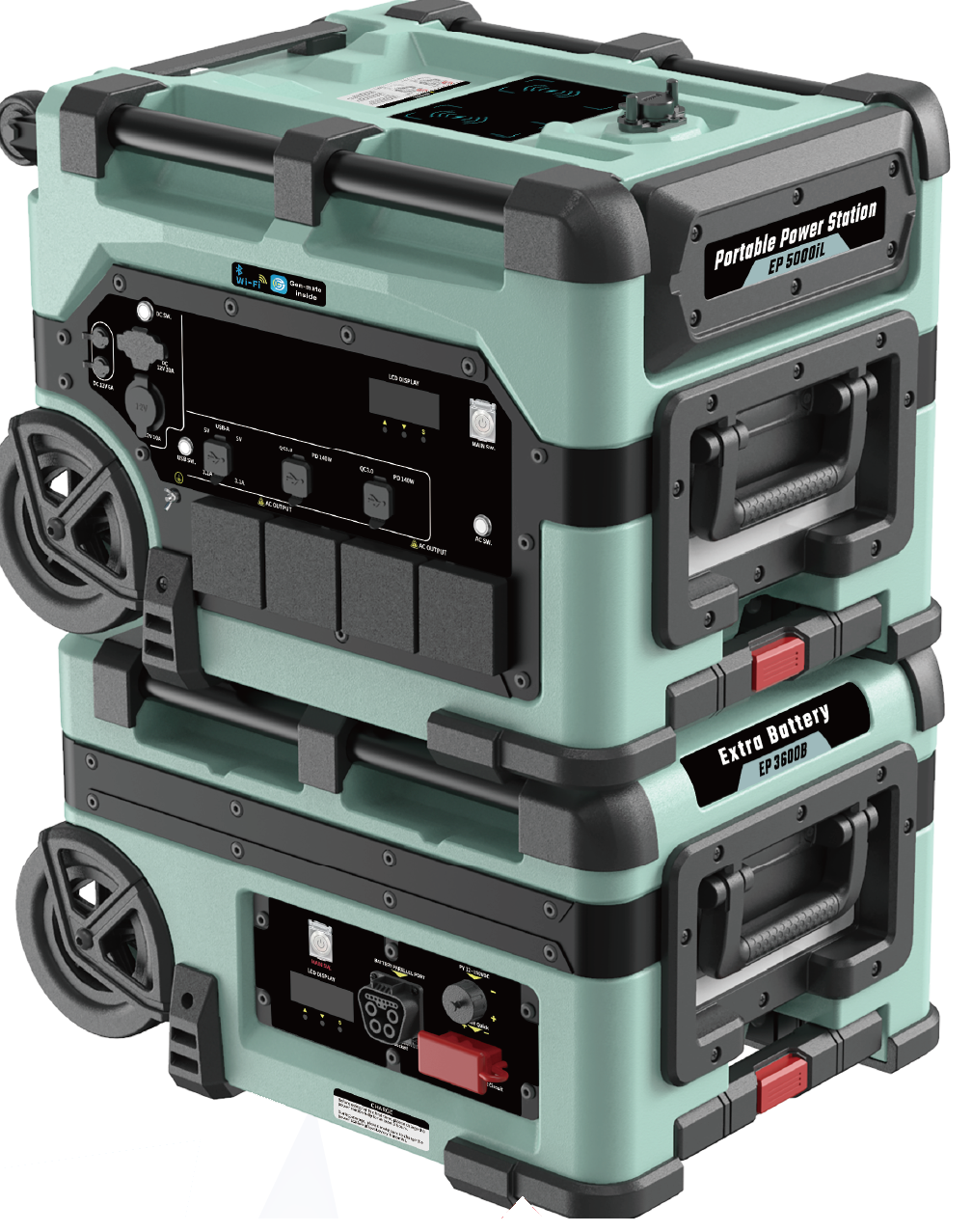
The EP5000iL Smart Mobile Power Station is listed with MPPT solar input of 12–150VDC up to 1600W, about 2.5 hours for a full solar charge, 3000W single-phase AC charging at about 1.2 hours, and UPS transfer of 10ms or less. The same 600W foldable panel is well inside the 1600W ceiling and comfortably inside the wider 150VDC window. Two points follow. First, the wider window accepts a broader range of panel operating voltages, so a buyer substituting a different panel model has more room to do so. Second, the panel count can rise toward the 1600W ceiling, but the current limit and the panel's voltage under load still have to be checked on the datasheet before the bundle is quoted.
Models without a documented PV window in the records
The BP1000, CP1200iL, DP3600iL and EP3600iL records in this set do not document a PV voltage window. For those four models, the MPPT window and maximum input amperage must be confirmed on the model datasheet or written into the RFQ. Do not publish a voltage range for them until that figure is supplied in writing.
| Model | Documented PV input window | Documented solar ceiling | Action before quoting |
|---|---|---|---|
| BP2400 | 12–105VDC, 25A max | Up to 1200W | Confirm panel operating voltage and current fall inside both limits |
| EP5000iL | 12–150VDC | Up to 1600W | Confirm panel count and current limit against the datasheet |
| BP1000 | Not documented in records | Built-in 500W MPPT listed | Request MPPT window and amperage in writing |
| CP1200iL | Not documented in records | Confirm on datasheet | Request MPPT window and amperage in writing |
| DP3600iL | Not documented in records | Built-in 1200W MPPT listed | Request MPPT window and amperage in writing |
| EP3600iL | Not documented in records | Confirm on datasheet | Request MPPT window and amperage in writing |
The confirm-on-datasheet list is short: PV voltage window, maximum input current, maximum solar wattage, the panel's voltage under load, and the connector type at the station input. Deep single-unit matching math is the subject of the site guide Solar Panel and MPPT Matching for a Portable Power Station; the job here is only to close the electrical question for each SKU in the bundle.
Pairing panels by station class
Station class narrows the panel choice faster than any single wattage figure. The decision rules below are written as rules, not as a specification dump.
Compact class: CP1200iL and BP1000
The CP1200iL Compact Power Station is listed at 2048Wh LiFePO4, 1200VA rated and 2400VA peak, full charge in about 2 hours, with an ATS auto start-stop controller and a telescopic rod. The BP1000 is listed at 2010Wh and 1000W rated, 2000W peak, with a built-in 500W MPPT, 18.5kg, 8000-cycle cells and a 5-year warranty. Decision rule: pair these with a single 200W or 300W foldable panel for carried use, or the 100W flexible panel where the install surface is curved. Do not bundle a 600W array with a station whose documented MPPT ceiling is lower until the ceiling is confirmed, since the excess panel capacity may not translate into shorter charging time.
Mid class: BP2400 and DP3600iL
The BP2400 has the documented 12–105VDC, 1200W ceiling and 25A limit described above, plus 2662Wh LiFePO4, 2400W rated and 4800W peak, UPS transfer under 10ms, IP53 unit and IP66 battery pack, CE, RoHS and UN 38.3, and a 5-year warranty. The DP3600iL is listed at 2662Wh, 3600VA rated and 7200VA peak, with a built-in 1200W MPPT, 80 percent charge in one hour, and support for up to 31 extra battery packs reaching 109kWh. Decision rule: pair these with one or two 600W foldable panels, sized to the station's documented wattage ceiling and confirmed current limit, and keep a single 200W or 300W panel as the light kit alternative for carried use.
High-power class: EP3600iL and EP5000iL
The EP3600iL is listed at 3430Wh, 3600VA rated and 7200VA peak, 80 percent charge in one hour, up to 31 extra batteries reaching 109kWh, and a four-wheel chassis. The EP5000iL carries the same 3430Wh LiFePO4 capacity and adds 5000W rated and 10000W peak output, the 12–150VDC MPPT input up to 1600W, 10ms or less UPS transfer, IP53 unit and IP66 battery pack, RoHS, CE and UN 38.3, and a 5-year warranty. Decision rule: on the EP5000iL, two 600W foldable panels reach 1200W combined, which stays under the documented 1600W ceiling, and a third panel would exceed it, so the count stops at two unless the datasheet states otherwise. On the EP3600iL, the PV window and amperage are not documented in the records, so confirm both on the datasheet and size the panel count after that reply. Choose flexible panels only when the mounting surface is curved or bonded; for carried or temporary use, foldable panels are the default. The wider EP5000iL window tolerates more panel substitution, so it is the safer pairing for buyers who expect to switch panel suppliers between orders.
Ordering the full set with an OEM RFQ checklist
Once the electrical pairing is fixed, the RFQ has to carry everything that turns a station and a panel into one orderable, private-label bundle. Write the checklist into the RFQ itself so the reply is comparable across suppliers.
- Model pairing per channel: station model, panel model or models, and panel count per carton, stated as a single SKU or as a kit SKU with its own code.
- Logo and packaging: where the private label appears (unit, carton, manual, panel bag), artwork files required, and whether the panel and station ship in one outer carton or two.
- Connector types: confirm MC4 and DC5521 18V on the panel side and the station input connector, plus any adapter included in the box.
- Certification scope: for models where the records list CE, RoHS and UN 38.3, state which certificates apply to which model and request the documents for the exact SKU ordered. Do not assume a certification listed for one model carries to another.
- Spare parts: panel connectors, fuses where applicable, spare cables, and the warranty terms for the panel separate from the station's 5-year warranty where listed.
- Documentation: user manual language set, datasheet with the confirmed MPPT window for models that lacked one in the initial records, and the pairing sheet that states which panel goes with which station.
MOQ, lead time and price are not established by this article; they are part of the RFQ reply and should be compared per supplier on identical terms. The value of the checklist is that every supplier answers the same questions, so the differences are commercial rather than informational.
Frequently asked questions
What is the best portable power station with solar panels for a wholesale range?
There is no single best model without the market defined, but the pairing rule is consistent: match the panel to the station's documented MPPT window and wattage ceiling, then match the panel format to the application. A three-step screen keeps the choice grounded. First, define the application and where the panel will live: carried, bonded to a curved roof, or semi-fixed on a job site. Second, shortlist stations whose documented MPPT window and wattage ceiling fit the panel count you plan to ship; models without a documented window stay off the shortlist until the datasheet supplies it. Third, pick the panel format that suits the install surface. For carried camping use, a mid-class station such as the BP2400 with its documented 12–105VDC, 1200W ceiling paired to one or two 600W foldable panels is a workable starting bundle. For curved RV and boat roofs, the 100W flexible panel is the format decision. For fixed high-power sites, the EP5000iL with its 12–150VDC, 1600W window offers the most room for panel substitution.
Where to buy power station with solar panel as a wholesale buyer?
Buy through a supplier that will quote the station and panel as one bundle and put the electrical pairing in writing. Ask for the datasheet of the exact station model with its MPPT window, the panel datasheet with its voltage under load, and confirmation of the connector set. Where the records do not document a PV window, as with the BP1000, CP1200iL, DP3600iL and EP3600iL in this set, treat the window as an open item until the supplier supplies it in writing on the RFQ reply.
How do I check compatibility before ordering?
Three checks in order. First, confirm the panel's operating voltage falls inside the station's MPPT window. Second, confirm the array current is within the station's maximum input amperage. Third, confirm total panel wattage does not exceed the station's solar input ceiling. Where any of these figures is missing from the datasheet, request it before the purchase order rather than after.
Should panels and stations be bought together from one supplier?
Buying together has one practical advantage: a single supplier can be held to the pairing sheet, and connector, documentation and packaging decisions sit in one RFQ. It also simplifies the private-label artwork across both items. Buying separately can widen panel choice, but then the buyer owns the electrical verification and the connector compatibility between two suppliers' products. Either route works if the pairing sheet and datasheet confirmations are in the file before the order is placed.