A category primer for importers, solar distributors and OEM or ODM brands on what a LiFePO4 portable power station is, why the chemistry matters in portable storage, and the seven points to verify with any supplier before you send an RFQ.
A powerstation lifepo4 is not a new appliance category so much as a battery chemistry decision that now sits at the centre of portable energy storage. For importers, solar distributors and OEM or ODM brands, the commercial question is no longer whether a unit can run a load for an hour, but whether the cell chemistry, protection design and paperwork behind that unit will survive warranty claims, retail compliance checks and repeat orders.
This article explains what the category is, why LiFePO4 chemistry changes the economics of portable storage, and which claims a buyer should put in writing before an RFQ goes out.
What this article covers
- What separates a LiFePO4 portable power station from older portable storage designs.
- Why cycle life and thermal behaviour make LiFePO4 the default for higher-value units.
- Seven verification points: cell chemistry, cycle rating, BMS, inverter output, ingress protection, certification, expandability.
- How OEM and ODM capability should be assessed separately from product specification.
What a LiFePO4 portable power station actually is
A LiFePO4 portable power station combines a lithium iron phosphate battery pack, a battery management system, an inverter, a charger and a set of AC and DC outlets in one transportable enclosure. The chemistry is the defining element: lithium iron phosphate (LiFePO4) uses an iron-phosphate cathode rather than the nickel-manganese-cobalt or nickel-cobalt-aluminium chemistry found in many earlier portable units.
That choice has practical consequences for a product that is expected to be shipped, stored, cycled daily and sometimes left in a vehicle or on a job site. LiFePO4 cells are generally more thermally stable and more tolerant of full-charge storage than higher-energy-density chemistries, and they typically deliver more cycles before capacity falls to a defined end-of-life threshold. The trade-off is weight and volume per kilowatt-hour, which is why the chemistry suits stationary or semi-stationary use better than it suits anything that must be carried far.
In procurement terms, a portable power station lifepo4 listing should tell you four things without prompting: the confirmed cell chemistry, the usable capacity, the continuous and peak AC output, and the BMS specification. If any of those is missing from the datasheet, the datasheet is a marketing document rather than a technical one.
Why the chemistry matters more than the capacity number
Buyers new to the category often compare units on watt-hours alone. That number tells you how long a load can run, but it says nothing about how the unit will behave in year three, or what happens when a customer leaves it plugged into a solar array through a heatwave.
Three properties of LiFePO4 matter commercially:
- Cycle life. A well-designed LiFePO4 pack can be specified to a cycle count measured against a defined end-of-capacity threshold, for example a supplier-declared 5,000 cycles to 80 percent of original capacity. This figure is a supplier declaration and should always be treated as such: it depends on depth of discharge, temperature, charge rate and the specific cells used.
- Thermal stability. LiFePO4 has a higher thermal runaway onset temperature than many alternative lithium chemistries, which supports safer integration in enclosed, portable housings.
- Charge retention and partial-state tolerance. Units can be stored at partial charge without the accelerated degradation that some chemistries show, which matters for retail inventory that may sit in a warehouse for months.
None of this removes the need to verify the build. Chemistry describes the cell; it does not describe the pack, the welding quality, the BMS thresholds or the inverter headroom.
The seven-point verification checklist before you request a quote
1. Declared cell chemistry and cycle rating
Ask for the cell chemistry in writing, including cell format and, where available, the cell manufacturer and model. Then ask for the cycle rating with its test conditions: depth of discharge, ambient temperature and the capacity threshold used to define end of life. A number quoted without conditions is not comparable across suppliers.
Here the BP2400 offers a concrete reference point for what a declared figure looks like: 2,662Wh of LiFePO4 capacity and a supplier-declared rating of 5,000 cycles to 80 percent capacity. Confirm both values, and the conditions attached to them, in your own specification document.
2. Battery management system behaviour
The BMS is where most field failures originate. Request the protection set (over-charge, over-discharge, over-current, short circuit, temperature), the cell balancing method, and the charge and discharge cut-off voltages. Ask also whether the BMS communicates state of charge, state of health and fault codes over any interface, because after-sales support becomes far cheaper when the unit can report its own condition.
3. Rated versus peak inverter output
Suppliers quote two figures and buyers routinely confuse them. Rated output is the continuous power the inverter can deliver; peak output is a short-duration surge for motor-driven or capacitive loads. A unit advertised at 3,600W should state that as a rated figure, with a separate peak value, and the datasheet should say how long the peak condition can be sustained.
| Model | Battery | Rated output | Peak output | Notes relevant to buyers |
|---|---|---|---|---|
| BP2400 | 2,662Wh LiFePO4 | 2,400W | 4,800W | Supplier-declared 5,000 cycles to 80%; UPS transfer under 10ms; 5-year warranty |
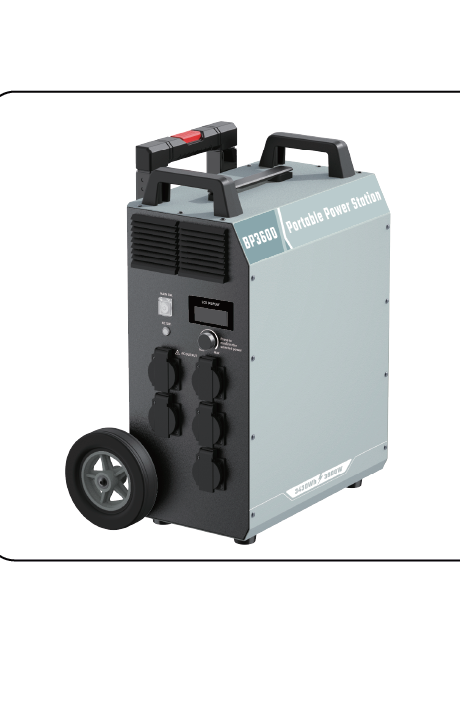
| BP3600 | 3,430Wh LiFePO4 | 3,600W | 7,200W | Built-in 2,400W MPPT solar input, 12 to 150VDC; UPS transfer within 10ms; unit IP53, battery pack IP66; RoHS, CE, UN 38.3; 5-year warranty |
| EP12000iL | 7,680Wh LiFePO4 | 12,000VA | 24,000VA | Stackable to 372kWh; 12kW three-phase, 11kW single-phase and 10kW split-phase output; built-in 22kW EV charger; 5-year warranty |
Match the rated figure to the load profile you intend to serve. A distributor selling into construction or emergency-response channels will see continuous loads that a consumer-oriented specification cannot hold.
4. Ingress protection grades
Portable storage gets used outdoors, in dust and occasionally in rain. Request ingress protection ratings separately for the enclosure and the battery pack, because they are often different and the lower figure governs real-world exposure. On the BP3600, for example, the unit is rated IP53 and the battery pack IP66. The IP53 figure, not the IP66 one, describes what the outer housing tolerates.
5. Certifications and transport documentation
Ask for the certification file by model and by target market, not by company. RoHS and CE cover market access in Europe; UN 38.3 covers lithium battery transport and is checked by freight forwarders before a shipment moves. Confirm that the certificates reference the exact model and configuration you are ordering, and that the documentation pack includes the test summary your forwarder will ask for.
6. Expandability and system architecture
Whether a unit can grow matters for distributors serving installers and for brands positioning a product family rather than a single SKU. Clarify how expansion works: additional battery modules, parallel stacking, or a separate high-power platform. The EP12000iL, for instance, is stackable to 372kWh, which moves the product from job-site backup into small commercial and mobile-charging applications.
7. OEM and ODM capability
Specification verification tells you what a unit is. Manufacturing capability tells you whether you can get it consistently, in your own configuration. Ask to see how the supplier handles custom enclosure tooling, branding, output configuration, firmware behaviour and packaging; ask which parts of the design they own and which are sourced.
DRIVELONG, operated by Suzhou Drivelong Intelligence Technology Co., Ltd., brings over 19 years of power generation experience and more than 120 patents to OEM and ODM energy programmes for Europe, North America, South America, Australia and other markets. Use that kind of track record as a starting point for questions about engineering ownership, not as a substitute for the specification checks above.
How to read a supplier datasheet critically
Three habits separate experienced buyers from first-time importers.
- Separate declared values from tested values. Cycle counts, capacity and efficiency are usually supplier-declared. Ask which figures were measured on the production configuration you are buying and in what conditions.
- Look for the conditions column. A capacity figure without a discharge rate and temperature is approximate. A solar input range stated as 12 to 150VDC, as on the BP3600 with its built-in 2,400W MPPT, is more useful than a vague maximum wattage.
- Check the warranty against the specification. A 5-year warranty is only meaningful if the cycle rating, BMS protections and thermal design support it. Ask what the warranty excludes and how claims are processed in your market.
Where a datasheet is silent, that silence is information. Mark the gap and put the question into your RFQ rather than assuming a favourable answer.
Questions to put in the RFQ
A structured RFQ shortens the evaluation cycle. Include the following, adapted to your market and volumes:
- Confirmed cell chemistry, cell format and supplier for the exact configuration quoted.
- Cycle rating with depth of discharge, temperature and end-of-capacity threshold.
- BMS protection list and whether fault data is accessible over any interface.
- Rated and peak AC output, plus the duration of the peak condition.
- IP rating for enclosure and battery pack separately.
- Certification file by model, covering RoHS, CE and UN 38.3 where applicable to your market.
- Expansion options and the interface or protocol used.
- OEM and ODM scope: tooling, branding, firmware, packaging, MOQ and sample lead time.
Ask for samples built to the quoted configuration. A sample that differs from the production BOM verifies very little.
Frequently asked questions
Is LiFePO4 always the right chemistry for portable storage?
It is the usual choice where cycle life, thermal stability and safe indoor storage matter more than weight. For applications where every kilogram counts, higher-energy-density chemistries may still be specified. The decision belongs in your product definition, not in a supplier's default.
How should a supplier-declared cycle rating be used?
As a comparison input that must be qualified by its test conditions. Ask for the depth of discharge, temperature and capacity threshold behind any cycle figure, and confirm that the same cells and BMS are used in the configuration you are ordering.
What does UPS transfer time mean for a portable unit?
It describes how quickly the unit switches to battery when grid input drops. The BP2400 and BP3600 both specify UPS transfer under or within 10ms, which matters for equipment that cannot tolerate a longer interruption. Confirm the figure for the load type you intend to support.
Does a higher IP rating on the battery pack mean the whole unit is protected?
No. Enclosure and battery pack ratings apply to different boundaries. Use the lower rating to judge what the product tolerates in service.
Can a portable platform be scaled to commercial capacity?
Some can. The EP12000iL stacks to 372kWh and provides 12kW three-phase, 11kW single-phase and 10kW split-phase output with a built-in 22kW EV charger, which places it in mobile and small commercial work rather than consumer backup.
Next step
Bring your load profile, target market and volume assumptions to the conversation, and ask for the specification and certification file against the exact model you intend to order. The BP3600 and BP2400 pages give starting specifications for portable and mid-range requirements, while the EP12000iL covers high-power and stackable deployments. For OEM and ODM programmes, request the engineering scope and sample plan alongside the quotation so that specification and manufacturing capability are assessed together.