How a 5kW 3430Wh LiFePO4 portable power station with built-in EV emergency charging answers the requirement of an Israeli importer/distributor: trunk-portable range recovery, layered fire safety, honest certification documents, FOB sea freight and sample orders.
Electric vehicle ownership is growing faster than public charging infrastructure in many markets. Drivers plan trips around charging stations — and a car that runs low on battery far from the next fast charger becomes a real problem, both for the owner and for the importers and distributors who serve that market. A recent inquiry from an Israeli importer and distributor, a company that brings 10–12 containers of goods from China every month, put the requirement plainly: emergency power for the electric car — enough range to reach the next high-power charging station, delivered by a unit that lives in the car, not on the grid.
The Buyer's Requirement, Broken Down
This was not a request for another fixed charging pile. Four conditions defined the right product:
- Emergency use only. The unit tops the car up — roughly 10 km of range in 20 minutes, or 25 km in 40 minutes — until the driver reaches a proper charger. It is a rescue tool, not a substitute for charging infrastructure.
- Portable. It has to fit in the back of the car, ready to travel.
- Independent recharging. It recharges from AC power and from solar panels, so it can be topped up at home, at the workshop, or off-grid.
- Useful between emergencies. Once fully charged, it also powers home appliances and outdoor equipment — a general-purpose power station that earns its place in the trunk.
The Recommended Configuration: EP5000iL
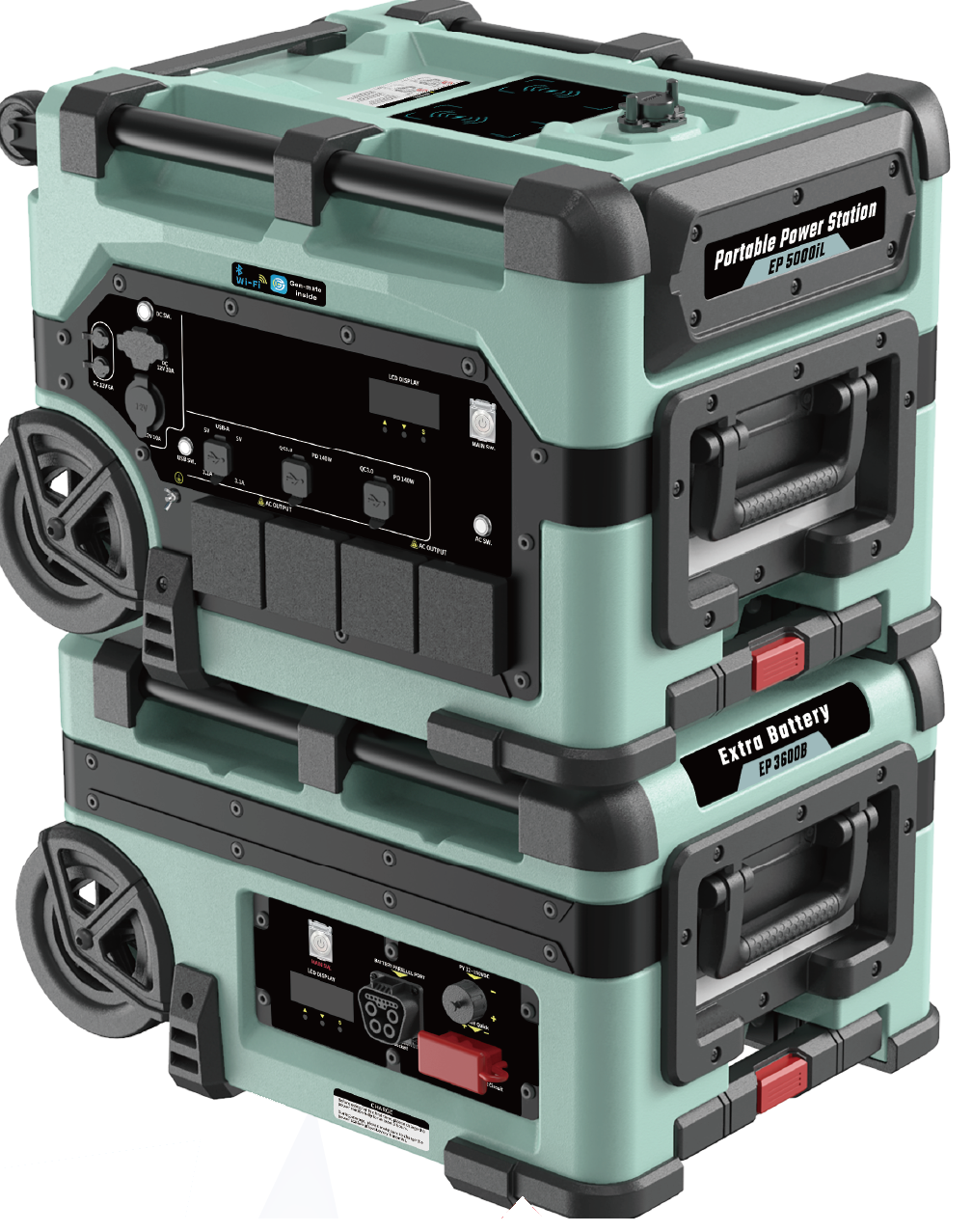
For this requirement we recommended the EP5000iL Smart Mobile Power Station. It is a 5 kW unit with a built-in EV charging output designed for emergency use, a 3430 Wh LiFePO4 battery, and a four-wheel chassis with large-diameter rollers that makes a 49 kg unit manageable to load into a vehicle.
| Battery | LiFePO4, 3430 Wh, 5000+ cycles to 80% capacity |
| Rated AC output | 5000 W (10000 W peak), pure sine wave |
| EV emergency charging | About 10 km of range in 20 min / 25 km in 40 min — emergency and rescue use only |
| AC recharging | Max. 3000 W single-phase, fully charged in about 1.2 hours |
| Solar recharging | MPPT 12–150 VDC, max. 1600 W, about 2.5 hours |
| Capacity expansion | Up to 31 × EP3600B extra batteries, 109 kWh total |
| UPS transfer | ≤ 10 ms |
| Protection | IP53 (unit) / IP66 (battery pack) |
| Size / weight | 555 × 430 × 420 mm, 49 kg |
| Warranty | 5 years |
For buyers whose market needs a larger unit, the same conversation applies to the EP12000iL, a 12 kW three-phase model in the same family.
Safety: Two Layers of Fire Protection
Battery fires are the first question serious buyers ask about, and this buyer asked it directly. The answer works in two layers:
- LiFePO4 cells, not NMC. When a LiFePO4 cell burns, the chemistry does not release oxygen the way conventional NMC lithium cells do, which limits how a thermal event can develop. That is why LiFePO4 is considered the safer chemistry for a unit that rides in a passenger vehicle.
- A built-in fire extinguishing device. The EP5000iL carries a fire extinguishing device installed inside the power station itself. A demonstration video of this device is available to serious buyers on request.
Documents and Certification, Stated Plainly
Importers need the paperwork before the product, so here is the current document set without overselling it:
- IEC 62368 for the complete unit and IEC 62619 for the battery
- CE and RoHS for the product
- UN 38.3 test summary and MSDS for dangerous-goods transport
- CB scheme certificates: not currently held. IEC test reports and certificates are provided with shipment documents or on request — ask for the exact set your import channel requires.
This matters because the buyer in this case — and likely your customs broker — will check. We would rather state the document set exactly than have a shipment held at the border.
Shipping, Pricing and Commercial Support
- Sea freight, delivered to port only. Large lithium battery units ship as dangerous goods; we deliver to the destination port and the buyer handles inland transport and customs.
- FOB pricing. Quotations are quoted FOB; send your destination port for an exact figure.
- Sample orders supported. A first order of one unit for testing is available before committing to volume.
- Proven in this market. This product family is already exported to Israel through a distributor channel.
- Regional exclusivity available. We offer exclusivity by territory, with the annual purchase volume requirement set accordingly — so distributors can invest in marketing and sales staff without competing against parallel imports of the same products.
What to Confirm Before You Commit
A few points are not fixed by a spec sheet and should be confirmed in your RFQ, exactly as we confirm them for every distributor:
- Peak-power duration and overload tolerance for your specific load profile
- The EV charging connector type required in your market
- Availability of IEC 62133 battery certification and BMS documentation, if your import channel asks for them
- Production lead time for your order quantity
- The annual volume threshold for exclusivity in your territory
- Import and certification requirements specific to your destination market
Request a Quotation
If you import or distribute in the EV, outdoor-power or emergency-equipment space and see the same gap this buyer saw, the conversation starts the same way: tell us your market, your estimated annual volume and your destination port. View the EP5000iL product page and submit an inquiry for an FOB quotation, sample order terms, the certification document set, and the exclusivity conditions for your territory.