
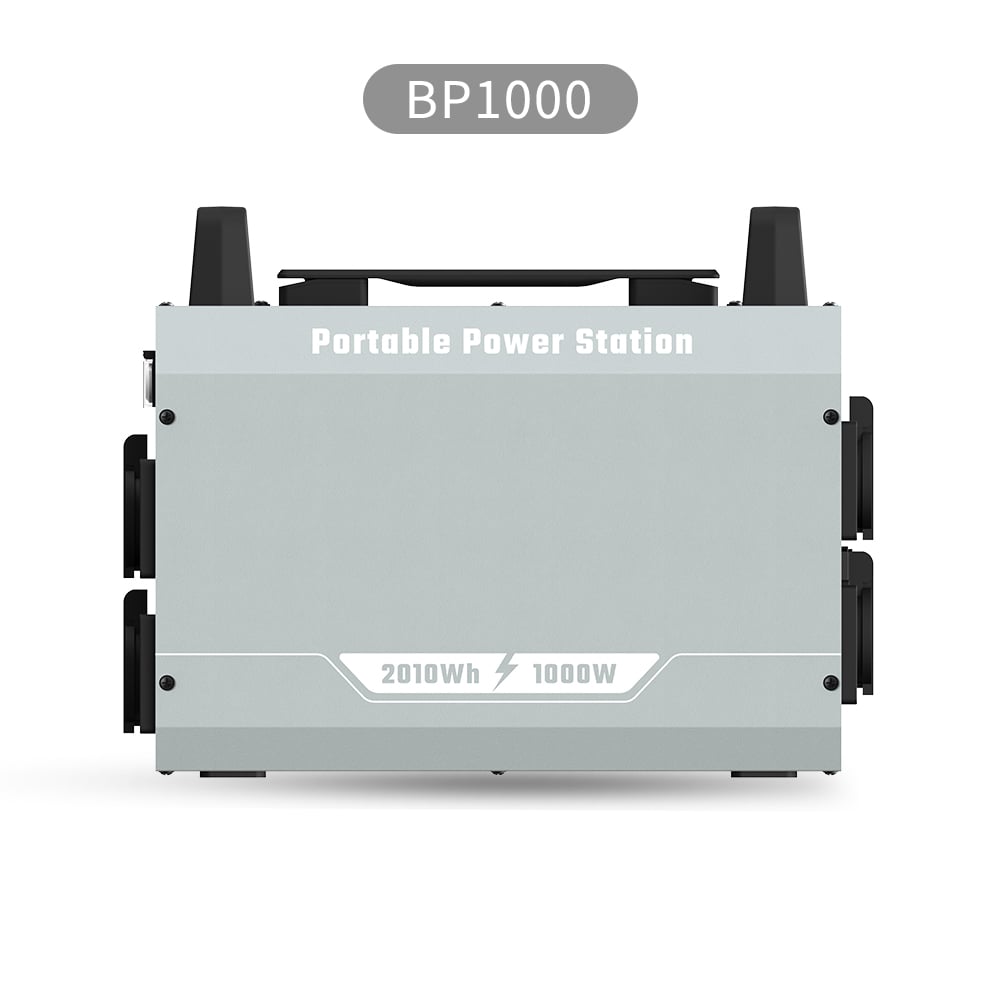
A LiFePO4 solar generator combines a lithium iron phosphate battery, a built-in MPPT solar charge controller, and an inverter in one unit. This article defines the class for solar distributors and outdoor brands, then explains how to pair panels and stations using verified controller windows and wattages from the BP1000, BP2400, BP3600, and EP5000iL, plus the DSF600A and DSF600 foldable panels.
A LiFePO4 solar generator is not a panel and it is not a bare battery. It is a portable power station built around a lithium iron phosphate battery, with a built-in MPPT solar charge controller and a DC-to-AC inverter in the same housing. Panels feed the controller; the controller charges the battery; the inverter supplies AC loads. Distributors and outdoor brands that understand this three-part structure can compare stations on the specifications that actually determine how they behave with solar.
Key takeaways
- The class is defined by LiFePO4 storage plus a built-in solar charge controller plus an inverter, recharged directly by PV panels.
- Controller wattage and input voltage window decide which panels can be paired, not the battery capacity alone.
- Panel open-circuit voltage must sit inside the station's MPPT input window, allowing for cold-weather voltage rise.
- Documented examples range from a 500W MPPT controller in the BP1000 to a 2400W controller in the BP3600.
What makes a station a LiFePO4 solar generator
Buyers often use the term loosely, so it helps to fix the definition. A unit qualifies when it stores energy in a LiFePO4 battery, accepts DC input from solar panels through an integrated charge controller, and delivers usable AC output through an onboard inverter. The controller is the component that separates a solar generator from a battery box that merely has a DC input.
LiFePO4 chemistry is a deliberate choice for this category. It holds a flat voltage curve across most of its state of charge, which simplifies charge-control logic, and it is tolerant of being stored partly charged between seasons. For a distributor, those characteristics matter because the product may sit in a warehouse or on a retail shelf for months before a customer takes it outdoors.
The phrase solar generator with LiFePO4 battery is mostly a specification clarification. The chemistry tells you what is inside; the solar generator part tells you the unit can be recharged from panels without an external charger. Both halves of the term belong in a listing, because buyers search for each separately.
The three components and what each one governs
Configuration decisions follow component boundaries, so it is worth separating them.
- Battery: sets the energy reserve. Capacity figures describe how much the station can hold, not how quickly it can be refilled.
- MPPT charge controller: sets the solar interface. Its wattage rating caps the array you can connect, and its input voltage window defines the panel string voltage that is acceptable.
- Inverter: sets the AC output available to connected equipment. Inverter rating is an output specification and does not by itself describe solar recharge speed.
A common procurement mistake is to read the inverter rating and the battery capacity, then assume solar recharge performance follows. It does not. Recharge time comes from the controller and the panel array together.
Documented controller windows across four station classes
The table below lists the solar input specifications for four stations, taken from the current product records. These are the numbers a distributor needs when building a panel bundle, and they cover a useful spread of array sizes.
| Station | MPPT controller | Solar input voltage | Max current | Full solar charge (approx.) |
|---|---|---|---|---|
| BP1000 | 500W built-in | To be confirmed with the supplier | To be confirmed with the supplier | To be confirmed with the supplier |
| BP2400 | 1200W built-in | 12 to 105 VDC | 25A | 2.5 hours |
| BP3600 | 2400W built-in | 12 to 150 VDC | 25A | 1.5 hours |
| EP5000iL | Solar MPPT input up to 1600W | 12 to 150 VDC | To be confirmed with the supplier | 2.5 hours |
Two patterns stand out. First, the voltage windows widen as the controller grows: the BP2400 accepts up to 105 VDC, while the BP3600 and EP5000iL both accept up to 150 VDC. Second, the BP3600 pairs the largest controller in this set with the shortest stated charge time. The BP1000's 500W controller suits smaller arrays and lighter bundles; its input window, current limit and stated charge time are not stated in the available product data, so treat those as items to confirm with the supplier before publishing a bundle specification.
Pairing panels to the MPPT input
Panel matching starts with open-circuit voltage, usually written as Voc on the module label or datasheet. The station's MPPT window is the acceptable range at its DC input. If the array's open-circuit voltage falls inside that window, the controller can work with the string; if it falls outside, the station will refuse to charge or will not operate efficiently.
Cold weather is the factor most often missed. Open-circuit voltage rises as cell temperature drops, so a string that sits comfortably inside the window at room temperature can exceed the upper limit on a cold morning. Leave headroom below the station's maximum input voltage rather than designing the string to reach it exactly.
Voltage is the gate, but wattage is the working figure. The controller's wattage rating caps the array: a 500W controller is intended for arrays at or below that level, a 1200W controller for arrays up to that level, and so on. Oversizing the array beyond the controller rating does not shorten charge time; the controller simply limits what it accepts. Undersizing the array leaves recharge capacity unused.
A panel that fits the workflow
The DSF600A and DSF600 are 600W foldable monocrystalline panels with MC4, USB, Type-C and DC5521 18V connectors. The MC4 output is the connection normally used to feed a station's DC input; the USB and Type-C ports serve direct device charging, and the DC5521 18V output covers small DC loads. For a distributor, the foldable format and the connector mix simplify bundling, because one panel model can serve both station recharge and accessory charging in the same carton.
Do not assume a 600W panel is automatically within every station's input window. Check the panel's Voc against the specific station. A 600W module connected to a 500W controller will be limited by the controller, while the same module may pair well with a 1200W or larger controller. The panel and the station have to be assessed as a pair.
Configuration guidance by market position
The right pair depends on what the bundle is meant to do in your market. The following are configuration approaches rather than product recommendations for a specific customer.
- Compact retail bundles: pair the BP1000 with a single panel sized within its 500W controller. Confirm the input window and current limit before finalizing the label.
- Mid-size outdoor bundles: the BP2400's 1200W controller and 12 to 105 VDC window suit arrays built from one or more panels whose Voc sits inside that range. The stated full charge time is about 2.5 hours.
- Fast-recharge bundles: the BP3600's 2400W controller, 12 to 150 VDC window and 25A limit support larger arrays, with a stated full solar charge of about 1.5 hours.
- High-capacity station bundles: the EP5000iL accepts solar MPPT input up to 1600W across 12 to 150 VDC; confirm its current limit with the supplier before sizing cables and connectors, and note the stated full charge time of about 2.5 hours.
Where a market needs a single panel model across several station SKUs, the DSF600A or DSF600 can be checked against each controller window in turn. The goal is one panel that stays inside every paired station's voltage range while remaining within each controller's wattage rating.
Procurement checks before you commit a bundle
- Write down the planned panel string's Voc at the lowest expected operating temperature, then compare it with the station's maximum solar input voltage.
- Compare total array wattage with the controller's wattage rating and decide whether any excess is acceptable for your positioning.
- Check the connector types on both sides; MC4 on the panel matches the DC input path used for station charging.
- Confirm the station's stated full charge time refers to solar charging, not AC charging, and note the panel wattage that figure assumes.
- For any model whose input window or current limit is not stated in your product data, request the figure from the supplier before printing it on packaging or a listing.
Charge-time figures are approximate and depend on array size, irradiance and conditions. Quote them with that qualification in retail and wholesale materials.
Frequently asked questions
Is a LiFePO4 solar generator the same as a portable power station with a solar input?
Functionally, yes, when the station uses a LiFePO4 battery and a built-in MPPT controller. The term emphasizes that the unit can be recharged directly from panels without an external charge controller.
Can I connect a 600W panel to the BP1000?
The BP1000 has a 500W MPPT controller, so a 600W array exceeds the controller rating and will be limited by it. Its input voltage window also needs to be confirmed against the panel's Voc.
Why does the voltage window matter more than panel wattage?
Wattage determines how much the controller can use; voltage determines whether the controller will accept the array at all. An array outside the voltage window will not charge the station properly regardless of its wattage.
Do the DSF600A and DSF600 work with every station listed here?
They provide the MC4 connection used for station charging, but suitability depends on each station's voltage window and controller rating. Match the panel's Voc and wattage to the specific station.
Building a LiFePO4 solar generator bundle for your market? Send us the station and panel combinations you are considering, along with your target market's voltage and connector expectations, and we can confirm the matching figures against the current product data.