
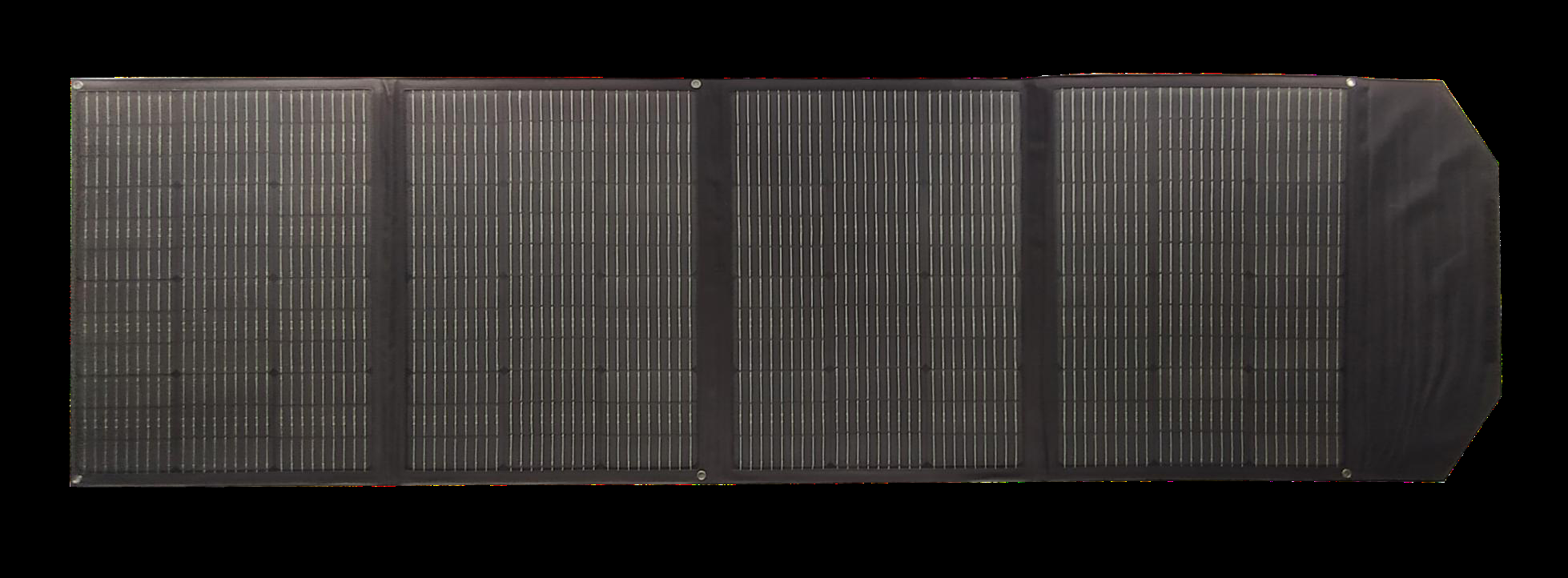
A pre-RFQ specification checklist for wholesale buyers comparing 200W foldable solar panels: folded versus open formats, the 200W and 300W output tiers, connector configuration, and portable power station pairing, including what still has to be confirmed with the factory.
Pre-RFQ Specification Checklist
200W is the tier where foldable panels stop being a phone-charging accessory and start being a product line a distributor can build a category on. It sits above the small 30W to 100W folding panels that many buyers treat as promotional items and below the larger multi-hundred-watt kits that ship as freight. That position makes it a competitive shelf SKU, and it also makes specification errors expensive: a 200 watt solar panel that is wrong on connector type, folded footprint or operating platform will not sell into the channel it was ordered for.
The points below are the ones worth settling with the factory before the RFQ goes out. They are ordered by how much they change the product you actually receive.
Key takeaways
- Folded and open states serve different decisions: folded for storage, transport and retail packing; open for the output you are promising.
- The 200W and 300W tiers usually target different end users, not different price points on the same buyer.
- Connector configuration decides whether a panel works with a portable power station or only with devices.
- Sizes, weights, cell efficiency, warranty and MOQ must come from the factory in writing, not from a generic listing.
On this page
Folded versus open format: two numbers, two different jobs
Every foldable panel has two physical states, and buyers routinely confirm only one of them. The folded state governs how the carton is sized, how many units fit a pallet, and what the panel looks like on a retail shelf or in a warehouse rack. The open state governs the charging area the end user sees and the surface the panel needs when it is in use.
DRIVELONG's 200W and 300W foldable monocrystalline panels are built around this trade-off: the panel is compact when folded, and the charging area increases sharply when it is opened. That is the design intent, and it is exactly where the specification conversation should start. Which dimension matters more to your channel depends on how the product reaches the buyer.
- Retail and e-commerce channels care about the folded footprint and the packed carton, because shelf space and shipping volume are the cost drivers.
- Project and fleet buyers care about the open footprint, because the user has to place the panel somewhere — on a vehicle roof, on the ground, or hung from a rail or fence line.
The DRIVELONG foldable series include eyelets for hanging and installation, so the open-state mounting method can be part of the product story rather than an afterthought. What the product records do not give is the specific folded and open dimensions or unit weight for these models. Ask the factory for both values in writing, then check them against your carton plan and your retail fixture before you commit to a quantity.
Choosing between the 200W and 300W tiers
DRIVELONG offers two output tiers in the foldable monocrystalline range: the 200W and 300W models. The natural question is whether to stock one, the other, or both. The answer is usually driven by the power station the end user already owns or plans to buy.
A 200 watt solar panel is a reasonable match for users who charge a mid-size portable power station over a day of good sun and top up phones, tablets, cameras and lights from the same panel. The 300W tier is for users who want faster replenishment or who run a larger station with higher continuous draw. Neither tier is automatically the better SKU; they serve different buyers in the same category.
| Decision point | 200W tier | 300W tier |
|---|---|---|
| Typical end user | Weekend campers, van and car travelers, small backup setups | Longer off-grid trips, larger stations, higher daily consumption |
| Channel fit | Broad retail and e-commerce assortment | Specialist outdoor, overlanding and preparedness channels |
| What to confirm with the factory | Open-state output and connector set at the 200W rating | The same, at the 300W rating, plus its folded size and weight |
| What not to assume | That a higher wattage model is the same product with more cells | That the two tiers share dimensions, weight or packing |
Because the two tiers differ in output, treat their physical specifications as separate items. Do not carry a folded dimension, weight or carton figure from one tier to the other without written confirmation.
Two series to compare
DRIVELONG lists the foldable range as the DSF200 and DSF300 series, and the DSF200C and DSF300C series. Both series are described as foldable monocrystalline panels with a space-saving design and the same connector set. The C-series and non-C-series are both options for a wholesale order; the variant-level differences between them should be confirmed with the factory rather than inferred from the naming.
Product pages for reference are the DSF200 and DSF300 foldable solar panel series and the DSF200C and DSF300C foldable solar panel series.
Connectors and power station pairing
The connector set on both DRIVELONG foldable series is consistent: USB output, TYPE-C, DC 5521 18V, and MC4. That is a useful configuration because it covers three different charging jobs with one panel, and the job you are selling into should decide which port you highlight.
- MC4 suits the solar input on a portable power station. This is the connector most station owners expect to use for panel charging, and it is the one to verify against the station's input specification.
- USB and TYPE-C suit direct device charging — phones, tablets, power banks, cameras and small accessories without a station in the chain.
- DC 5521 18V suits compatible DC input devices. Compatibility depends on the device's input voltage and plug size, so confirm the target device list with the factory before making claims in your listing.
Pairing is where connector claims most often outrun reality. A panel can carry an MC4 output and still be the wrong match for a given station if the station's solar input has a voltage window the panel does not sit inside. Ask the factory for the panel's electrical characteristics at the 200W tier, then check them against the input range published by the station brands you expect your customers to own. Confirm the numbers against the actual station documentation rather than a marketplace summary.
What the connector set means for packaging and support
A four-connector panel needs a cable set and a clear printed guide, because the buyer's customer will ask which port to use. Ask the factory what is included in the box with each series and whether the cable lengths are fixed. This affects your returns rate more than most specification items, and it is cheap to settle before the order.
The pre-RFQ confirmation checklist
The following items should come back from the factory in writing with the quotation. Where a value is not in a generic listing, that is normal — the point is to ask for it directly.
| Specification | What to ask | Why it changes your order |
|---|---|---|
| Folded dimensions and packed carton | Value in mm for the selected model and series | Pallet count, freight cost and shelf fit |
| Open dimensions | Value in mm for the selected model and series | What you can claim about usable charging area and mounting |
| Unit weight | Net weight per panel | Handling, retail shipping and customer expectations |
| Electrical output at rated power | Voltage and current figures for the 200W or 300W model | Power station compatibility and listing accuracy |
| Connector set | Confirmation of USB, TYPE-C, DC 5521 18V and MC4 on the ordered series | Which charging scenarios you can market |
| Included accessories | Cables, adapters and printed instructions in the box | Support load and return rate |
| Series variant | The differences between the standard and C series for the ordered model | Correct model code on the purchase order |
| Warranty terms | Written warranty period and scope | What you can state to your own customers |
| MOQ and lead time | Per model and per series | Order planning and cash flow |
| Cell efficiency and panel construction | Documented figures for the ordered model | Listing claims and comparison against competing offers |
Two items on that list deserve extra attention. First, the C-series and standard series share the same connector set and the same foldable monocrystalline construction according to the product records, but the variant-level differences between them are not something to guess. Ask, and get the answer attached to the quotation. Second, warranty terms and MOQ vary by order and are not part of the published product description; they must be quoted, not assumed.
How to run the comparison
Put your shortlisted suppliers on the same sheet, using the rows above. Where a supplier cannot give a folded dimension or an electrical figure, that is itself information: it tells you how well the product has been documented for export buyers. The panel with the most complete written specification is usually the easier one to sell, because your own listing, packaging copy and customer support can all be built from the same sheet.
Next step
If you are assembling a 200W foldable panel assortment, the most useful action now is to send the checklist above to the factory and ask for the values on the model and series you are considering. That gives you a comparable, written basis for the RFQ instead of a set of marketplace listings.
DRIVELONG's DSF200, DSF300, DSF200C and DSF300C series are the place to start: view the DSF200 and DSF300 foldable solar panel series or view the DSF200C and DSF300C series, then request the specification sheet, folded and open dimensions, connector confirmation, MOQ and lead time for your target model.