The physics behind high-frequency inverter whine at high output, the design levers that control it, and five evaluation points distributors can use to compare portable power station suppliers.
Distributors and procurement teams evaluating portable power stations and high-power inverter units regularly receive one specific field complaint: at high power output, the inverter emits a sharp high-frequency whine — described by end users as a screaming noise — loud enough to disturb sleep in residential backup and camping applications. The complaint is real, predictable from the physics, and entirely addressable at the design stage. This article explains the mechanism behind the noise, the design levers that control it, and a practical evaluation framework distributors can use when comparing suppliers — grounded in DRIVELONG's published product records, with unpublished figures marked as RFQ confirmation items.
The mechanism: why inductors sing at high power
Every inverter contains inductors — coils wound on magnetic cores that smooth and shape the output current. The switching stage driving these coils never delivers a perfectly flat current; a residual ripple rides on top of the working current at the switching frequency. That ripple current, interacting with the magnetic core and the windings, generates mechanical forces: magnetostriction in the core material and electromagnetic attraction between conductors and core laminations. The core and coil physically vibrate. When the vibration spectrum reaches the audible band, the unit produces the thin, high-pitched tone users report.
The severity scales with the working current, which is why the noise concentrates at high power output — an air conditioner compressor, a well pump, a bank of site tools. At light loads the same inductor may be inaudible; at rated output the forces grow and so does the sound. For a distributor, this means the complaint will arrive precisely from the customers who push the product hardest: whole-home backup users and job-site operators. It is not a random quality escape; it is a design variable.
The design levers that control the noise
Three measures determine whether an inverter whines or stays quiet, and they are exactly the direction DRIVELONG applies in its inverter design:
Smaller inductor current ripple. The vibration amplitude follows the ripple current. A drive design that minimizes ripple at each switching cycle reduces the mechanical excitation at its source — before any acoustic treatment can help.
Reinforced magnetic cores and windings. Whatever ripple remains produces forces; a core with adequate clamping, winding bobbin support and structural stiffness converts less of that excitation into audible vibration and resists long-term loosening.
Elimination of the high-frequency noise path. With low ripple and a mechanically strong core, the residual vibration no longer reaches the housing as an audible tone — the outcome the user actually experiences.
When you evaluate a supplier, treat these as questions, not claims: what is the specified ripple current at rated load, what core material and reinforcement are used, and what measured acoustic level does the finished unit produce? Product records that do not list ripple figures or decibel levels are not lying — they are simply incomplete on this dimension, and the answer belongs in your RFQ.
Five evaluation points for comparing suppliers
1. Published output waveform specification. A supplier that publishes THD<3% pure sine output — as DRIVELONG does for the EP5000iL and BP3600 — is documenting a controlled inverter stage. It is an electrical figure, not an acoustic guarantee, but it shows the engineering discipline that low-ripple design requires.
2. Rated-versus-peak architecture. Check whether the rated continuous output is honestly stated. The EP5000iL specifies 5,000W continuous / 10,000W peak; the EP12000iL specifies 12,000VA rated / 24,000VA peak with 12kW three-phase, 11kW single-phase and 10kW split-phase continuous output. Units with genuine continuous ratings let end users run heavy loads below the limit — the operating region where ripple-driven noise is lowest.
3. Thermal management of the inverter section. The EP5000iL documents dual-channel cooling; the EP6000iLS documents super-fast charging with a patented 16A/32A dual input reaching 90% in one hour. Ask specifically how the inductor and switching section dissipate heat under continuous rated load, because thermal stress accelerates the mechanical loosening that makes whine worse over time.
4. Acoustic test data at defined conditions. Request measured noise levels at stated loads (for example 50% and 100% of rated continuous output) and distances. DRIVELONG's published records do not include decibel figures or ripple-current specifications; these are RFQ confirmation items, and any supplier comparison should be made on identical measurement conditions.
5. Structural protection. Enclosure and damping quality affects how much internal vibration reaches the user. The EP5000iL documents IP53 unit protection with an IP66 battery pack; the BP3600 adds a metal housing with a fully enclosed IP66 battery pack and an integrated automatic fire suppression system. These indicate build standards that also constrain noise transmission.
Where DRIVELONG's lineup fits
| Model | Output Class | Capacity | Positioning |
|---|---|---|---|
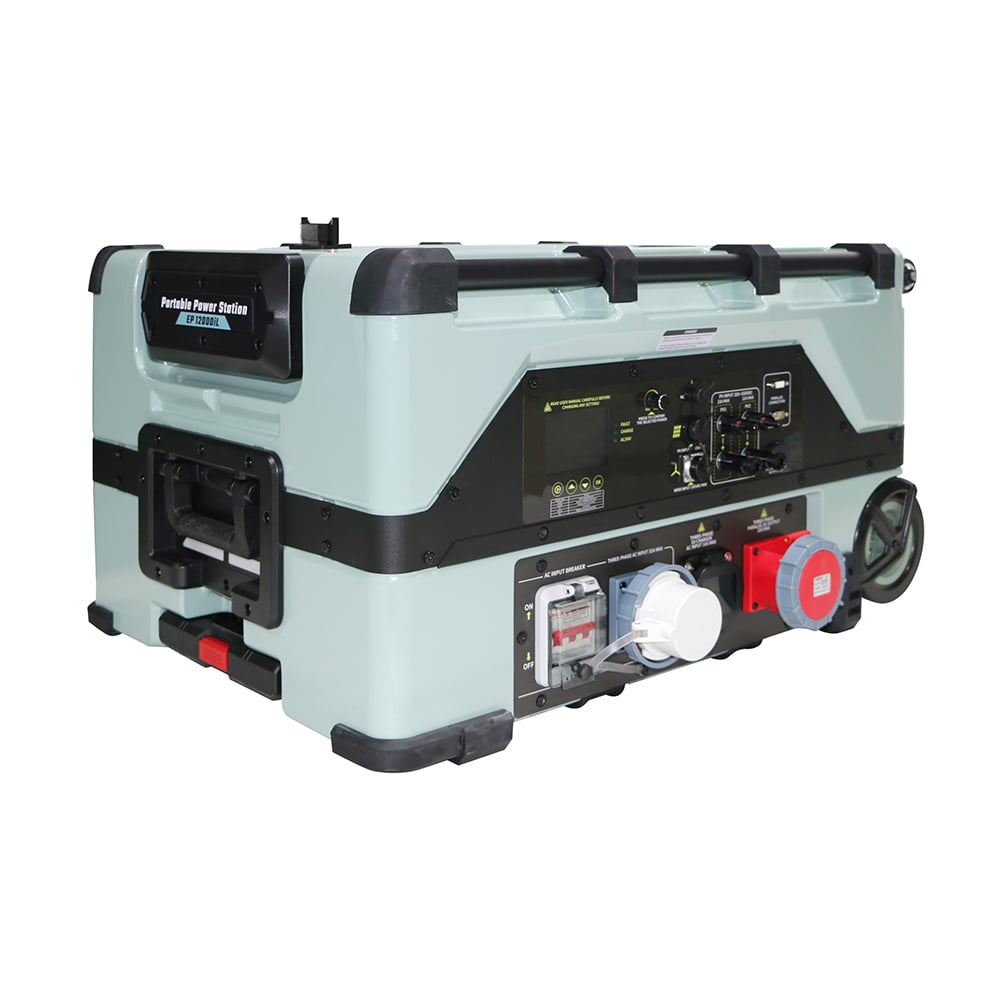
| EP12000iL | 12kW three-phase / 11kW single-phase / 10kW split-phase; 24,000VA peak | 7,680Wh, expandable to 372kWh | Flagship for construction sites, workshops and whole-building backup; built-in 22kW EV charger; 24kW parallel output |
| EP5000iL | 5,000W rated / 10,000W peak; 10kW with two units stacked | 3,430Wh, expandable to 109kWh | Whole-appliance backup; THD<3% pure sine; UPS ≤10ms; dual-channel cooling |
| EP6000iLS | 6,000W rated / 12,000W peak | 5,376Wh, expandable to 172kWh | 6kW class with 90% charge in one hour via patented 16A/32A dual input |
| DP6000iL | 6,000W rated / 12,000W peak | 5,376Wh, expandable to 172kWh | 6kW class with EV charging support |
| BP3600 | 3,600W rated / 7,200W peak | 3,430Wh | 3.6kW class; THD<3% pure sine; UPS ≤10ms; IP53/IP66 with fire suppression |
All models use LiFePO4 batteries and carry a 5-year warranty. The EP5000iL is certified to RoHS, CE and UN 38.3. For markets where nighttime noise complaints are a documented pain point — residential backup, campground rental fleets, residential-installation channels — the waveform and headroom specifications above give you concrete comparison criteria that go beyond capacity and price.
Include this in your next RFQ
A supplier evaluation that stops at capacity and price will miss the dimension that generates field complaints. Add these line items to your next request: measured acoustic noise levels at defined loads and distances; inverter ripple-current specification and switching-frequency range; magnetic core material, winding reinforcement and damping construction; inverter-section thermal design under continuous rated output; and warranty terms covering noise-related defects. DRIVELONG will confirm these specifications for the models matching your target market and load profile — request a quotation with your requirements stated, and the applicable test data will be provided with the offer.